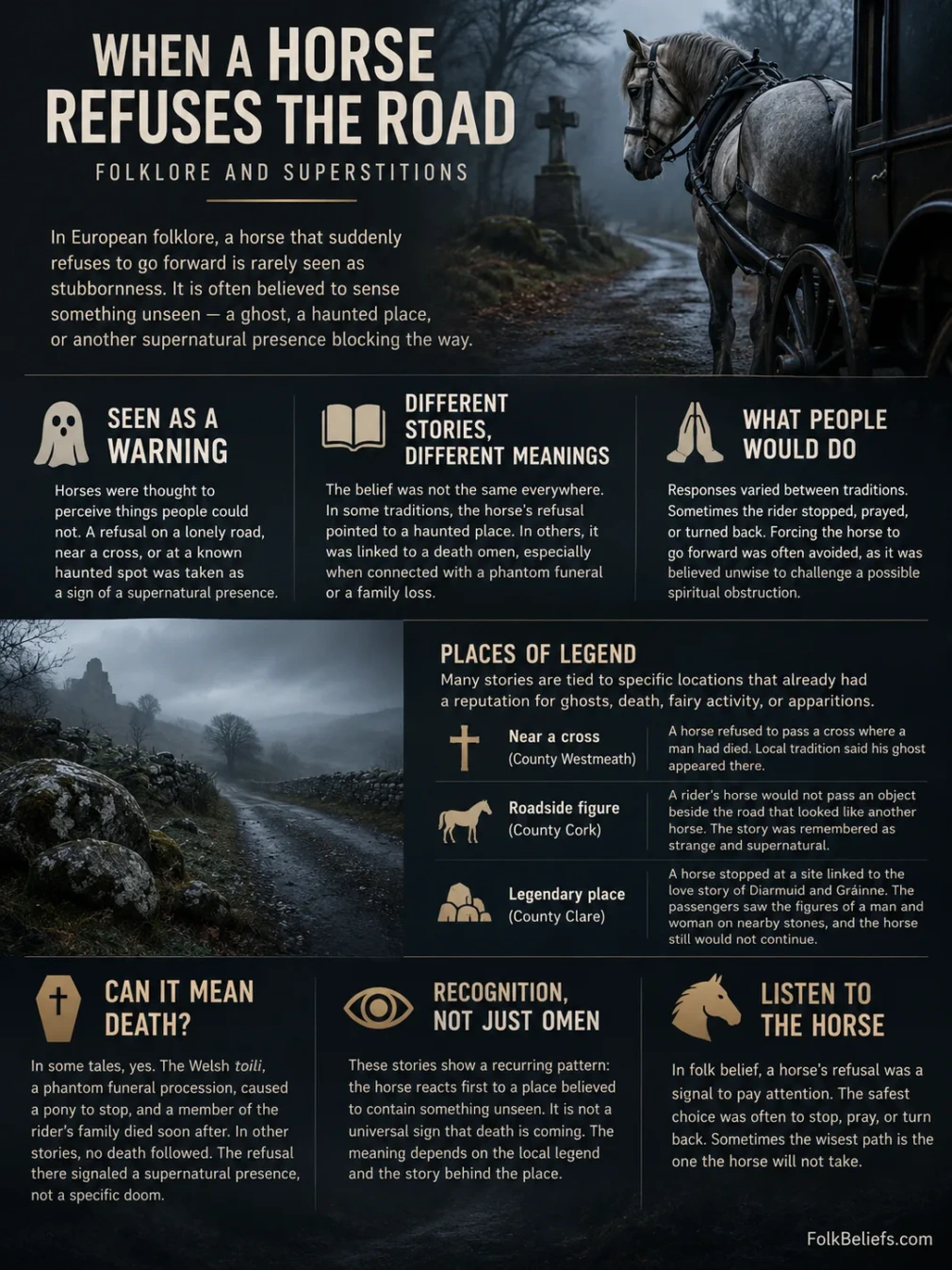
A horse suddenly refusing to continue along a road was sometimes interpreted in European folk tradition as a warning that the animal sensed something its rider could not. Recorded explanations include a ghost, a haunted place, a phantom funeral, or another supernatural presence blocking the way. The belief was not uniform, however. A balking horse could signal a particular haunted location in one tradition and an approaching death in another.
When a Horse Would Not Go Forward
One of the clearest descriptions appears in Robert Means Lawrence’s 1898 collection of animal folklore. He wrote that horses were popularly credited with detecting ghosts and haunted places. In a tradition attributed to Thuringia, a rider whose horse refused to continue along a gloomy forest road was not supposed to treat the animal’s behavior as simple stubbornness. The obstruction was understood as spiritual, and prayer rather than force was presented as the response.[1]
Welsh folklore provides a related but more specific example. Jonathan Ceredig Davies recorded a Cardiganshire story in which a woman riding home from Machynlleth Market encountered a toili, or phantom funeral. Her pony reacted first. It refused to go forward, turned back, and stood trembling beneath a tree until the spectral procession had passed.[2]
Folklore meaning: an unexplained refusal to pass a particular point could be understood as the horse detecting a supernatural presence, especially when the place already had a reputation for ghosts, death, fairy activity, or apparitions.
The Road or Place Often Mattered More Than the Horse
Irish folklore records show that these stories were frequently tied to a very specific stretch of road, field, stone, cross, or other landmark. The animal’s refusal gave that location an additional supernatural meaning.
| Recorded Place | What Happened | Folklore Context |
|---|---|---|
| Clonmellon area, County Westmeath | A horse would not pass a cross beside a field. | The place was associated with the death of a man thrown from a horse, and local tradition said a ghost appeared there.[3] |
| Upton area, County Cork | A rider’s horse refused to pass an object beside the road that appeared to resemble another horse. | The incident was collected among stories of strange or supernatural animals.[4] |
| Near Lahinch, County Clare | A horse stopped at a place associated locally with Diarmuid and Gráinne and would not continue. | The passengers reportedly saw the figures of a man and woman on nearby stones, and the horse still would not pass when help arrived.[5] |
These records do not establish one universal rule such as “a horse stopping means death.” They instead show a recurring story pattern: the horse becomes the first creature to react to a place believed to contain something unseen.
Could It Be an Omen of Death?
In some traditions, yes, but the connection depended on the story. The Welsh toili was a spectral funeral procession, so the horse’s refusal occurred within folklore already concerned with death and funerary forewarning. In the Cardiganshire account recorded by Davies, a member of the rider’s family died soon after the encounter.[2]
Other records have no such outcome. The Clonmellon horse stopped at a place already associated with a ghost, while the Cork story involved a strange roadside figure or animal-like apparition. In those cases, the refusal functions more as recognition of a supernatural obstacle than as a prediction of someone’s death.
For that reason, interpreting every horse that refuses a road as a death omen goes beyond the surviving evidence. The meaning changes with the local legend attached to the place.
What People Did When the Horse Refused
The rider’s response also varies between traditions. Sometimes the safest action in the story was simply not to continue.
In the Welsh phantom-funeral account, the pony withdrew and remained beneath a tree until the procession had gone by.[2] In the Lahinch story, the travelers eventually returned by another route because the horse still refused to pass the place.[5]
The Cork record preserves a more unusual protective practice. When the horse would not pass the strange horse-like object beside the road, the rider dismounted, turned his coat inside out, and placed it on the horse. The account describes this as the means by which the obstacle could be passed.[4]
Turning clothing inside out appears in several branches of European supernatural folklore, but this particular record should be read narrowly: it documents the practice in one collected Cork story rather than proving that every community followed the same custom.
Why the Horse Was Treated as the First to Notice
In these narratives, the rider often sees nothing unusual until after the horse stops, trembles, turns aside, or refuses commands. That sequence gives the animal a special role. The horse acts as an early warning before the human traveler recognizes the ghost, procession, strange animal, or haunted landmark.
Lawrence’s nineteenth-century account states this idea directly by describing a popular belief that horses could detect ghosts and haunted places from a distance.[1] The Welsh toili story follows the same pattern: the pony notices the approaching apparition before its rider fully understands what is happening.
This makes the horse more than transportation within the story. Its behavior becomes evidence for the traveler that an apparently ordinary road is not ordinary at that moment.
Folklore and Ordinary Horse Behavior Are Different Questions
A real horse refusing to move does not demonstrate that a road is haunted. Horses can react strongly to real or perceived threats, unfamiliar surroundings, noise, previous frightening experiences, or particular locations. Modern veterinary guidance describes fear as a normal response to a real or perceived threat and notes that horses can develop fear associated with places or environmental conditions.[6]
Refusal to move can also accompany physical discomfort. World Horse Welfare advises riders to consider how a horse feels physically and emotionally when behaviors such as refusing to move appear, and to seek veterinary advice when pain or discomfort may be involved.[7]
The supernatural interpretation belongs to folklore. What the historical records preserve is the belief that a horse’s sudden refusal could reveal an unseen presence or warn a traveler away from a particular place. They do not provide evidence that horses literally perceive ghosts.
Sources and Records
- ↑1a ↑1b Robert Means Lawrence, The Magic of the Horse-Shoe, with Other Folk-Lore Notes,
- ↑2a ↑2b ↑2c Jonathan Ceredig Davies, Folk-Lore of West and Mid-Wales,
- ↑3 National Folklore Collection, “Local Place Names,” Clonmellon,
- ↑4a ↑4b National Folklore Collection, “Strange Animals,” Cnoc an Bhile, Upton,
- ↑5a ↑5b National Folklore Collection, Lahinch local tradition,
- ↑6 Merck Veterinary Manual, “Behavior Problems in Horses”,
- ↑7 World Horse Welfare, “Tacking Up and Ridden Behaviours”,
Documented Locations
Countries: Ireland
These labels identify where a version has been documented. They do not mean that everyone in the country, region, or community shares the belief.