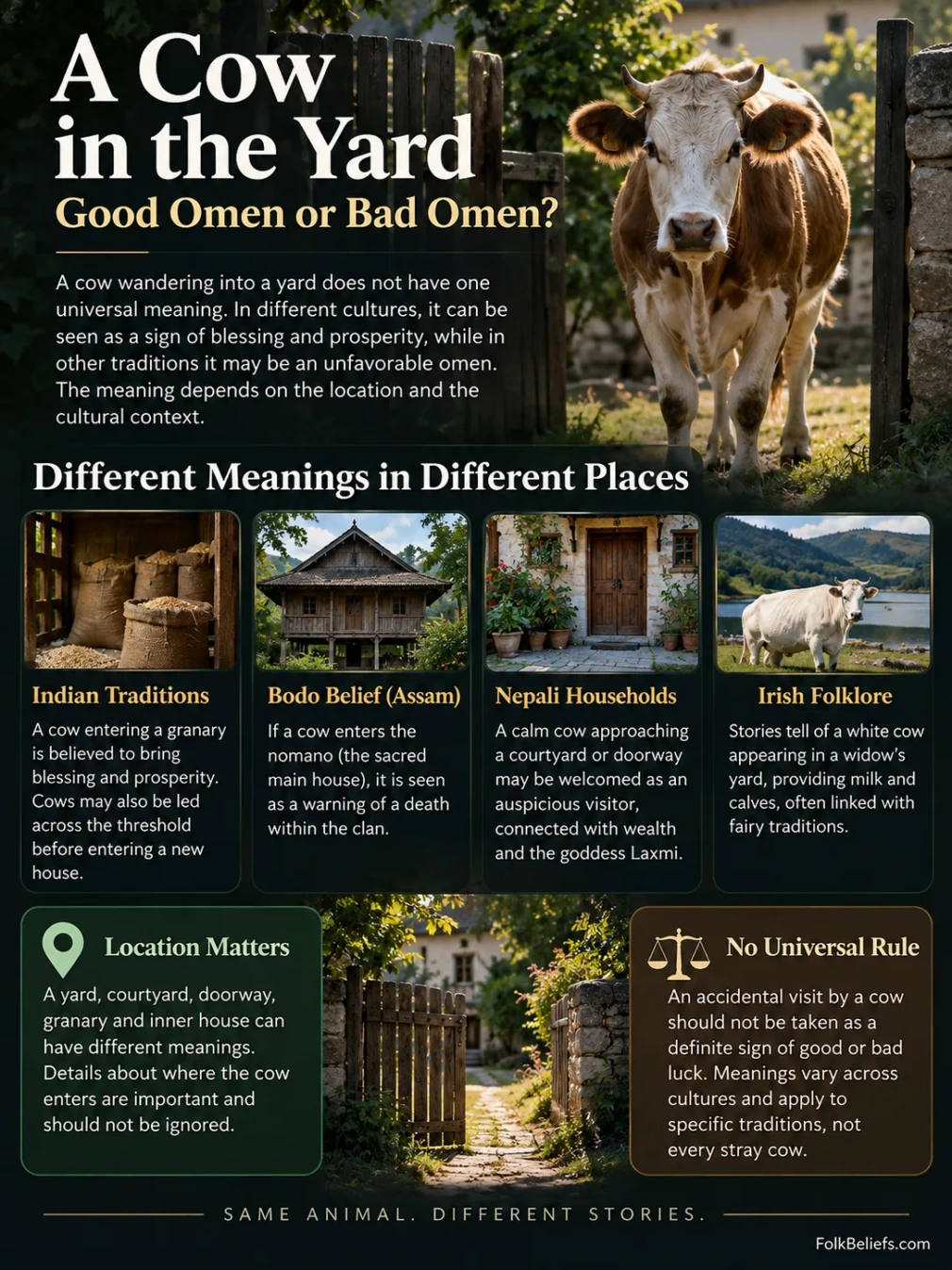
A cow wandering into a yard does not carry one fixed meaning across folklore. Some records connect cows approaching household space with blessing, prosperity, or protection, while another documented tradition treats a cow entering a particular sacred part of the home as an unfavorable omen.
The location matters. A yard, courtyard, doorway, granary, and inner house can have different meanings within the same cultural setting. An accidental visit by a cow should therefore not be turned into a universal rule such as “good luck is coming” or “something bad will happen.”
Recorded Meanings of a Cow Approaching the Home
| Recorded Setting | Folklore Meaning |
|---|---|
| Indian household traditions recorded by J. Abbott | Cows appear in several favorable household customs. Abbott records a belief in Sind that a cow entering a granary brings barkat, or blessing, to the store. He also describes a cow being led across the threshold before the owner enters a new house for the first time.[1] |
| Bodo homestead tradition in Assam | A much different meaning is recorded when a cow enters the nomano, the sacred main house. The event is described as a warning of a death within the clan, followed by a household cleansing practice.[2] |
| Nepali courtyard or doorway | A calm cow approaching a courtyard or doorway may be welcomed as an auspicious visitor in some Nepali household belief.[3] |
| Irish folklore narrative from County Cork | A National Folklore Collection record tells of a white cow appearing in a widow’s yard, remaining there, providing milk, and producing calves before the story develops into a tale of cattle connected with a lake and the fairy tradition.[4] |
Why the Yard and the House Should Not Be Treated as the Same Omen
The Bodo record illustrates why the exact setting cannot be ignored. A traditional Bodo homestead is arranged around a central courtyard called the chithla. The nomano, however, is the main residential house and has its own sacred status. The recorded cow omen concerns the animal entering the nomano, not merely walking into the courtyard.[2]
This distinction changes the meaning of the evidence. It would be inaccurate to turn that record into a claim that a cow entering any yard in Assam predicts death. The source describes a particular event within a particular household tradition.
The positive records also involve different boundaries. Abbott’s examples include a granary, an open doorway, and the threshold of a newly occupied house. These examples connect the cow with household blessing, but they do not establish a general Indian rule for every stray cow that walks onto private land.
Why a Cow Can Carry an Auspicious Household Meaning
Positive interpretations are easier to understand in traditions where the cow already has a sacred or ceremonial role. In Nepal, for example, the cow is honored during Gai Tihar. The Nepal Tourism Board describes the cow as representing Laxmi during the festival, while homes are prepared to welcome the goddess associated with wealth.[5]
That background helps explain why a calm cow near a courtyard or doorway can receive a favorable interpretation in some Nepali households. It does not mean that every family follows the belief or that every wandering cow is treated as a supernatural message.
Abbott’s older Indian records show a related pattern. A cow entering a granary was associated with blessing, and a cow could be deliberately sent into a house as part of a first-entry custom. In these cases, the cow’s presence inside domestic space is welcomed rather than feared.[1]
The White Cow in Irish Yard Stories
The Irish record from Bantry, County Cork, belongs more clearly to legend than to a simple everyday omen. A white cow comes into a widow’s yard during the night. She initially assumes it belongs to a neighbor and attempts to drive it away, but the animal stays. The cow becomes a source of milk and later produces calves. Eventually the cattle return toward a nearby lake, linking the story with supernatural cattle lore.[4]
The story gives the unexpected cow a connection with provision and the fairy tradition, but it should not be reduced to a rule that a white cow entering an Irish yard always means wealth. It is one recorded narrative from a named locality and informant.
Does a Cow Entering the Yard Mean Good Luck?
It can carry a lucky meaning in some traditions, but not universally. The Nepali courtyard belief and several Indian household customs associate the cow with favorable fortune or blessing. The Bodo record shows that an animal crossing into a specially protected interior space can receive the opposite interpretation.
The cited records also do not support a universal system in which the cow’s color, the direction it walks, or the side of the yard it enters automatically determines the outcome. Even the time of day matters only where a particular tradition explicitly gives it meaning. Abbott, for example, recorded a Mahar belief concerning a cow passing an open door specifically around sunset, rather than a rule applying to every cow encounter.[1]
These interpretations are records of folklore, ritual practice, and traditional narrative. A cow entering a modern yard is ordinarily an animal moving through an accessible space and does not provide evidence that a future event will occur.