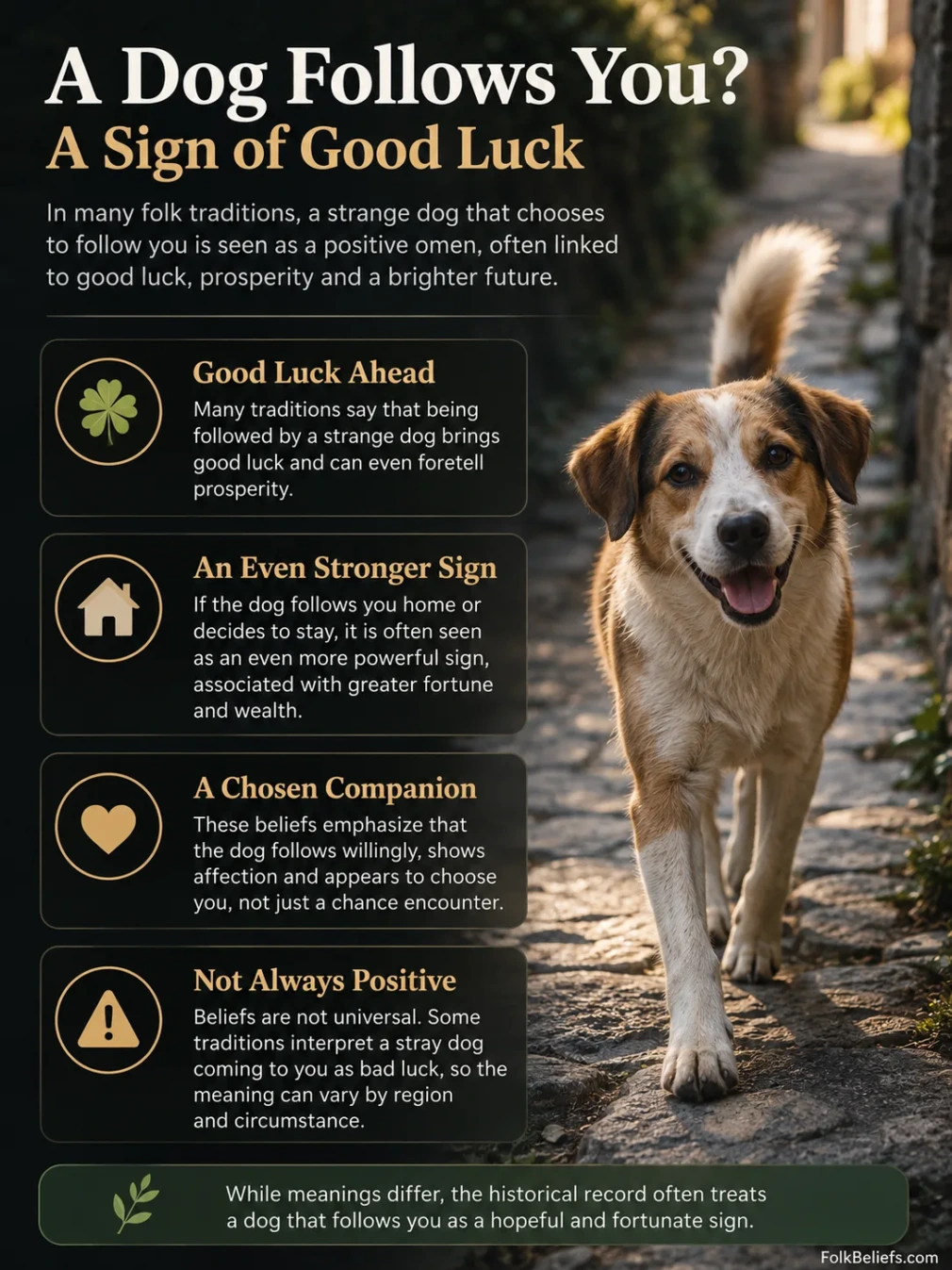
In several recorded British and American folk traditions, a strange dog choosing to follow you was treated as a good-luck or prosperity omen. The belief was not universal, however. Older collections preserve different rules about a stray dog approaching, following, entering a home, or deciding to remain there, so there is no single traditional meaning that applies everywhere.
What Does It Mean When a Strange Dog Follows You?
The clearest recurring interpretation is favorable. Charles Mackay recorded a belief that when a strange dog followed a person, showed affection, and seemed eager to attach itself to them, it foretold prosperity.[1]
A Kentucky collection published in 1920 gives an even shorter version: being followed by a strange dog brings good luck.[2] The focus in these records is not simply seeing a dog. The animal voluntarily follows, stays close, or appears to choose the person.
| Recorded Context | Meaning Attached to the Dog |
|---|---|
| Strange dog follows and acts friendly | Prosperity in Mackay’s nineteenth-century omen collection.[1] |
| Strange dog follows a person | Good luck in Kentucky Superstitions.[2] |
| Strange dog comes and makes its home with someone | Good luck in Clifton Johnson’s New England collection.[3] |
| Strange dog comes and remains with a household | Good fortune and greater wealth in a Chinese belief reported by N. B. Dennys in 1876.[4] |
Why Following You Home Has a Stronger Meaning
Some records make a distinction between briefly encountering a dog and having it continue all the way to a house. In New England material collected by Clifton Johnson in the nineteenth century, a strange dog or cat that came to a person and then made its home there was said to bring good luck.[3]
This form of the belief treats the animal’s decision to remain as more meaningful than an ordinary meeting on the road. The dog is no longer simply passing by; it has attached itself to a person or household.
Dennys recorded a related idea while comparing nineteenth-century English and Chinese beliefs. He wrote that a strange dog following a person was regarded as lucky in many rural English districts. He then reported a Chinese belief that a strange dog coming and remaining with a household foretold good for the family and greater wealth.[4]
That evidence should be read as a historical record from a particular nineteenth-century author, not as a rule shared by everyone in England or China.
Is It Always Good Luck?
No. Folklore collections often preserve contradictory beliefs, even within the same region.
Kentucky Superstitions provides a useful example. One entry says that a stray dog coming to you means bad luck. The very next entry says that being followed by a strange dog means good luck.[2]
The difference may look minor, but folk beliefs often depend on exactly that kind of circumstance. A dog merely appearing, a dog following a traveler, and a dog settling at a household can carry different meanings in the same collection.
There is therefore no universal dog-following superstition. The better-supported historical reading is that following was often favorable in the records above, while related encounters with stray dogs could receive a different interpretation.
Does It Mean the Dog Has Chosen You?
The idea of being “chosen” is a natural modern way to describe these beliefs, because several old versions emphasize voluntary attachment. Mackay’s version specifically involves a dog following, behaving affectionately, and appearing to want to stay with the person.[1]
That does not mean historical sources describe the dog as sensing a person’s destiny, moral character, or supernatural protection. Those explanations go beyond what these particular records say. The documented omen is simpler: an unfamiliar dog voluntarily attaching itself to you could be interpreted as fortunate.
Does the Dog’s Color Change the Superstition?
The historical records used here do not establish a general rule in which the dog’s color changes the meaning of following. Their wording usually centers on a strange or unfamiliar dog and on what it does.
Black-dog legends form a separate body of folklore in Britain and elsewhere, but they should not automatically be mixed with the ordinary superstition about a real stray dog following someone. A black dog walking behind you is not enough, by itself, to turn the good-luck belief into a different omen.
What If the Dog Follows You but Then Leaves?
The surviving records are much clearer about the act of following or remaining than about what happens if the dog eventually walks away. There is no need to invent a separate prediction for that situation.
Some traditions attach extra meaning when the animal stays with the household, while others treat the following itself as lucky. A dog leaving later does not have one established meaning across these sources.
Folklore Is Different from Dog Behavior
A dog following a person does not demonstrate that an omen is taking place. Dogs are social animals, and following can develop through familiarity, attention, routine, confidence, or the expectation of something they want. Dogs Trust notes these ordinary behavioral reasons when explaining why dogs remain close to people.[5]
If an unfamiliar loose dog approaches or begins following you, treat the situation as an animal encounter rather than a prediction. Avoid forcing contact. Blue Cross advises staying calm around an unfamiliar approaching dog, avoiding sudden movement, and moving away slowly when necessary.[6]
Sources and Records
- ↑1a ↑1b ↑1c Charles Mackay, Memoirs of Extraordinary Popular Delusions, Volume III, historical discussion of European omens; Project Gutenberg digital edition.
- ↑2a ↑2b ↑2c Daniel Lindsey Thomas and Lucy Blayney Thomas, Kentucky Superstitions, animal superstitions section, Princeton University Press, 1920.
- ↑3a ↑3b Clifton Johnson, What They Say in New England: A Book of Signs, Sayings, and Superstitions, Boston: Lee and Shepard, 1896; Library of Congress digitized collection.
- ↑4a ↑4b N. B. Dennys, The Folk-Lore of China and Its Affinities with That of the Aryan and Semitic Races, London and Hong Kong, 1876; Project Gutenberg digital edition.
- ↑5 Dogs Trust, “Why Your Dog Follows You”, dog behavior guidance.
- ↑6 Blue Cross, “Being Safe Around Dogs”, guidance for encounters with unfamiliar dogs.
Documented Locations
Countries: Turkey
These labels identify where a version has been documented. They do not mean that everyone in the country, region, or community shares the belief.