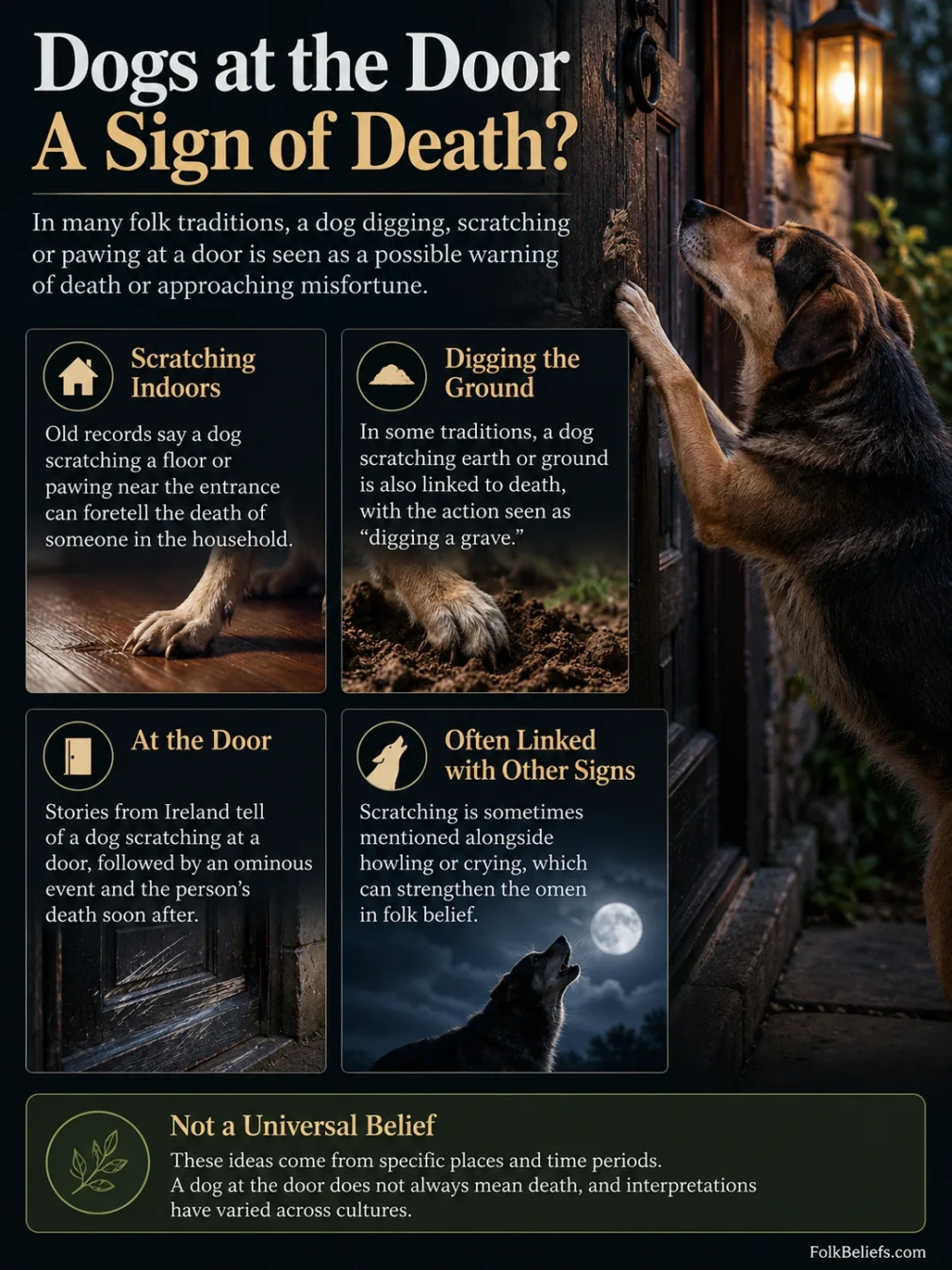
A dog digging or pawing at a doorway is sometimes interpreted as a warning of death or approaching misfortune. Older folklore records support closely related beliefs, but the wording varies. Historical collections more often describe dogs scratching a floor, scratching the ground, howling near a house, or scratching at a door rather than using one fixed rule called “dog digging at the door.”
The strongest recurring idea is that unusual scratching or digging by a dog could be read as a death omen. This was never a universal belief, and records from different places should not be treated as versions of one worldwide superstition.
What Does a Dog Digging at the Door Mean in Superstition?
In the darker form of the belief, a dog repeatedly digging, scratching, or pawing near the entrance of a home is taken as a warning that someone connected with the household may die. The association becomes especially clear in older records where a dog’s scratching is imagined as digging a grave.
An 1880s record of New England superstitions, reproduced in The Folk-Lore Journal, says that a dog scratching on the floor or howling in a particular manner was believed to indicate an approaching death.[1]
A much more explicit version appears in L. Roy Terwilliger’s Cuban Folk-Lore, published in Havana in 1908. Among a series of household superstitions, Terwilliger records the belief that a dog scratching the floor of a house was thought to be digging its master’s grave and therefore predicting his death.[2]
These records document beliefs held or reported in particular settings. They do not show that every person in New England, Cuba, Ireland, or any wider culture interpreted a scratching dog in the same way.
Scratching the Ground Could Carry the Same Omen
The connection between a dog’s paws and death was not limited to indoor floors. The National Folklore Collection of Ireland preserves a record from Meelin, County Cork, in which the howling and crying of dogs together with scratching earth or ground was said to be a sign of death.[3]
This Irish record is useful because it comes close to the modern phrase “dog digging.” The action is not merely a dog standing at an entrance or barking. The animal is disturbing the earth with its paws, while the surrounding tradition interprets the behavior as an omen.
| Recorded Dog Behavior | Place or Record | Folklore Meaning |
|---|---|---|
| Scratching the floor or unusual howling | New England superstition recorded in the 1880s | Approaching death |
| Scratching the floor of the house | Cuba, published 1908 | Figuratively “digging” the master’s grave |
| Howling, crying, and scratching earth or ground | Meelin, County Cork | Sign of death |
| Scratching at the door | Kilcoole, County Wicklow folk narrative | Part of a story that ends with the man’s later death |
What About a Dog Scratching Directly at the Door?
A doorway version appears in the Irish Schools’ Collection from Kilcoole, County Wicklow. In the recorded story, a man preparing for bed hears a dog scratching at his door. He goes outside, the dog follows him down the road, and an encounter with a passing coach leaves him injured; the narrative says that he dies several weeks later.[4]
This record should be read as a folk narrative rather than a universal omen formula. It does not state that every dog scratching at a door predicts death. Instead, the scratching begins a supernatural or ominous sequence that ends in death.
That distinction matters. Folklore can preserve the same association in several forms: one record may state a direct rule, another may place the behavior inside a story, and another may combine scratching with howling or crying.
Why “Digging at the Door” and “Scratching at the Door” Get Mixed Together
The surviving records suggest that several related expressions have gradually overlapped. One tradition describes a dog scratching a floor as though digging a grave. Another describes actual scratching of earth or ground. Other narratives put the scratching directly at a household door.
Because these actions look similar, later retellings can compress them into the phrase “a dog digging at the door.” The underlying death-omen association has historical parallels, but it is safer not to present that exact wording as one fixed tradition with a single origin.
The details change the folklore. A dog scratching the ground, scratching an indoor floor, howling outside a house, and scratching at a closed door appear in different records. They should not automatically be treated as identical beliefs.
Does the Superstition Always Mean Death?
No. Animal omens are highly variable, and small changes in behavior, place, time, or family tradition can produce different interpretations. Even within death-omen folklore, some records emphasize howling, others crying, scratching, approaching a house, or unusual behavior around a sick person.
There is therefore no reliable rule that a dog pawing at a doorway has one traditional meaning everywhere. The death interpretation is well documented for related scratching and digging behavior, but it belongs to specific folklore records rather than to canine behavior itself.
What It Means When a Real Dog Scratches or Digs at a Door
Outside folklore, pawing or scratching at a door has ordinary behavioral explanations. A dog may want access to the other side, want to go outdoors, react to something it hears or smells, or repeat a behavior that has previously caused someone to open the door.
Persistent scratching can also occur when a dog is distressed by being left alone. Texas A&M’s College of Veterinary Medicine & Biomedical Sciences lists scratching at doors and windows among behaviors that can occur with canine separation anxiety, together with signs such as whining, barking, pacing, destructive behavior, and attempts to escape.[5]
A dog suddenly starting to claw repeatedly at a door is therefore better understood first through its surroundings and behavior. The old omen remains part of documented folklore, but scratching or digging does not predict a death or future event.
Sources and Records
- ↑1 The Folk-Lore Journal, Volume 2, “Notes and Queries”,
- ↑2 L. Roy Terwilliger, Cuban Folk-Lore,
- ↑3 National Folklore Collection, UCD, “Customs Pertaining to Death”,
- ↑4 National Folklore Collection, UCD, Kilcoole folk narrative,
- ↑5 Texas A&M College of Veterinary Medicine & Biomedical Sciences, “Home Alone: Separation Anxiety in Dogs”,
Documented Locations
Countries: Slovakia, South Korea
These labels identify where a version has been documented. They do not mean that everyone in the country, region, or community shares the belief.