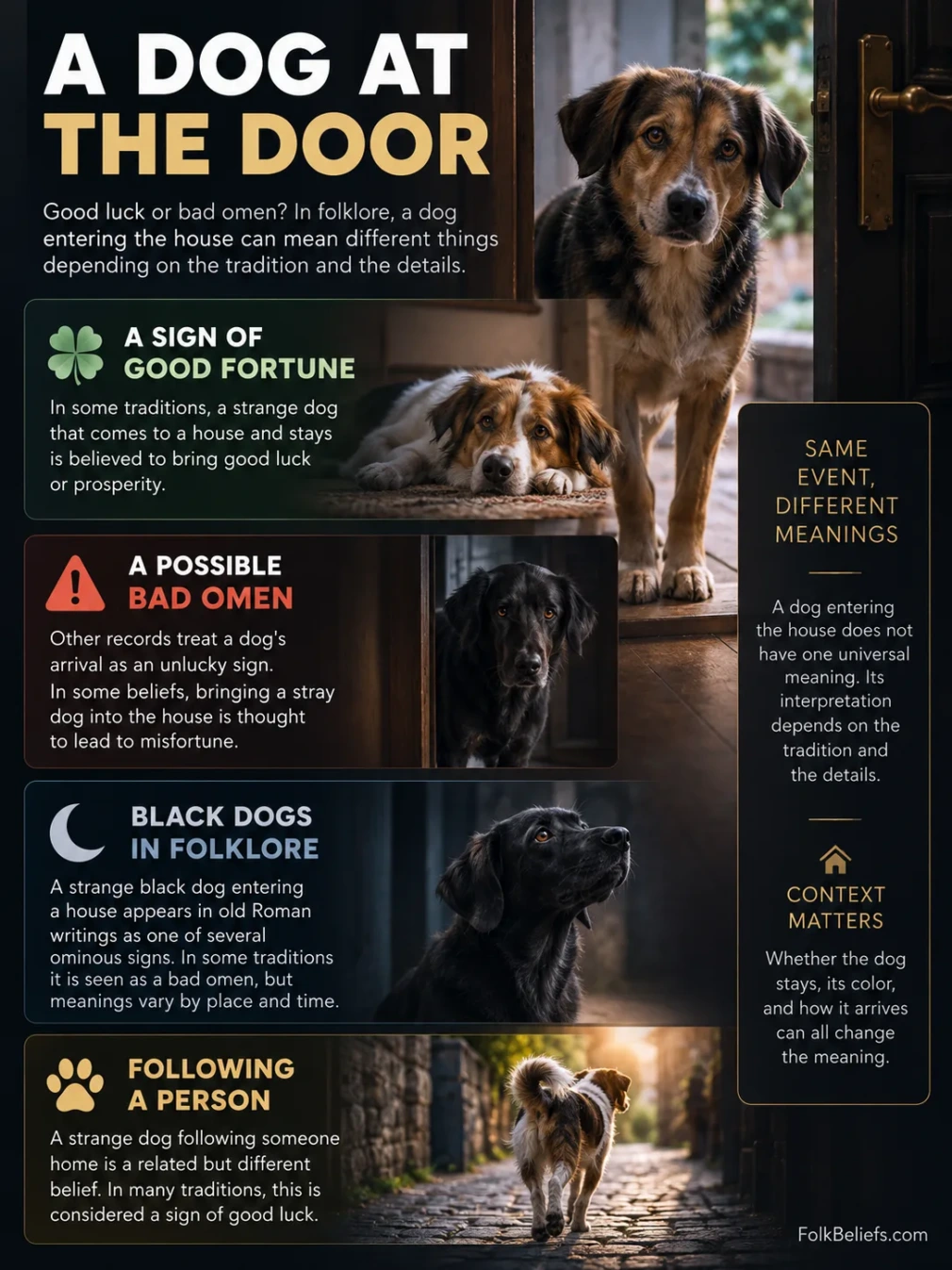
A dog entering the house does not carry one fixed meaning in folklore. In several recorded traditions, an unfamiliar dog arriving and choosing to stay is treated as good luck or approaching prosperity. Other collections record the same event as unlucky, and an old Roman literary example places a strange black dog entering a house among ominous occurrences.
The details matter. Some records concern a dog that simply appears at the home, others require the animal to remain there, and still others refer to a dog following a person home. These related beliefs should not be treated as one universal superstition.
When a Strange Dog Brings Good Fortune
One of the clearest British records comes from Charlotte Latham’s collection of West Sussex superstitions. In material gathered at Fittleworth, she recorded the belief that if a strange dog came to a house and remained there as a domestic animal, its arrival brought good fortune.[1]
The important detail is that the dog does more than cross the threshold. It comes from elsewhere and stays. The belief therefore resembles the idea of an unexpected animal voluntarily joining the household.
A related belief was collected in New England by Clifton Johnson and published in 1896. His collection states that when a strange dog or cat comes to a person and makes its home with them, the animal brings good luck.[2] The close resemblance between the New England and West Sussex records is notable, although the two collections should still be treated as records from their own places rather than evidence of a rule shared everywhere.
In these good-luck records, staying matters. A strange dog that adopts the household has a stronger folkloric meaning than a dog that briefly runs through an open door.
The Meaning Changes in Other Traditions
Not every record treats a dog’s arrival positively. The National Folklore Collection of Ireland preserves a contrasting example from Edenmore in County Monaghan. On a page listing unlucky omens, the collection includes the simple statement: “If a dog comes to the house.”[3]
This record does not give a breed, color, action, or predicted consequence. It only places the dog’s arrival among unlucky signs. That narrow wording is important: it supports a local recorded belief about an unwanted omen, but not a general Irish rule about dogs entering homes.
An even more specific negative variant appears in the James T. Callow Computerized Folklore Archive at the University of Detroit Mercy. One collected belief says that bringing a stray dog into the house and feeding it would be followed by someone in the family getting lost.[4] This is an individual archival record, not evidence that the belief was widely held in Michigan or elsewhere.
Does a Black Dog Entering the House Mean Bad Luck?
Color appears in some older material, but black dogs should not automatically be treated as unlucky in every tradition.
A much older example occurs in the Roman comedy Phormio by Terence. In the play, a character proposes a series of portentous events as reasons for delaying planned business: among them is a strange black dog entering the house, followed by a snake falling through the roof opening, a hen crowing, and warnings from diviners.[5]
The scene shows that a strange dark dog entering a household could function as recognizable omen language in Roman comedy. It does not establish a timeless belief that every black dog entering a home predicts misfortune. Later folklore contains many different black-dog traditions, and their meanings depend on place and context.
Coming to the House and Following Someone Home Are Different Motifs
Folklore collections also preserve beliefs about a strange dog following someone. This is close to the house-entry superstition, but it is not identical.
In a record from County Galway in the Irish Schools’ Collection, a strange dog following a person is described as a sign of good luck.[6] British collections also contain versions in which being followed by an unfamiliar dog is fortunate.
| Situation | Recorded Meaning | Context |
|---|---|---|
| A strange dog comes to the house and stays | Good fortune | West Sussex record |
| A strange dog makes its home with the household | Good luck | New England collection |
| A dog comes to the house | Unlucky omen | County Monaghan record |
| A stray dog is brought inside and fed | Negative household omen | Individual Michigan archive record |
| A strange black dog enters the house | Included among portentous events | Terence’s Phormio |
| A strange dog follows a person | Good luck | County Galway record |
A Living Version of the Good-Luck Belief
The association has not survived only in old printed collections. A 2025 entry in the USC Digital Folklore Archives records an informant of Chinese background who grew up in Vietnam. The informant recalled hearing from family, neighbors, and peers that a stray dog coming to the house was welcomed because it was supposed to bring good luck.[7]
This record is useful because it documents the belief as something remembered from lived oral tradition. Its scope remains personal: it should not be expanded into a claim that all Chinese or Vietnamese communities interpret an arriving dog in the same way.
What the Superstition Usually Depends On
- Whether the dog stays: In the West Sussex and New England records, an unfamiliar dog settling with the household is connected with good fortune.
- Whether the dog merely arrives: The Monaghan record treats a dog coming to the house as unlucky without requiring it to remain.
- Whether a person brings the dog inside: The Michigan archive example changes the event from an animal arriving voluntarily to a person taking in and feeding a stray.
- Whether color is mentioned: Terence’s Roman example specifically describes a strange black dog. Many later dog-arrival beliefs do not mention color at all.
- Whether the dog follows someone: Some traditions treat being followed by a strange dog as lucky even when they say nothing about the animal actually entering the house.
These meanings are folklore records, not predictions about what will happen after a dog enters a home. The surviving evidence shows variation rather than a single universal interpretation. A strange dog’s arrival could represent luck in one recorded tradition and an unwelcome omen in another.
Sources and Records
- ↑1 Charlotte Latham, Some West Sussex Superstitions Lingering in 1868,
- ↑2 Clifton Johnson, What They Say in New England: A Book of Signs, Sayings, and Superstitions,
- ↑3 National Folklore Collection, UCD, The Schools’ Collection, Edenmore, Co. Monaghan,
- ↑4 University of Detroit Mercy Libraries, James T. Callow Computerized Folklore Archive,
- ↑5 Terence, Phormio, Act IV,
- ↑6 National Folklore Collection, UCD, The Schools’ Collection, “Omens, Disappointments, etc.”,
- ↑7 USC Digital Folklore Archives, “Cats and Dogs as Sign Superstition”,
Documented Locations
Countries: Angola
These labels identify where a version has been documented. They do not mean that everyone in the country, region, or community shares the belief.