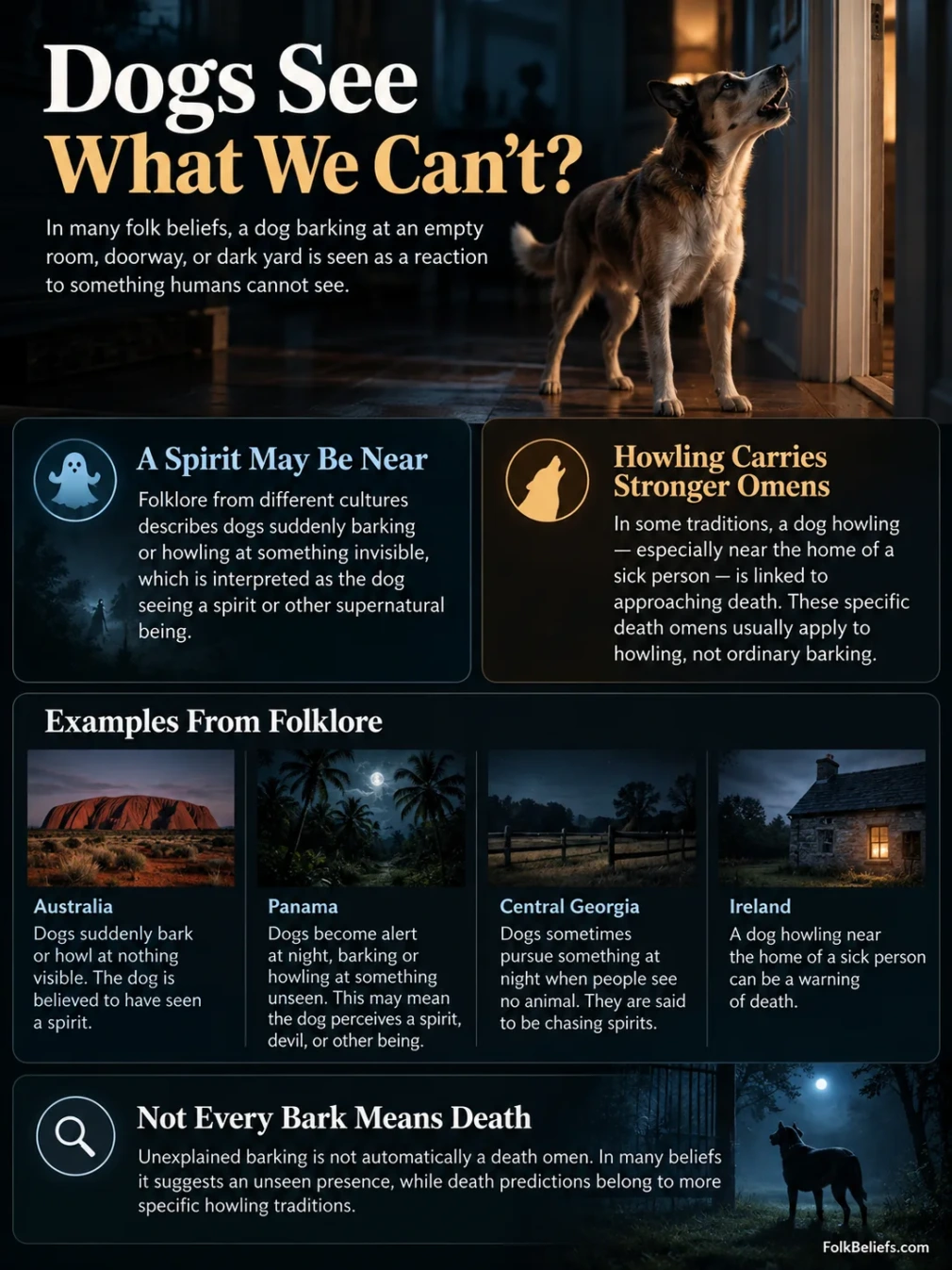
A dog barking at an empty corner, doorway, wall, or dark yard is sometimes interpreted in folklore as reacting to something people cannot see. The best-documented versions do not give unexplained barking one universal meaning. In some records, the dog is believed to perceive a spirit or other unseen presence; in others, stronger omens such as approaching death are attached specifically to howling rather than ordinary barking.
When a Dog Barking at Empty Space Means a Spirit
The idea that dogs can perceive beings hidden from human sight appears in several separate folklore records. One unusually direct example comes from K. Langloh Parker’s 1905 account of Euahlayi life in Australia. The recorded belief says that when dogs suddenly bark and howl while people can see nothing around them, the dogs have seen a spirit.[1]
A later oral-history record in the USC Digital Folklore Archives preserves a related belief remembered by a Panamanian informant. She described dogs becoming alert at night, moving their ears, barking, or howling at something humans could not detect. Within the belief she learned as a child, such behavior could be interpreted as the dog seeing a spirit, devil, or another supernatural being.[2]
| Recorded Setting | Dog’s Behavior | Folklore Interpretation |
|---|---|---|
| Euahlayi record, Australia | Sudden barking or howling when nothing is visible | The dog has seen a spirit |
| Panamanian oral account | Nighttime alerting, barking, or howling toward something unseen | The dog may be perceiving a supernatural being |
| Central Georgia historical record | Dogs pursue something at night when people see no animal | The dogs are said to be chasing spirits |
| Irish historical collection | Howling near the home of a sick person | An omen associated with approaching death |
The Meaning Comes From What Humans Cannot See
In these beliefs, the striking part is not simply that a dog makes noise. It is the apparent mismatch between the dog’s reaction and the human observer’s experience. The dog behaves as though someone or something is present, while the person sees an empty room, road, yard, or stretch of darkness.
A Central Georgia folklore collection published by Roland Steiner in 1899 records another version of this theme. Dogs were sometimes said to be “running” spirits at night when they continued pursuing something that the people with them could not see. The record also says dogs encountering a spirit might retreat, whine, or seek protection.[3]
This was a specific regional record gathered in a particular historical setting. It should not be turned into a rule for the United States as a whole, nor treated as a belief shared by every community represented in the collection.
Barking and Howling Do Not Always Carry the Same Omen
Modern retellings often combine every strange dog sound into one idea: a dog barks or howls at nothing, therefore something supernatural or dangerous must be nearby. Older folklore records are less uniform.
Lady Wilde’s collection of Irish legends gives howling a particularly ominous role. A dog howling near the home of someone who was ill could be interpreted as a warning of death. The same collection specifically states that a dog sensing a spirit was believed to howl rather than bark.[4]
That distinction matters for the superstition about a dog barking at empty space. Unexplained barking is not automatically a death omen. Some documented traditions connect it with an unseen presence, while death predictions belong to more specific howling traditions.
Does Barking at an Empty Corner Mean a Ghost Is There?
Within some folk beliefs, that is one possible interpretation. A dog that fixes its attention on an apparently empty place and suddenly barks can be understood as perceiving a spirit that remains invisible to people.
The folklore record does not establish a fixed code for different parts of a house, however. There is no dependable traditional rule in these sources saying that a dog barking at a corner means one kind of spirit, barking at a wall means another, or barking at a doorway predicts a particular event. Those precise location-based meanings should not be added unless a particular tradition actually documents them.
Nor does the superstition prove that a house is haunted. Folklore records the interpretation people gave to an unusual experience; it does not establish the supernatural explanation as fact.
Why a Dog May Seem to Bark at Nothing
An apparently empty space may contain information that is obvious to a dog and imperceptible to a person. The American Kennel Club notes that dogs can hear higher-pitched sounds than humans, detect scents that people miss, and see more effectively in low-light conditions. A dog staring into darkness or toward a blank wall may therefore be responding to an ordinary stimulus outside human perception.[5]
- A faint or high-pitched sound may be coming from another room, outdoors, or inside a wall.
- A small animal or insect may be moving where the person has not noticed it.
- A scent can remain meaningful to a dog even when a human smells nothing unusual.
- Movement, reflections, or shadows can be easier for a dog to notice in dim conditions.
This sensory difference also helps explain why unexplained dog behavior became such a natural subject for folklore. People could clearly see the animal reacting, yet could not perceive the apparent cause themselves. In traditions that already allowed for invisible beings, the dog’s sharper awareness provided a ready explanation for the mystery.
Why Nighttime Appears So Often in These Beliefs
Several records place the behavior after dark. The Panamanian account describes dogs reacting to unseen things at night, while the Central Georgia record also places spirit-chasing dogs in nighttime settings. Darkness makes the object of a dog’s attention harder for a person to identify, even though the dog may still hear, smell, or see what prompted the response.
The supernatural meaning varies with the tradition. A sudden bark into darkness may indicate an unseen presence in one record, while prolonged howling may become an omen in another. There is no source-backed reason to treat every unexplained nighttime bark as bad luck, a warning of death, or evidence of a ghost.
Sources and Records
- ↑1 K. Langloh Parker, The Euahlayi Tribe: A Study of Aboriginal Life in Australia,
- ↑2 USC Digital Folklore Archives, “Through the Eyes of a Dog”,
- ↑3 Roland Steiner, “Superstitions and Beliefs from Central Georgia”,
- ↑4 Lady Wilde, Ancient Legends, Mystic Charms & Superstitions of Ireland,
- ↑5 Stephanie Gibeault, “Why Does My Dog Bark at Nothing?”,
Documented Locations
Countries: Nepal
These labels identify where a version has been documented. They do not mean that everyone in the country, region, or community shares the belief.