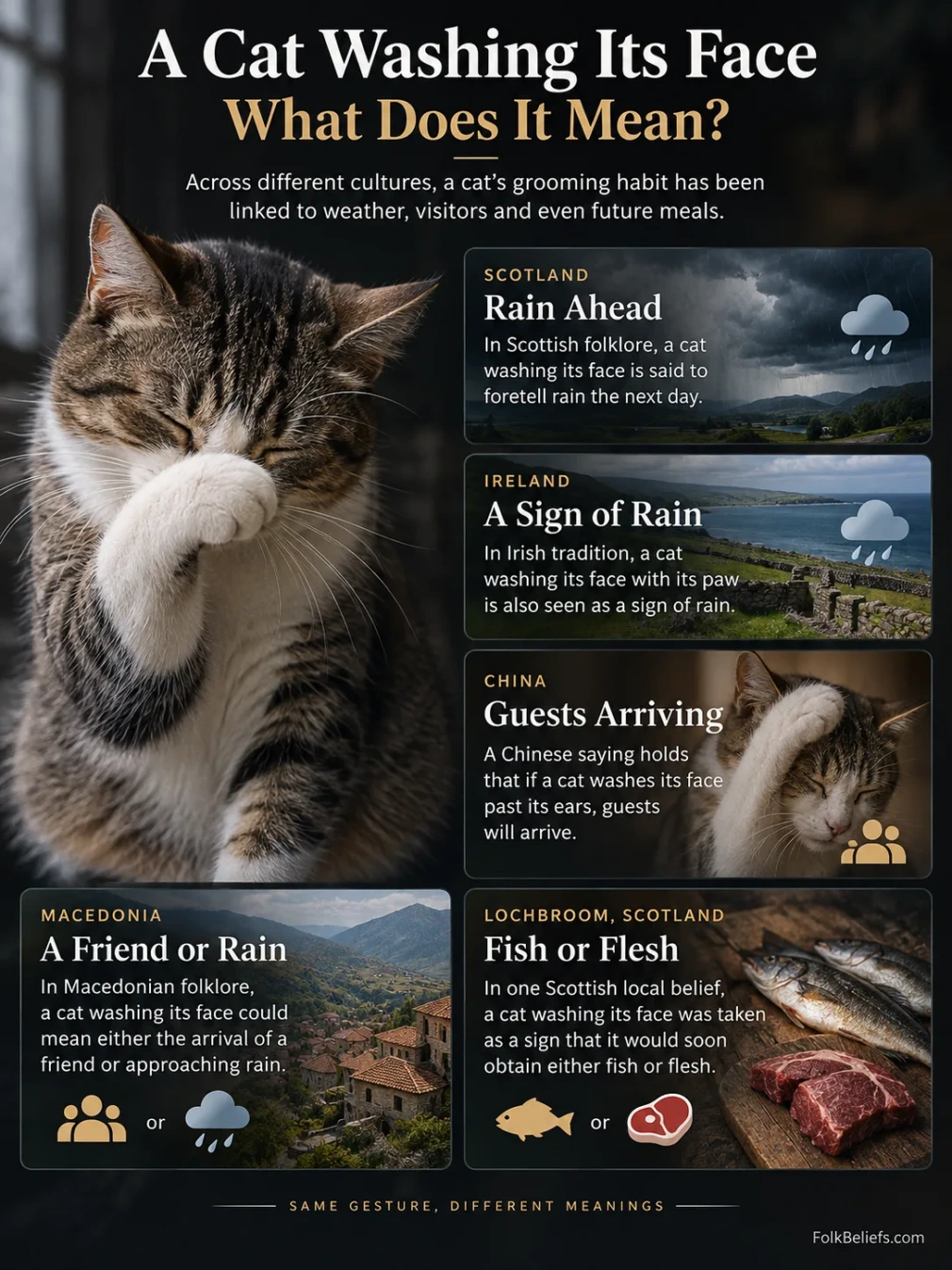
A cat washing its face has carried several different meanings in recorded folklore. Rain is one of the best-documented interpretations, especially in Scottish and Irish weather lore, while other traditions connect the same grooming action with arriving guests, friends, or food. The exact movement can matter: some records refer simply to washing the face, while others specifically mention the paw passing over the ears.
When a Cat Washing Its Face Means Rain
Scottish Highland folklore gives a direct weather interpretation. John Gregorson Campbell’s Witchcraft & Second Sight in the Highlands & Islands of Scotland, published in 1902 from material collected from oral sources, records that a cat washing its face foretells rain the following day. The same passage places this belief among several weather and animal omens associated with cats.[1]
The belief also appears independently in Irish folklore records. An entry from Tynagh, County Galway, preserved in the National Folklore Collection’s Schools’ Collection, states that a cat washing its face with its paw is a sign of rain. The record sits among other observations about animals, insects, soot, and weather changes rather than being presented as a general belief about cats.[2]
The scope matters: these records show that the rain interpretation existed in particular Scottish and Irish folklore contexts. They do not establish that everyone in Scotland, Ireland, or Britain shared the belief.
Washing Over the Ears and the Arrival of Guests
A different interpretation appears in Chinese textual tradition. A recorded saying states that if a cat washes its face past its ears, guests will arrive. The movement is more specific than ordinary face cleaning: the paw is described as passing over the ear.[3]
This detail is important because later retellings sometimes reduce the belief to simply “a cat washing its face means company is coming.” In the recorded Chinese wording, however, washing past the ears forms part of the omen. It is therefore safer to preserve that detail rather than treat every brief grooming movement as equivalent.[3]
A Friend or Rain in Macedonian Folklore
The two better-known interpretations can even occur within the same recorded tradition. G. F. Abbott’s Macedonian Folklore, published in 1903 from research in Greek-speaking parts of Macedonia, records that a cat washing its face could foretell either the arrival of a friend or approaching rain.[4]
This example shows why the gesture does not have one fixed folkloric meaning. Rain and visitors are not necessarily competing explanations created by modern retellings; both meanings appear in historical records. Their interpretation depends on the particular source and community in which the belief was documented.
The Lochbroom Fish-or-Flesh Omen
A more unusual local variant was recorded for Lochbroom in the Scottish Highlands. George Henderson’s 1911 Survivals in Belief Among the Celts states that a cat washing its face was taken as an omen that the animal would soon obtain either fish or flesh. The accompanying belief could give the omen an unwelcome meaning because the meat might result from an accidental loss of livestock; Henderson records an attempt to avert the prediction by striking the cat.[5]
This is a particularly local record and should not be expanded into a general Scottish rule. It is useful precisely because it shows how a familiar action could acquire a very different meaning within one locality.
What the Different Records Actually Say
| Recorded Context | Grooming Action | Folklore Meaning |
|---|---|---|
| Scottish Highlands | Washing the face | Rain the next day |
| County Galway, Ireland | Washing the face with a paw | Rain |
| Chinese textual tradition | Washing the face past the ears | Guests arriving |
| Greek-speaking Macedonia | Washing the face | A friend arriving or approaching rain |
| Lochbroom, Scotland | Washing the face | The cat soon obtaining fish or meat |
The table also shows why small details should not be discarded. Washing over the ears is specifically relevant to some visitor beliefs, whereas several rain records mention face washing without requiring that movement.
Why Cats Wash Their Faces
Face washing itself is ordinary feline grooming rather than evidence that an event is about to happen. Cats lick a paw and use it to clean areas that their tongues cannot reach directly, including parts of the head and face. Grooming occupies a large part of normal feline behavior; Cornell University’s Feline Health Center notes that cats may spend roughly 30 to 50 percent of their day grooming.[6]
Because the action happens frequently, rain, visitors, meals, and other events will sometimes follow it by chance. The historical records document how communities interpreted the behavior; they do not establish face washing as a reliable method of forecasting weather or visitors.
The safest reading of the superstition is therefore contextual: rain, visitors, and other outcomes are documented variants rather than one universal rule. Location, period, and the precise grooming movement determine what a particular record supports.
Sources and Records
- ↑1 John Gregorson Campbell, Witchcraft & Second Sight in the Highlands & Islands of Scotland,
- ↑2 National Folklore Collection, UCD, “Weather-Lore,” Tigneatha, County Galway,
- ↑3a ↑3b Chinese Text Project, Leishuo, Volume 42, “On Cats”,
- ↑4 G. F. Abbott, Macedonian Folklore,
- ↑5 George Henderson, Survivals in Belief Among the Celts,
- ↑6 Cornell University College of Veterinary Medicine, “Cats that Lick Too Much”,
Documented Locations
Countries: Canada, Costa Rica, Cuba, Greece, Italy, Japan, Liechtenstein, Paraguay, Philippines, Russia, Spain, United Kingdom, Uruguay
These labels identify where a version has been documented. They do not mean that everyone in the country, region, or community shares the belief.