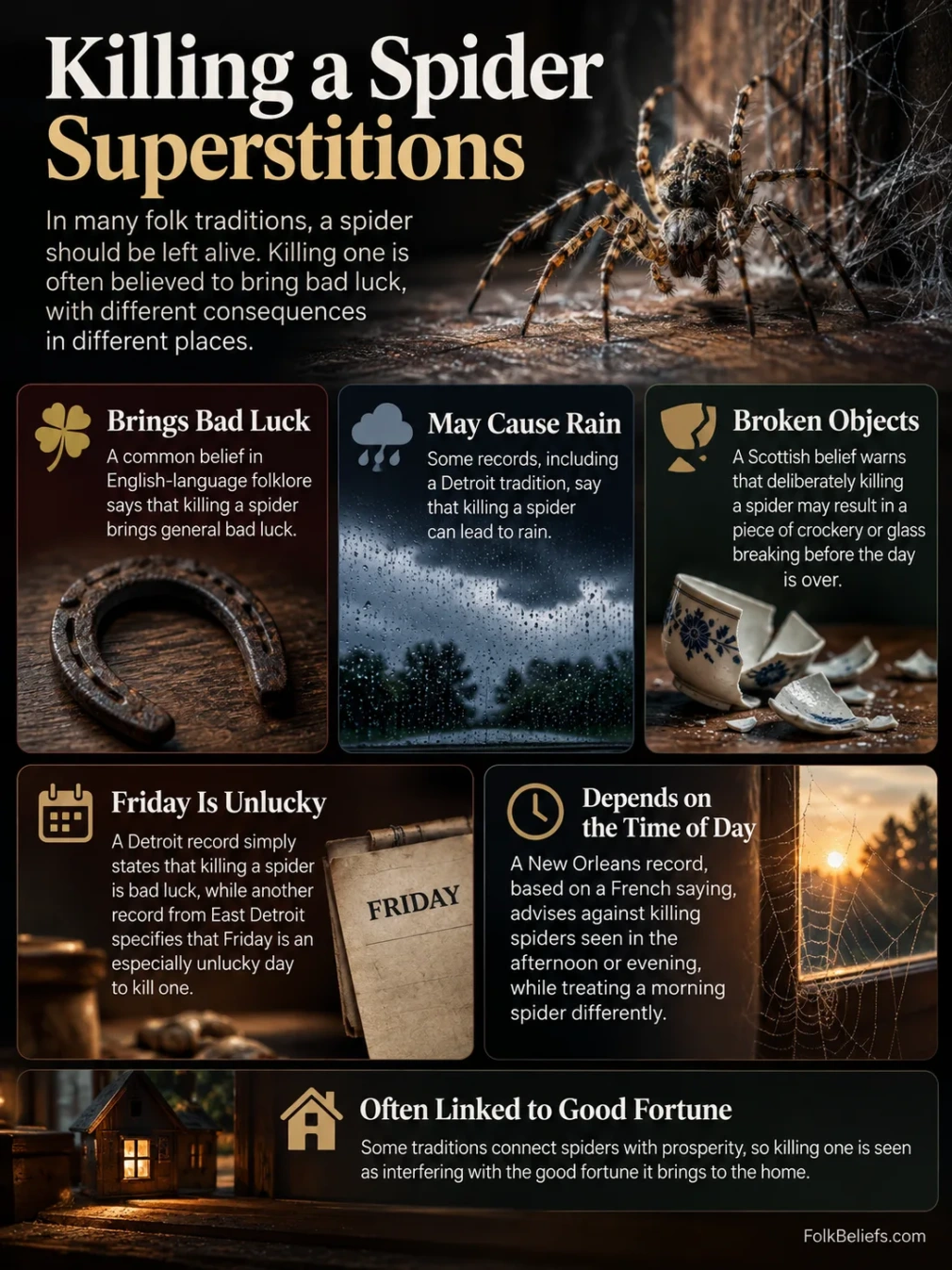
In several recorded folk traditions, killing a spider is treated as unlucky, but the predicted consequence is not always the same. A Detroit folklore record learned in 1967 states simply that killing a spider brings bad luck, while a 1969 East Detroit record singles out Friday as an especially unlucky day to kill one.[1]
Other versions connect the act with rain, broken household objects, or rules that change according to the time of day. The shared idea is usually that the spider should be allowed to live, rather than that seeing a spider is itself unlucky.
Is It Bad Luck to Kill a Spider?
Bad luck is one of the clearest meanings attached to killing a spider in English-language folklore records. An 1881 collection of domestic folklore gives the rhyme, “If you wish to live and thrive, let the spider run alive.” It adds that harming or killing the spider was believed to invite ill luck.[2]
The same collection records a more precise Scottish version. In parts of Scotland, a servant who deliberately killed a spider was said to break a piece of crockery or glass before the end of the day. This was not presented as a rule for every Scottish community, but as one recorded regional belief.[2]
Later American records preserve the simpler form. The James T. Callow Folklore Archive includes both “killing a spider is bad luck,” learned in Detroit in 1967, and a version collected in East Detroit in 1969 that warns specifically against killing a spider on Friday.[1]
Recorded Variations of the Belief
| Recorded Belief | Place or Context | Recorded Detail |
|---|---|---|
| Killing a spider brings bad luck | Detroit, Michigan | A folklore item learned in 1967 gives the belief without an additional condition.[1] |
| Killing a spider on Friday brings bad luck | East Detroit, Michigan | A 1969 record makes the day of the week part of the warning. |
| Killing a spider brings rain | Detroit, Michigan | A record learned from the informant’s mother in 1967 predicts rain after a spider is killed.[4] |
| Deliberately killing a spider leads to broken crockery or glass | Parts of Scotland, as described in an 1881 folklore collection | The predicted consequence was expected before the day ended. |
| The correct action depends on the time of day | New Orleans record drawing on a French saying | An 1886 account advises against killing spiders seen in the afternoon or evening, while treating a morning spider differently.[5] |
The differences matter. “Killing a spider is bad luck” and “killing a spider makes it rain” are related pieces of folklore, but they are not interchangeable. Neither should a Friday-specific record be expanded into a rule followed everywhere.
Why Does the Spider Have to Be Left Alive?
Some nineteenth-century collectors linked the taboo with the idea that spiders could represent prosperity. In that interpretation, destroying the spider meant interfering with the good fortune associated with its presence in the home.[2]
Protective legends were also used to explain why spiders should not be harmed. William Henderson’s nineteenth-century collection records an incident from Malton in Yorkshire in which an elderly woman stopped a visitor from killing a spider. She connected the animal with a story in which a spider’s web protected the infant Christ. Henderson placed beside this account the Kentish saying that a person wishing to thrive should let spiders live.[3]
These protective stories help explain how people understood the custom, but they should not be treated as a proven single origin for every spider-killing superstition. Folklore can preserve similar rules while attaching different stories and meanings to them.
Does Killing a Spider Mean It Will Rain?
Rain is a documented variant, not merely a recent internet addition. The Callow archive preserves a Detroit record stating that if a spider is killed, rain will follow. The informant said the belief had been learned from her mother.[4]
This version turns the act into a weather sign rather than a general punishment. Other records simply predict misfortune, so rain should not be presented as the inevitable meaning of the superstition.
Morning, Afternoon, and Evening Spiders
Time of day can completely alter the rule. Lafcadio Hearn’s 1886 account of superstitions current in New Orleans records a warning not to kill a spider in the afternoon or evening, yet says that a spider appearing early in the morning could be killed. He connects the distinction with the French saying “Araignée du matin—chagrin; Araignée du midi—plaisir; Araignée du soir—espoir”: a morning spider was associated with sorrow, a midday spider with pleasure, and an evening spider with hope.[5]
This record is a useful reminder that spider folklore does not always follow the simple rule “never kill a spider.” In some traditions, when the spider appeared could matter as much as what was done to it.
The Belief in Nineteenth-Century American Literature
The association between a dead spider and bad luck also appears in Mark Twain’s Adventures of Huckleberry Finn. Early in the novel, Huck accidentally sends a spider into a candle flame and immediately interprets its death as an omen of coming bad luck. He tries several actions intended to protect himself but admits that he does not know a specific remedy for the misfortune caused by killing a spider.[6]
A literary appearance does not prove that everyone in a particular region shared the belief. It does show that the idea of a killed spider as an unlucky sign was recognizable enough to be used directly in a nineteenth-century American story without a lengthy explanation.
What If You Accidentally Kill a Spider?
The records do not provide one shared rule separating accidental death from deliberate killing. Some historical accounts specifically refer to wilfully killing or injuring a spider, while Twain’s fictional example treats an accidental death as ominous too. The distinction therefore depends on the version being considered rather than on a single folklore rule.
There is also no consistently documented remedy. Turning around, making protective gestures, saying a phrase, or performing another action may belong to separate bodies of folk practice, but they should not automatically be attached to the spider belief unless a particular record connects them.
Folklore meaning: killing a spider can represent bad luck, lost prosperity, coming rain, or another unwanted event depending on the recorded tradition. These accounts document beliefs and sayings; they do not establish that killing a spider can actually cause changes in luck, weather, or future events.
Sources and Records
- ↑1a ↑1b ↑1c University of Detroit Mercy Libraries, The James T. Callow Folklore Archive,
- ↑2a ↑2b ↑2c T. F. Thiselton Dyer, Domestic Folk-Lore,
- ↑3 William Henderson, Notes on the Folk-Lore of the Northern Counties of England and the Borders,
- ↑4a ↑4b University of Detroit Mercy Libraries, “If You Kill a Spider, It Will Rain”,
- ↑5a ↑5b Lafcadio Hearn, “New Orleans Superstitions”,
- ↑6 Mark Twain, Adventures of Huckleberry Finn,
Documented Locations
Countries: Azerbaijan, Bahamas, Barbados, Estonia
These labels identify where a version has been documented. They do not mean that everyone in the country, region, or community shares the belief.