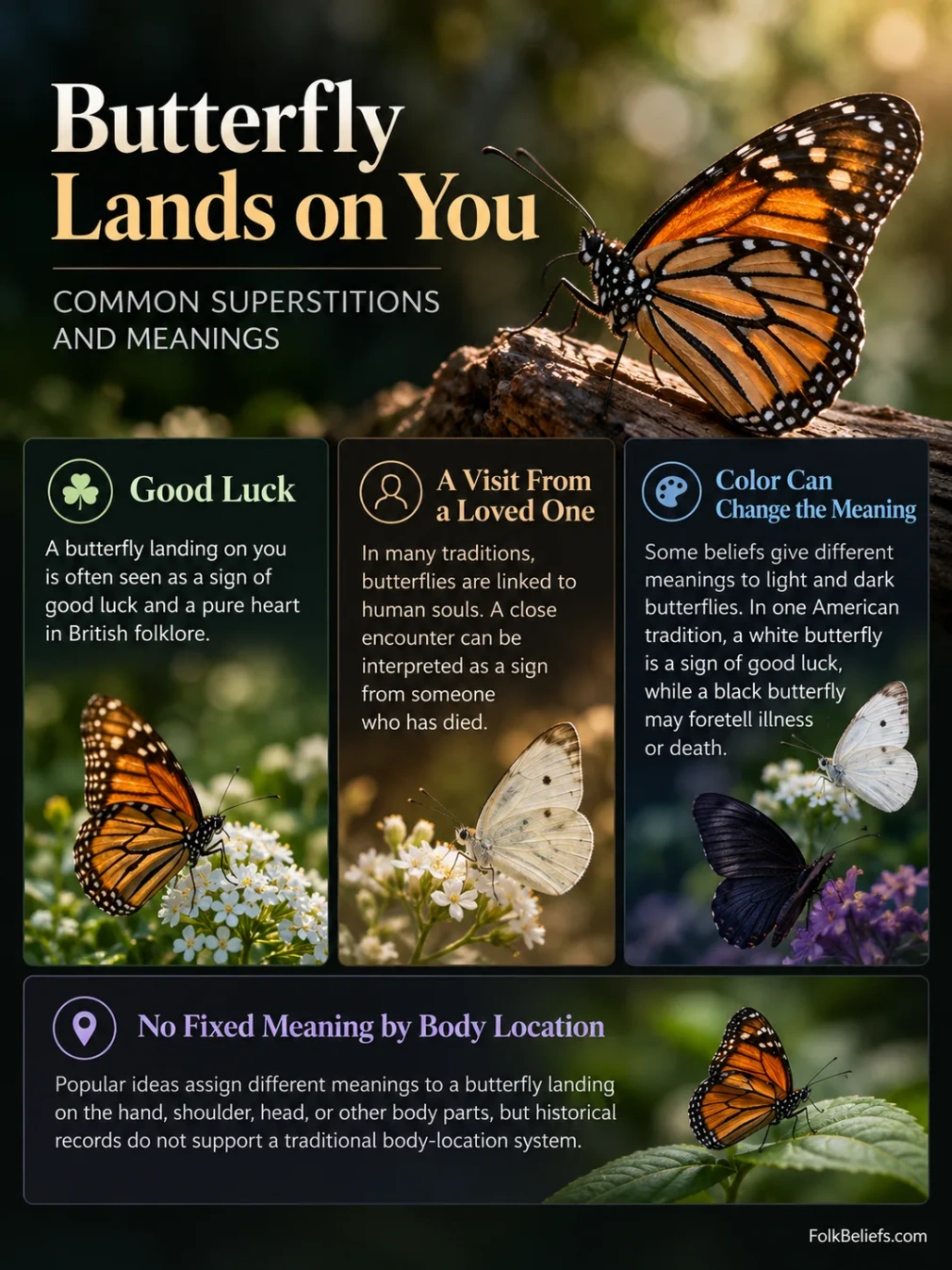
If a butterfly lands on you, the most familiar superstition treats the encounter as good luck. That meaning is recorded in a Hampshire County Council overview of British countryside beliefs, which describes a butterfly landing on a person as a lucky sign associated with purity of heart.[1] Other records give very different meanings, however. The butterfly’s color, the setting, and the tradition in which the belief was recorded can change the interpretation.
What Does It Mean When a Butterfly Lands on You?
There is no single traditional rule shared across cultures. The available records point to several separate ideas that have become associated with the experience:
Good Luck
A butterfly resting directly on a person can be interpreted as a favorable omen. This is the clearest landing-specific meaning in the Hampshire folklore summary.[1]
A Soul or Personal Visitor
Older records from several traditions connect butterflies with human souls. These records help explain why a butterfly that approaches closely is sometimes interpreted today as a visit from someone who has died, although the older sources do not always describe the butterfly actually landing on a person.
A Color-Based Omen
Some recorded beliefs assign opposite meanings to light and dark butterflies. These interpretations are local or individual traditions rather than a universal color code.
White and Black Butterflies Can Carry Opposite Meanings
A 2017 entry in the USC Digital Folklore Archives records a belief told to an American college student by an older woman during a gardening project. In that account, a black butterfly landing on someone was said to foretell severe illness or death involving that person or someone close to them, while a white butterfly was associated with good luck. The student’s mother knew a related but different rule: a white butterfly was lucky when it was the first butterfly seen that year.[2]
This archive entry documents what particular informants reported. It does not show that all Americans, or any broad cultural group, share the same black-versus-white butterfly belief.
The contrast is useful because it shows how butterfly superstitions change even between people familiar with related versions of the belief. A color meaning should therefore be tied to a documented tradition rather than treated as a fixed rule.
Why Butterflies Became Associated With Souls
The idea that a close butterfly encounter might represent a deceased relative or another person has deeper roots than many modern “spiritual meaning” lists suggest.
In Lafcadio Hearn’s writing on Japanese butterfly beliefs, the soul of a living person could take butterfly form. He also recorded the idea that a butterfly entering a guest room and settling behind a screen could announce the coming of the person most loved by the occupant. Hearn further described beliefs in which butterflies represented the souls of people who had died.[3]
A British and Irish example appears in Donald A. Mackenzie’s Ancient Man in Britain. Drawing on an earlier account by Lady Wilde, Mackenzie recounts an Irish story in which a butterfly represents a soul leaving a dead person’s body. He also discusses butterfly and moth soul traditions recorded in Scotland, England, and Ireland.[4]
These records support a historical butterfly-and-soul association. They do not establish a universal rule that every butterfly landing on someone is a deceased loved one delivering a message. That more personal interpretation can be understood as one way older soul symbolism has been applied to a close encounter.
Does Where the Butterfly Lands Change the Meaning?
Popular explanations sometimes assign separate meanings to a butterfly landing on the hand, shoulder, head, face, or foot. The historical and archival records used here do not provide a traditional body-location system of that kind.
A butterfly on the hand therefore cannot reliably be assigned one old folkloric meaning while a butterfly on the shoulder is assigned another. Such interpretations may exist as personal or recent beliefs, but they should not automatically be presented as established historical superstition.
What If the Butterfly Stays for a Long Time?
The length of the visit can make the experience feel more unusual, but the records cited here do not give a set rule such as “a butterfly that stays for five minutes carries a stronger omen.” There is no documented time threshold in these sources for determining luck, a spiritual visit, or another prediction.
Older butterfly beliefs more often focus on what the butterfly represents, its color, where it appears, or the circumstances surrounding the encounter rather than measuring how long it remains on the person.
Why a Butterfly May Actually Land on Your Skin
There is also a well-documented biological reason for some encounters. Butterflies obtain minerals from moist sources through behavior commonly called puddling. A 2025 review in the Annals of the Entomological Society of America describes butterflies using mineral-rich sources including mud, animal material, tears, and human perspiration. Sodium and nitrogen are among the nutrients involved, and historical observations specifically recorded butterflies landing on exposed human skin to take up substances from perspiration.[5]
So a butterfly may settle on an arm, hand, face, or other exposed skin because sweat provides moisture and minerals. The biological explanation and the folklore surrounding the experience answer different questions: one concerns butterfly behavior, while the other records meanings people have attached to the encounter.
How the Recorded Meanings Differ
| Recorded Situation | Meaning in the Record | Context |
|---|---|---|
| Butterfly lands on a person | Good luck and purity of heart | Modern Hampshire countryside folklore summary |
| Black butterfly lands on a person | Illness or death involving the person or someone close | One informant account preserved by the USC Digital Folklore Archives |
| White butterfly | Good luck | Related beliefs recorded from informants in the same USC archive entry |
| Butterfly appears as a human soul | A living or dead person’s soul may take butterfly form | Historical Japanese material recorded by Lafcadio Hearn |
| Butterfly as the soul of the dead | The butterfly represents a departing or lingering soul | Irish and wider British Isles material discussed by Mackenzie |
Folklore meaning and prediction are not the same thing. These beliefs document how people have interpreted butterflies in particular settings. They do not provide evidence that a landing predicts future events or proves supernatural contact.
Sources and Records
- ↑1a ↑1b Hampshire County Council, “Myths about animals in Hampshire’s countryside”,
- ↑2 USC Digital Folklore Archives, “Good Luck Butterflies”,
- ↑3 Lafcadio Hearn, Kwaidan: Stories and Studies of Strange Things,
- ↑4 Donald A. Mackenzie, Ancient Man in Britain,
- ↑5 Elise R. Morton, Harald F. Parzer et al., “Puddling in butterflies: current knowledge and new directions”,
Documented Locations
Countries: Jordan, United States
These labels identify where a version has been documented. They do not mean that everyone in the country, region, or community shares the belief.