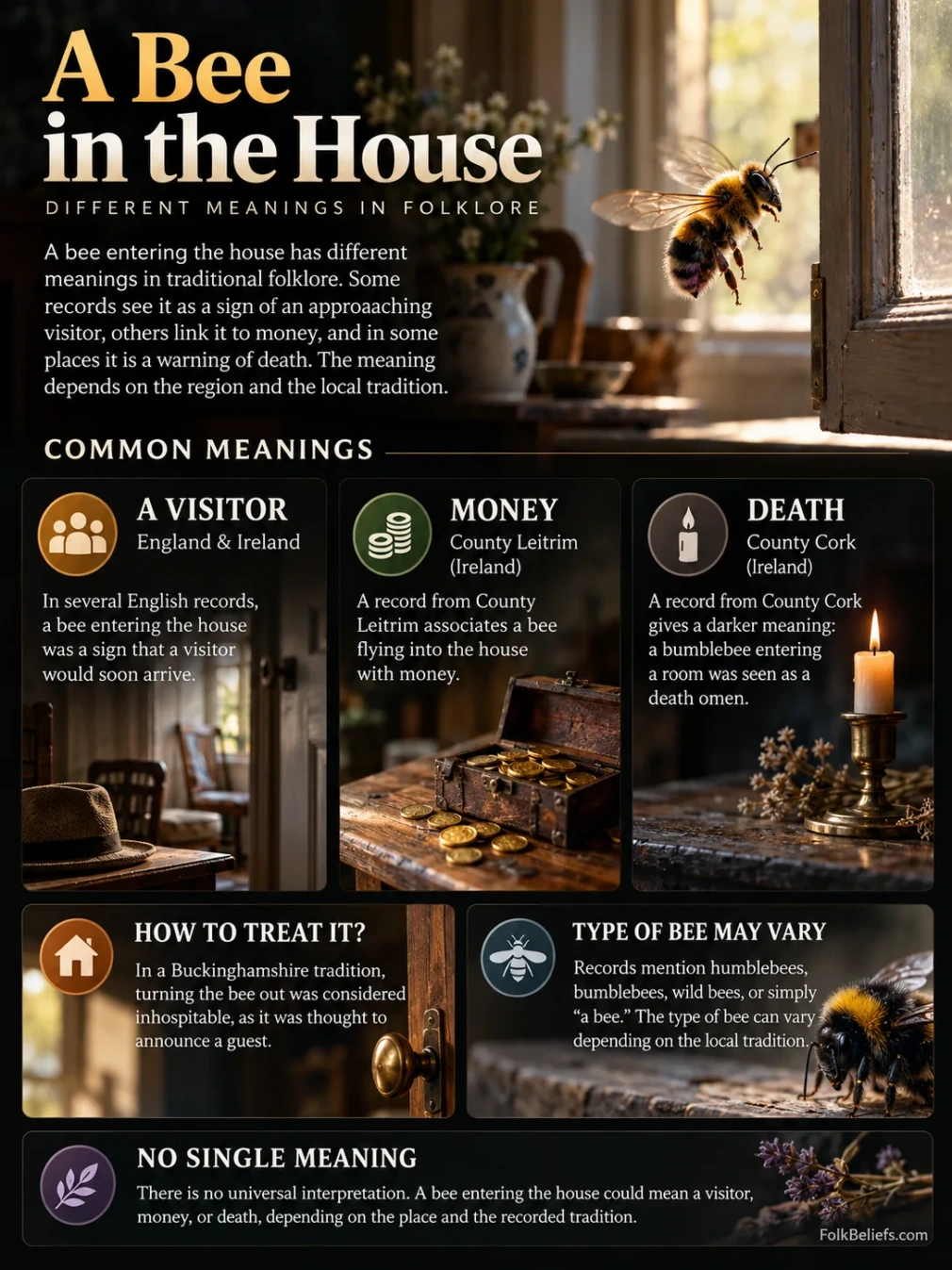
A bee entering the house does not have one fixed meaning in documented folklore. Some records connect the event with an approaching visitor, while others interpret it as a sign of money or, in a much darker local version, death. The meaning depends on the place, the recorded tradition, and sometimes the kind of bee named in the belief.
A Bee Indoors Could Announce a Visitor
One of the clearest English versions comes from Buckinghamshire. William Henderson’s 1879 collection records a humblebee entering a house as an omen that a visitor is coming. The same account adds that turning the bee out was considered inhospitable, linking the treatment of the insect with the expected guest.[1]
Richard Jefferies preserved a closely related belief while describing rural life in southern England. In his account, a humblebee coming through the sitting-room window was taken as a sign that a visitor would soon arrive.[2]
These records make the coming-visitor interpretation a well-documented form of the house-bee superstition. They do not, however, establish it as a rule shared everywhere.
Irish Records Give Three Different Meanings
Ireland’s National Folklore Collection provides a useful example of how much one omen could vary locally. The Schools’ Collection was assembled mainly between 1937 and 1939, when schoolchildren recorded folklore and oral tradition from parents, grandparents, neighbours, and other people in their home districts.[3]
Money in County Leitrim
A record collected at Drumeela, County Leitrim, associates a bee flying into the house with money.[4]
A Visitor in County Longford
A belief recorded from Julia Whitton of Clonwhelan, County Longford, says that a wild bee entering the house signals a visitor.[5]
Death in a County Cork Record
A collection from Burnfort, County Cork, gives the opposite type of reading: a bumblebee entering a room was recorded as a death omen.[6]
Is a Bee Entering the House Good Luck?
It can be in some traditions. The County Leitrim money omen is plainly favorable, while the visitor belief can also be read as welcoming rather than threatening. The County Cork record shows why describing every indoor bee as a good-luck sign goes beyond the historical evidence.
There is therefore no source-based reason to assign one universal meaning such as wealth, good news, or bad luck whenever a bee crosses a doorway or window. Different communities attached different outcomes to essentially the same event.
Does the Type of Bee Matter?
The wording of the records is worth preserving. Henderson and Jefferies refer to a humblebee; the Cork record specifies a bumblebee; the Longford account refers to a wild bee; and the Leitrim entry simply says a bee.
This does not prove that every community deliberately maintained a separate omen for each species. It does show that later retellings should not silently turn every historical version into an identical “honey bee in the house” superstition.
A single bee entering a room and a swarm settling at a house are also different folklore motifs. Beliefs concerning swarms, hives, beekeepers, and customs surrounding household bees should not automatically be treated as alternative versions of the indoor-bee omen.
Was the Bee Supposed to Be Left Alone?
At least one documented tradition attached meaning to how the household treated the visitor. In Henderson’s Buckinghamshire account, putting the humblebee out of the house was regarded as an inhospitable act.[1]
That detail fits the local interpretation particularly well: if the bee announces a guest, expelling it symbolically resembles turning away the person whose arrival it foretells. The record supports that connection in this specific English context; it should not be expanded into a universal rule about what everyone was expected to do with a bee indoors.
Why Do the Meanings Conflict?
The surviving records do not point to a single origin from which every version can be derived. Instead, they show a short domestic omen that could be remembered and transmitted with different consequences attached to it.
A bee crossing the boundary of the home might therefore mean a visitor in one record, money in another, and death somewhere else. Even records collected within Ireland preserve incompatible readings. That is useful folklore evidence in itself: variation is part of the tradition rather than a problem that needs to be corrected.
These meanings document folk belief rather than the predictive behavior of bees. An actual bee entering a house does not provide evidence that money, a visitor, or a death will follow.
Sources and Records
- ↑1a ↑1b William Henderson, Notes on the Folk-Lore of the Northern Counties of England and the Borders,
- ↑2 Richard Jefferies, Wild Life in a Southern County,
- ↑3 National Folklore Collection, UCD, “The Schools’ Collection”,
- ↑4 National Folklore Collection, UCD, The Schools’ Collection, Drumeela, County Leitrim,
- ↑5 National Folklore Collection, UCD, The Schools’ Collection, Monedarragh, County Longford,
- ↑6 National Folklore Collection, UCD, The Schools’ Collection, Burnfort, County Cork,
Documented Locations
Countries: Greece
These labels identify where a version has been documented. They do not mean that everyone in the country, region, or community shares the belief.