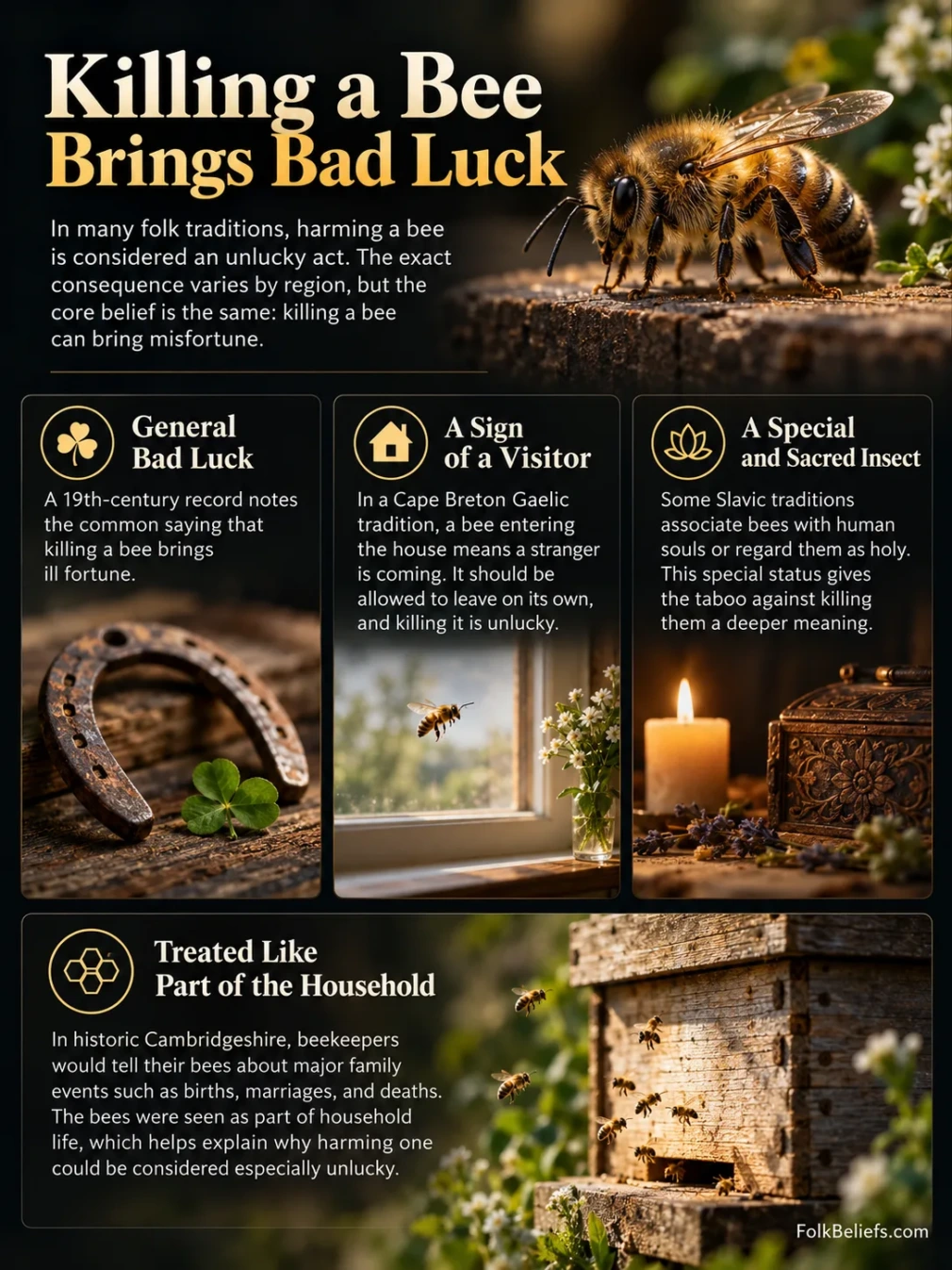
In several documented folk traditions, killing a bee was treated as an unlucky act. The predicted consequence was not always defined. Some records simply say that ill fortune follows, while more local versions connect the bee with a visitor, household luck, or a special respect owed to bees. An 1865 collection of insect folklore records the saying that ill fortune attends the killing of bees.[1]
What Does the Killing-a-Bee Superstition Mean?
The simplest form of the belief is that killing a bee brings bad luck. Frank Cowan recorded it as a common saying rather than attaching a precise punishment, deadline, or type of misfortune to the act. This matters because later retellings sometimes give the superstition much more specific consequences than the older record actually supports.
The belief also belongs to a wider body of bee folklore in which bees were treated differently from ordinary insects. Their arrival, departure, swarming, health, and behavior around a household could all acquire meanings in local tradition.
Folklore note: These records document traditional beliefs. They do not establish that killing a bee causes later misfortune.
A Cape Breton Gaelic Version Connects the Bee With a Visitor
A more detailed version was recorded from the Gaelic folkways of Kingsville in Inverness County, Cape Breton, Nova Scotia. In material collected from local historian Jimmy MacKay, a bee entering the house was said to mean that a stranger was coming. The instruction was not to catch the bee but to allow it to leave by itself, and killing it was considered unlucky.[2]
This record gives the superstition a clear sequence: the bee enters the home, its appearance is interpreted as a sign of an approaching visitor, and the bee should be left unharmed. It should not be expanded into a rule for all Scottish, Canadian, or Gaelic communities; the source presents it as part of a particular body of local folk knowledge.
Why Did Killing Bees Carry More Weight Than Killing Other Insects?
Some traditions gave bees an unusually close relationship with human life. A 2024 review of Slavic insect traditions notes records from parts of Russia and Bulgaria in which human souls could be represented as bees. It also describes the bee as a “holy insect” in some peasant traditions and reports a prohibition against killing bees.[3]
That does not mean every belief against killing bees came from ideas about souls. Different records supply different contexts. In some places the emphasis was household luck; elsewhere bees had religious, symbolic, economic, or social importance. These strands should not be compressed into a single origin story.
Bees Could Be Treated Almost Like Members of the Household
Another related custom helps explain why harming a bee could feel especially improper in some communities. In historic Cambridgeshire folklore, beekeepers practiced telling the bees: major family events such as births, marriages, and deaths were communicated to the hives. Failure to inform them of a death was believed to risk the bees leaving, failing to produce honey, or dying.[4]
This custom is separate from the killing-a-bee superstition, but the two fit a similar pattern. Bees could be imagined as participants in household life rather than as insects that happened to live nearby. Within that setting, deliberately killing one could naturally acquire an unlucky meaning.
Does Accidentally Killing a Bee Have the Same Meaning?
The historical records do not provide one consistent rule separating an accidental death from a deliberate killing. The older sayings usually state the prohibition briefly: killing bees is unlucky. Local records may add circumstances, such as a bee entering the house, but they do not create a universal system for determining how much bad luck follows or whether intent changes the outcome.
Claims that an accidentally killed bee guarantees a particular event—such as a death, financial loss, or a fixed period of bad luck—should therefore be treated cautiously unless they can be traced to a specific local tradition.
Not One Universal Bee Superstition
General Bad Luck
A nineteenth-century source records the broad saying that ill fortune attends the killing of bees.
A Bee Inside the House
In one Cape Breton Gaelic record, an indoor bee foretells a stranger’s arrival. It should be allowed to leave freely, because killing it is considered unlucky.
Respect for a Special Insect
Some Slavic records associate bees with souls or sacred status, giving the taboo against killing them a different cultural setting.
The safest reading of the evidence is therefore narrow: “killing a bee brings bad luck” is a genuinely documented superstition, but its meaning varies by source and community. The records do not support one worldwide consequence or a single explanation for how the belief began.
Sources and Records
- ↑1 Frank Cowan, Curious Facts in the History of Insects; Including Spiders and Scorpions,
- ↑2 Nova Scotia Highland Village Society, An Rubha, Vol. 10, No. 1,
- ↑3 Agnieszka Orkusz and Martyna Orkusz, “Edible Insects in Slavic Culture: Between Tradition and Disgust”,
- ↑4 Museum of Cambridge, “Folklore in Cambridgeshire: Telling the Bees”,