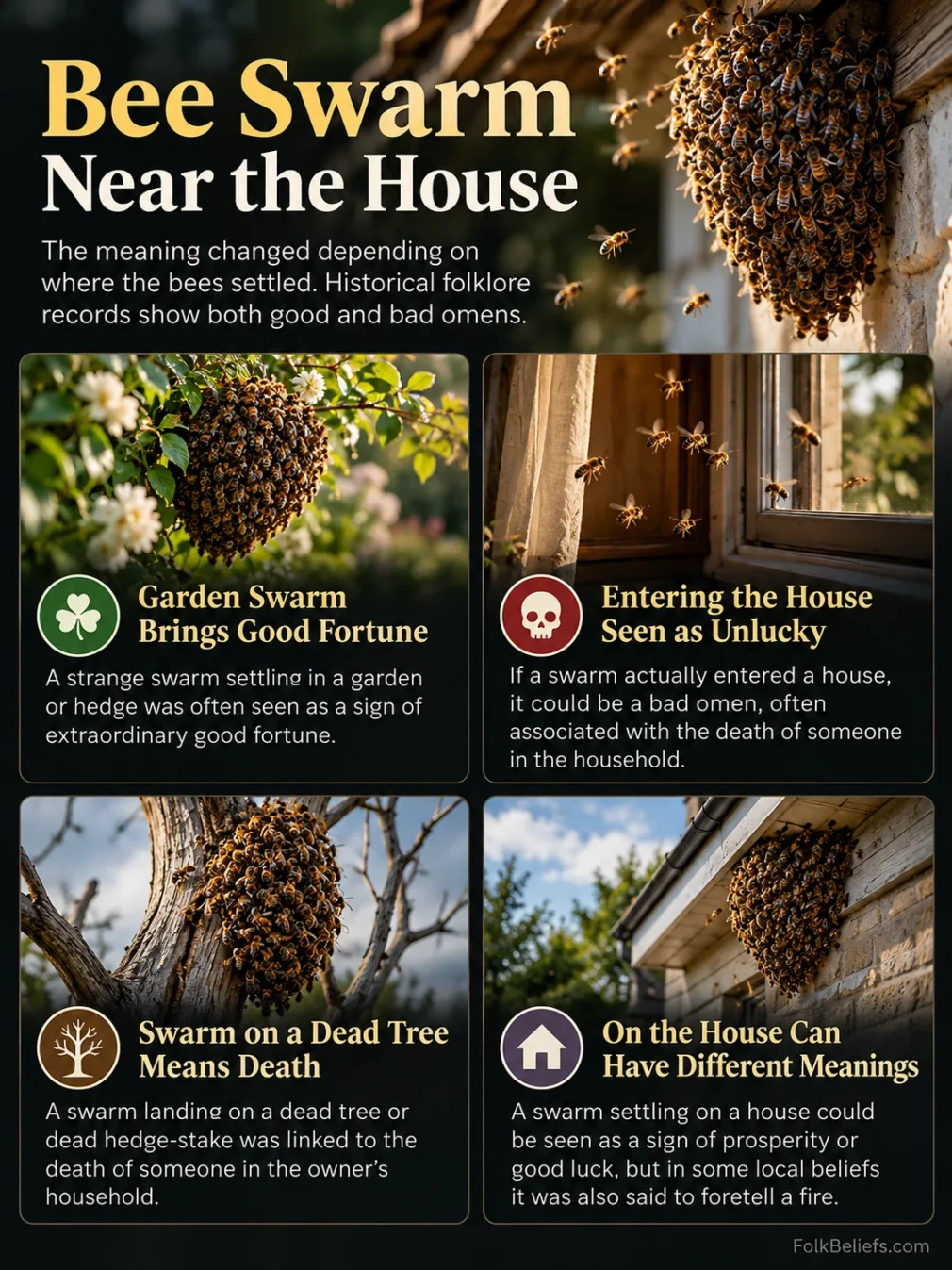
A bee swarm near a house does not have one fixed meaning in recorded folklore. The interpretation could change with only a few feet of distance. A strange swarm settling in a garden was recorded as good fortune in nineteenth-century English collections, while bees entering the house could be treated as a death omen in a Welsh record. A swarm landing on a dead tree or dead hedge-stake carried another death association.[1][2]
These beliefs are folklore records, not predictions of what will happen to a household.
When a Strange Swarm Meant Good Luck
One of the clearest favorable interpretations comes from Charlotte Latham’s collection of West Sussex beliefs. Her record says that finding a swarm in a hedge, or having a strange swarm settle in a garden, was regarded as a sign of extraordinary good fortune.[1]
William Henderson recorded a similar distinction in his collection of northern English and border folklore. A strange swarm arriving and settling in a person’s garden could bring good fortune. The same source, however, gave a very different meaning when bees chose a dead tree.[2]
This makes the older superstition more specific than the modern question, “Are bees near my house lucky?” In these records, where the swarm settled mattered.
Entering the House Could Reverse the Meaning
Elias Owen’s 1896 collection of North Welsh folklore records an unfavorable belief about a swarm that actually entered a dwelling. In that account, a swarm entering a house was considered unlucky and was associated with the death of someone living there.[3]
Marie Trevelyan’s 1909 collection shows just how easily nearby variants could conflict. She recorded a strange swarm settling on a house or entering a garden as a token of prosperity or good luck. Yet the next distinction says that strange bees entering the house itself could be followed by misfortune and death. She also noted that in some parts of Wales a swarm settling on a house was said to foretell a fire.[4]
These swarm traditions should not be confused with beliefs about a bee entering the house. A single bee flying into a room is a different encounter from a swarm arriving together. Some recorded single-bee omens predict a visitor or money, while others are unfavorable. Those interpretations belong to their own local records and cannot automatically be applied to an entire swarm.
| Where the Bees Appeared | Recorded Folklore Meaning | Recorded Setting |
|---|---|---|
| Strange swarm settling in a garden | Good fortune | West Sussex and northern English collections[1][2] |
| Swarm entering the house | Unlucky; associated with death | North Welsh and Welsh collections[3][4] |
| Swarm settling on a dead tree or dead hedge-stake | Death omen | English folklore records[2] |
| Swarm settling on the house | Prosperity in one record; fire omen in another local Welsh variant | Marie Trevelyan’s Welsh collection[4] |
The Dead Tree Was an Important Detail
The darker interpretation was not always attached to the swarm itself. Henderson wrote that a swarm landing on a dead tree was said to foretell a death in the owner’s household within a year. Latham recorded a closely related West Sussex belief involving bees swarming on a dead hedge-stake, where the event was treated as a token of death.[1][2]
That distinction helps explain why historical sources can appear to contradict each other. A healthy garden receiving a new swarm could be read as an arrival of luck, while the same insects clustering on dead wood could become a death sign. The meaning belonged to the combination of the bees, their behavior, and the place where they stopped.
Bees Were Treated as Part of the Household
Bee folklore around homes extended beyond unexpected swarms. Henderson recorded beliefs that bees had a special relationship with their owners and that they should be informed when someone in the family died. If this was neglected, the bees were sometimes expected to leave or fail to thrive. The same collection also records a belief that bees nesting in the roof of a house could affect the marriage prospects of girls born there.[2]
Welsh collections contain comparable household customs. Owen describes bees being put into mourning after a family death, while Trevelyan records the practice of telling the bees about a death and turning beehives before a funeral.[3][4]
These records help place the swarm omens in context. Bees around the home were not always treated merely as insects in older rural belief. Their arrival, departure, nesting place, and response to events in the household could all acquire different meanings.
What a Swarm Near a House Means in Practical Terms
A real honey bee swarm beside a house has a natural explanation. Honey bee colonies reproduce by swarming, and the departing group may temporarily cluster on a tree, shrub, fence, or house while scout bees search for a new nesting place. Such clusters often move on without establishing a permanent colony.[5]
This temporary gathering is different from a wasp nest on the house. A honey bee swarm forms a cluster of bees without building a nest at that temporary stopping place. Social wasps, by contrast, construct nests where their colonies live and raise young; some build papery structures beneath eaves or other sheltered parts of buildings. The insects, behavior, and associated household beliefs are different, even when both are noticed in the same garden or near the same roof.[6]
A swarm that remains in a temporary cluster should generally be left undisturbed. Iowa State University Extension advises keeping people at a safe distance and explains that the bees commonly move on after finding another nesting site. If the cluster is in a heavily used area or presents a safety concern, a local beekeeper may be able to collect and relocate it.[5]
A temporary cluster should therefore be separated from the folklore attached to it. The historical meanings above document what particular people and collectors recorded in particular places; they do not establish that a swarm predicts luck, death, fire, marriage, or any other future event.
The closest historical answer: a strange swarm merely arriving in the garden or near the home was sometimes considered lucky. If it crossed into the house, landed on dead wood, or appeared in another locally meaningful place, the omen could change completely. There was no single belief shared everywhere.
Sources and Records
- ↑1a ↑1b ↑1c ↑1d Charlotte Latham, Some West Sussex Superstitions Lingering in 1868,
- ↑2a ↑2b ↑2c ↑2d ↑2e ↑2f William Henderson, Notes on the Folk-Lore of the Northern Counties of England and the Borders,
- ↑3a ↑3b ↑3c Elias Owen, Welsh Folk-Lore: A Collection of the Folk-Tales and Legends of North Wales,
- ↑4a ↑4b ↑4c ↑4d Marie Trevelyan, Folk-lore and Folk-stories of Wales,
- ↑5a ↑5b Iowa State University Extension and Outreach, “What to Do When You See a Honey Bee Swarm”,
- ↑6 University of Minnesota Extension, “Wasps and Bees”,
Documented Locations
These labels identify where a version has been documented. They do not mean that everyone in the country, region, or community shares the belief.