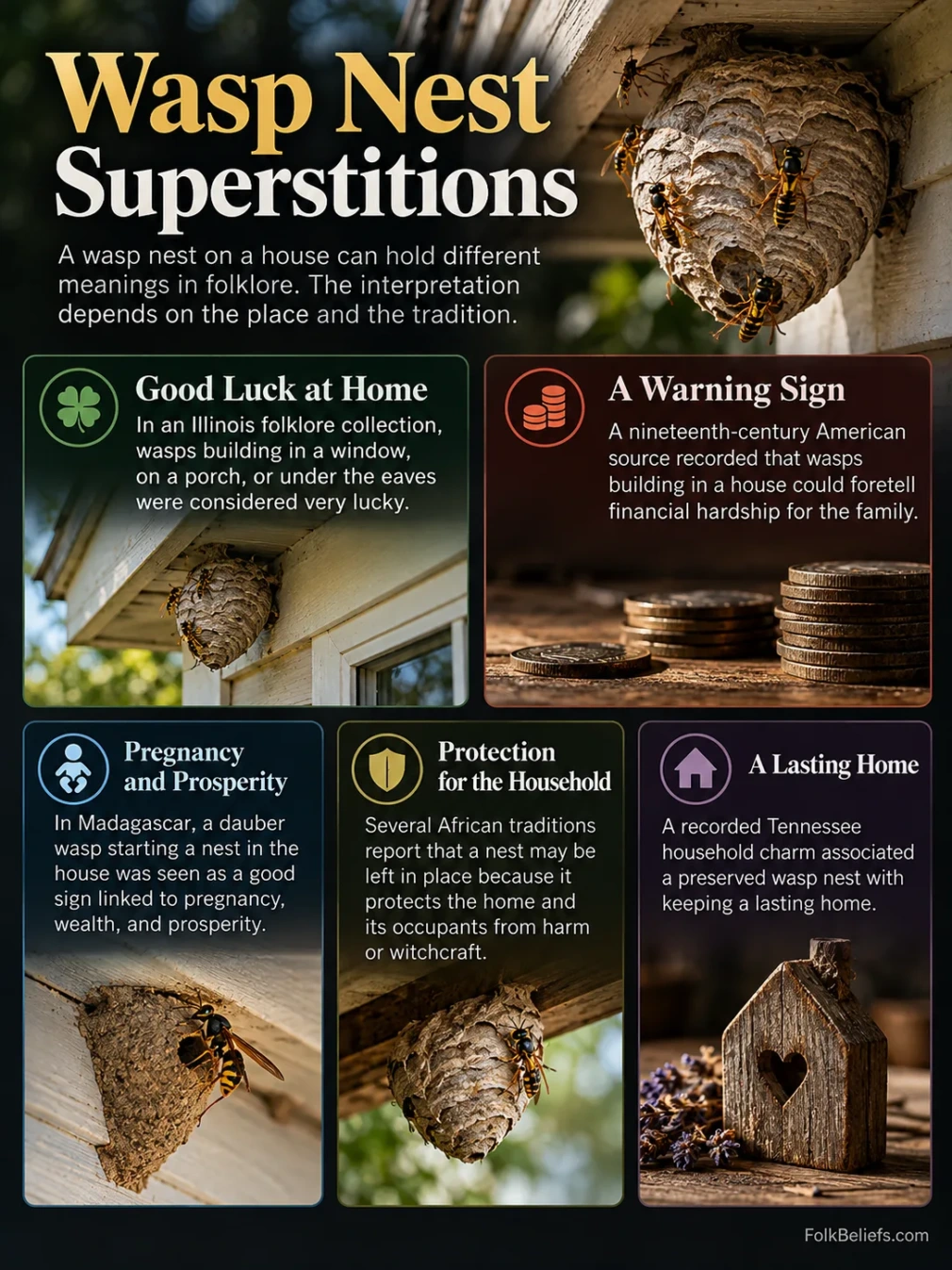
A wasp nest on a house does not have one universal folkloric meaning. In a 1935 collection from Adams County, Illinois, having wasps build in a window, on a porch, or under the eaves was recorded as very lucky.[1] Yet an earlier American book on insect lore recorded the opposite idea: wasps building in a house could foretell that the household would fall into financial need.[2] Other documented traditions connect a nest with prosperity, pregnancy, protection, or the endurance of the home.
Is a Wasp Nest on the House Good Luck or Bad Luck?
The surviving records support both interpretations. The meaning depends on the place, the community, and sometimes the exact position of the nest.
| Recorded Setting | Folkloric Meaning |
|---|---|
| Window, porch, or under the eaves in an Illinois folklore collection | Good luck |
| Wasps building inside a house in a nineteenth-century American source | Coming financial hardship |
| Dauber wasp beginning a nest inside a house in records from Madagascar | Pregnancy, prosperity, or good fortune |
| Several documented African community traditions | A nest may be left in place as protection for the household |
| A recorded Tennessee household charm | A preserved wasp nest was associated with keeping a lasting home |
These are separate folk records rather than parts of a single belief system. A lucky interpretation found in Illinois should not automatically be treated as an American rule, just as a belief recorded from particular communities in Africa should not be generalized to an entire country or continent.
Good Luck Under the Eaves in Illinois Folklore
Harry Middleton Hyatt’s Folk-lore from Adams County, Illinois, first published in 1935, contains a short group of wasp beliefs. One says that killing a wasp causes bad luck, while another describes a wasp entering the house as a good omen. Most directly related to nests, item 1402 records that it is lucky when wasps build in a window, on the porch, or beneath the eaves of the house.[1]
This record is especially useful because it names the physical locations that people still notice today. A nest attached to the exterior of the home was not presented as a warning in this collection. It was treated as a favorable household sign.
An Older Record Gives the Opposite Meaning
Frank Cowan’s 1865 Curious Facts in the History of Insects preserves several wasp superstitions that do not agree even with one another. Cowan noted beliefs about killing the first wasp of the season, being stung, and encountering the first wasp inside a house. He also recorded that wasps building in a house foretold that the occupying family would come to want.[2]
The contrast with the Illinois record matters. Folklore does not supply a stable rule that a wasp nest is always fortunate or always unfortunate. Two American sources separated by time and place preserve opposing readings.
Prosperity, Pregnancy, and Protection in Recorded African Traditions
Ethno-entomologist Arnold van Huis published a study in 2021 based on literature research and interviews conducted with more than 300 people from 27 sub-Saharan African countries. The author repeatedly identifies the particular countries and communities from which information was obtained rather than treating the material as one shared African tradition.
In Madagascar, informants described a dauber wasp starting to build its nest in the house as a good sign associated with pregnancy, wealth, and prosperity. Pregnancy was also mentioned in material from Hutu respondents in Burundi. Informants identified with Bainuk and Diola communities in Senegal, Bamileke, Bassas and Bolous communities in Cameroon, Mbochi in the Democratic Republic of the Congo, and Iraqw in Tanzania also reported beliefs that a nest could be left in the house because it protected the household or owner from harmful people or witchcraft.[3]
The same study records disagreement. Van Huis states that information from other groups was contradictory: some respondents regarded a wasp nest as a sign of prosperity and left it alone, while others removed it because they considered it a bad omen.[3]
A Wasp Nest Could Also Represent a Lasting Home
The James T. Callow Computerized Folklore Archive at the University of Detroit Mercy preserves a particularly specific household belief learned in Nashville, Tennessee, in 1973. According to the record, a person who wanted a lasting home should obtain a wasp nest, spray it with perfume, place it in a box, and store it somewhere inside the house.[4]
This is different from simply discovering an active nest under the roof. The nest has become a household object used in a deliberate charm. It shows how the symbolism of the nest could extend beyond luck and into ideas about permanence, residence, and keeping a home together.
Why the Nest’s Location Matters
Historical sources often distinguish between a nest on the house and one in the house. That difference should not be erased when interpreting the superstition.
- Under the eaves or on a porch: recorded as lucky in the Adams County, Illinois, collection.
- Inside the house: connected with hardship in Cowan’s nineteenth-century account, but with prosperity or protection in other documented traditions.
- A preserved empty nest kept indoors: used in the Tennessee record as part of a charm for a lasting home.
A single statement such as “a wasp nest means good luck” therefore hides much of the actual folklore. The surviving material is more local and more varied.
Why Wasps Actually Build on Houses
A nest on an eave, porch, roofline, shed, or other part of a building also has a straightforward biological explanation. The Natural History Museum explains that social wasps look for nesting places that are dry, safe, and able to support the nest. Human-made structures can provide exactly those conditions.[5]
The physical presence of a nest is therefore not evidence that a folkloric prediction will occur. Folklore records what people have believed or practiced; the wasps themselves choose sites according to their nesting needs.
An active nest should also be treated as an active insect colony rather than only as a symbolic object. A nest close to a doorway, window, walkway, play area, or frequently used part of the home may present a sting risk. The folklore attached to the nest does not require anyone to leave an unsafe nest undisturbed.
Sources and Records
- ↑1a ↑1b Harry Middleton Hyatt, Folk-lore from Adams County, Illinois,
- ↑2a ↑2b Frank Cowan, Curious Facts in the History of Insects; Including Spiders and Scorpions,
- ↑3a ↑3b Arnold van Huis, “Cultural aspects of ants, bees and wasps, and their products in sub-Saharan Africa”,
- ↑4 University of Detroit Mercy Libraries, James T. Callow Computerized Folklore Archive,
- ↑5 Natural History Museum, “Why do wasps build nests?”,
Documented Locations
Countries: Burundi, Cameroon, Democratic Republic of the Congo, Madagascar, Senegal, Tanzania
These labels identify where a version has been documented. They do not mean that everyone in the country, region, or community shares the belief.