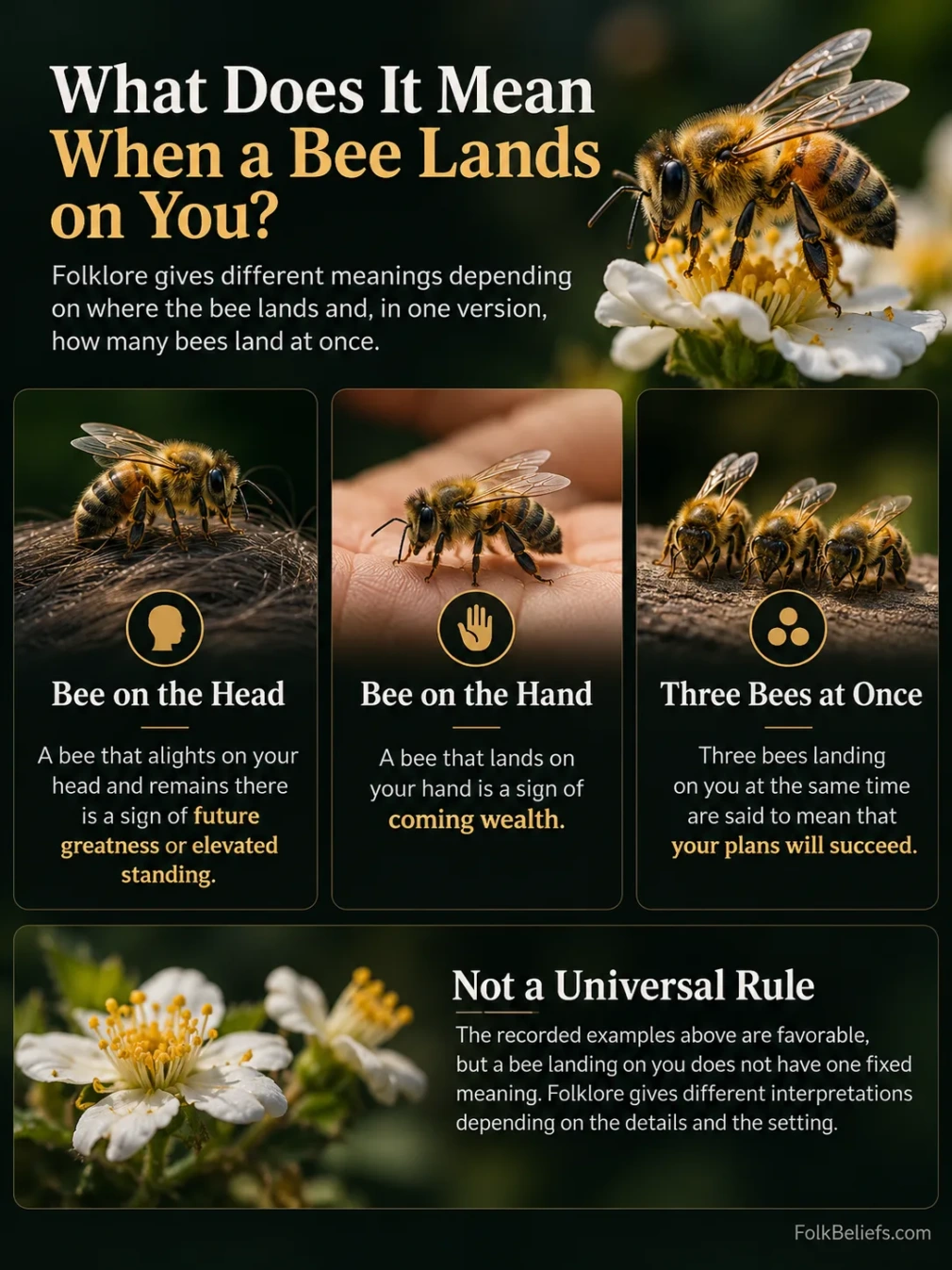
A bee landing on you does not carry one fixed superstition. Surviving folklore records give different meanings according to where the bee settles and, in one recorded version, how many bees land at once. The clearest traceable examples are favorable: future distinction when a bee stays on the head, coming wealth when one alights on the hand, and success for a person’s plans when three bees settle on them together. These are folk beliefs, not predictions about what will happen.
What Does It Mean When a Bee Lands on You?
Older records are more specific than the modern idea that any bee landing anywhere simply means “good luck.” The meaning changes with the detail of the encounter.
| Recorded Encounter | Folklore Meaning | Documented Context |
|---|---|---|
| A bee alights on the head and remains there | Future greatness or elevated standing | Recorded in Sidney Oldall Addy’s 1895 collection of traditions from York, Lincoln, Derby, and Nottingham.[1] |
| A bee alights on the hand | Coming wealth | Recorded in Iona Opie and Moira Tatem’s reference work on British and Irish superstitions.[2] |
| Three bees alight on a person at the same time | The person’s plans will succeed | Recorded in an early twentieth-century superstition collection and also in a 1925 San Jose, Batangas belief paper.[3][4] |
A Bee on the Head: A Future-Greatness Omen
One of the clearest historical records for this topic comes from folklorist Sidney Oldall Addy. In Household Tales with Other Traditional Remains (1895), a belief appears in the section on animal superstitions: if a bee settles on a person’s head and stays there, that person will later rise to greatness.[1]
The wording matters. The record is not merely about seeing a bee nearby, and it does not say that every bee encounter has this meaning. The omen depends on the bee alighting on the head and remaining there. Addy’s book collected material from several northern and Midlands counties in England, but the passage does not justify treating the belief as a rule shared by all English communities.
A Bee on the Hand: Money to Come
A different landing place carries a different omen in A Dictionary of Superstitions, edited by Iona Opie and Moira Tatem. The bee entry records the belief that a bee alighting on a person’s hand promises coming wealth.[2]
This is the source behind the familiar “bee on the hand means money” interpretation. It is better treated as a documented superstition than as a universal symbolic rule. The source preserves a traditional belief; it does not establish that every community attached the same meaning to the same event.
Three Bees Landing at Once: Success for Your Plans
Astra Cielo’s 1918 book Signs, Omens and Superstitions gives another form of the landing belief: three bees alighting on someone at the same time are said to mean that the person’s plans will meet with success.[3]
A closely matching belief was written down in San Jose, Batangas, in the Philippines, in 1925 by Agapito H. Mendoza. His paper likewise states that three bees landing on a person at the same time are a sign that the person’s plans will succeed.[4] This is a useful example of why folklore should be tied to its actual record rather than assigned broadly to an entire nation or culture.
Is a Bee Landing on You Always Good Luck?
The landing records above are favorable, but they do not prove a single universal rule. Bee folklore contains many other beliefs concerning swarms, hives, beekeepers, household events, death, visitors, and weather. Even within one collection, the meaning can change with the bee’s behavior and the setting.
Folklore distinction: “A bee landed on me” is too broad to have one historically fixed meaning. In the records cited here, the head, the hand, and three bees landing together each carry a different interpretation.
Modern Spiritual Readings and Older Bee Lore
Modern spiritual writing often gives a bee landing meanings such as encouragement, abundance, personal transformation, or a message from someone who has died. Those ideas may be meaningful within contemporary spiritual practice, but they should not automatically be presented as old folk beliefs.
Older sources do document a strong connection between bees and household death customs, especially the practice of informing the hive when a beekeeper or family member died. That is a different tradition from claiming that an ordinary bee landing on a person is itself a message from the dead.[1][3]
Why a Bee May Actually Land on Your Skin
A real bee landing on someone does not require a folkloric explanation. Some species commonly called sweat bees are attracted to human perspiration because it provides moisture and salts. The University of Florida’s entomology department notes that these bees may rest on sweaty skin and take in salt from perspiration.[5]
That biological behavior can exist alongside the superstition as a separate explanation. Folklore records what people believed an encounter meant; entomology explains why at least some bees may make the contact in the first place.
A bee landing on you can be read as an omen within a particular tradition, but the historical record does not support one meaning for every place, period, or community.
Sources and Records
- ↑1a ↑1b ↑1c Sidney Oldall Addy, Household Tales with Other Traditional Remains,
- ↑2a ↑2b Iona Opie and Moira Tatem, eds., A Dictionary of Superstitions,
- ↑3a ↑3b ↑3c Astra Cielo, Signs, Omens and Superstitions,
- ↑4a ↑4b Agapito H. Mendoza, “Beliefs in San Jose, Batangas”,
- ↑5 University of Florida IFAS Entomology and Nematology Department, “Bug of the Day: Sweat Bee”,
Documented Locations
Countries: Burkina Faso, Cameroon, Chad, Kenya, Madagascar, Mali, Mozambique, Niger, Nigeria, Rwanda, Senegal, Tanzania, Uganda, Zambia, Zimbabwe
These labels identify where a version has been documented. They do not mean that everyone in the country, region, or community shares the belief.