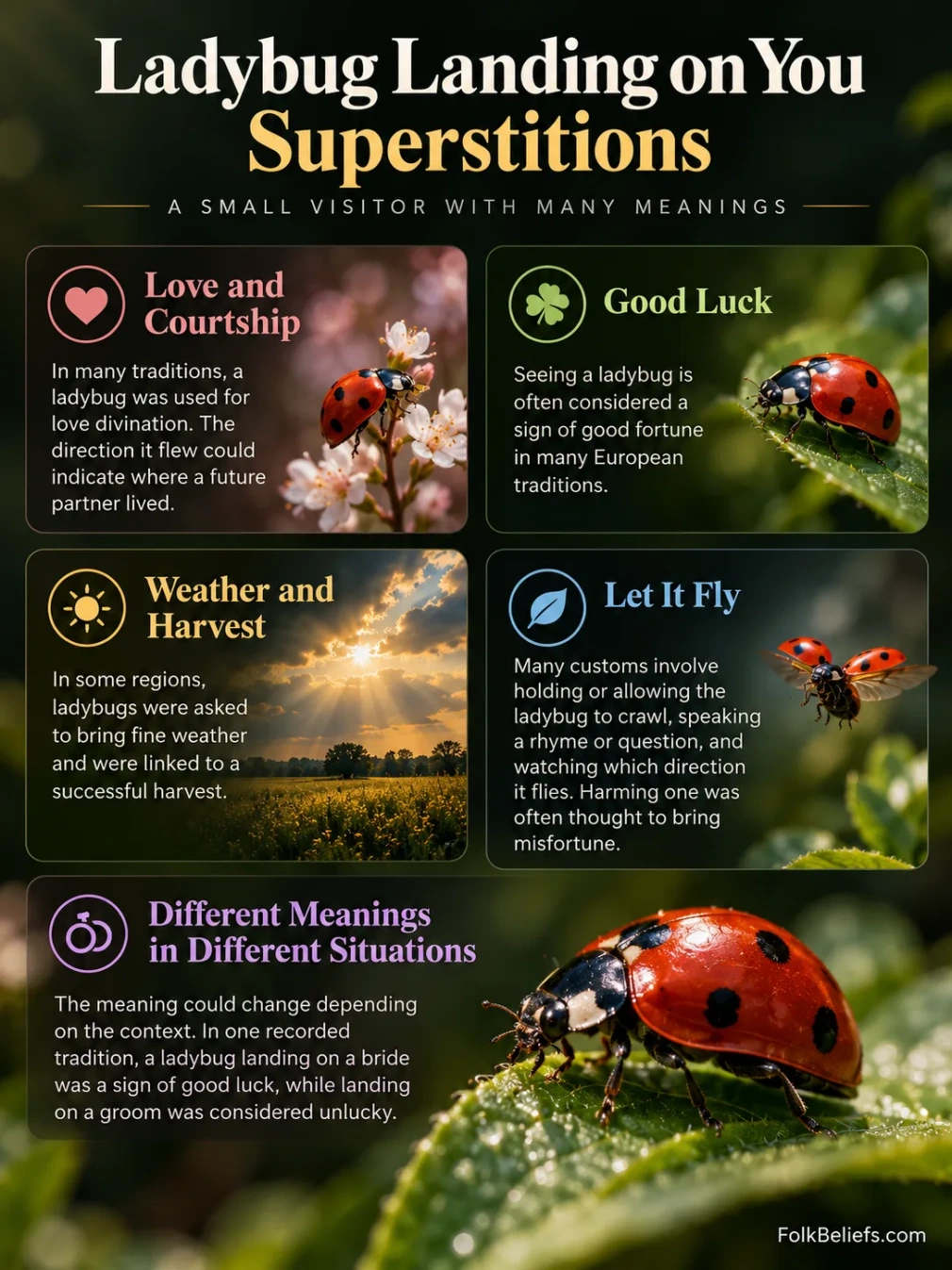
A ladybug landing on you is often described today as a sign of good luck, but older folklore records give the encounter several more specific meanings. Depending on the place and situation, the insect could be used for love divination, treated as a favorable visitor, asked to bring good weather, or allowed to fly away while its direction was watched for an omen. Historical records also show that the meaning was not identical everywhere.
What Did a Ladybug Landing on a Person Mean?
One of the clearest recorded interpretations concerns love and courtship. James Napier’s 1879 collection of beliefs from the west of Scotland describes young women holding a ladybird in their hands and asking it to fly east or west and reveal where the person they liked lived. The direction of its flight was then treated as an augury.[1]
Lina Eckenstein’s 1906 study of nursery and custom rhymes preserves related English-language examples. One rhyme asks a ladybird to fly from the person’s hand and indicate where a true love stands. Other recorded versions ask the insect to fly east, west, north, or south toward a future or desired partner.[2]
Love
The direction in which the ladybug flew could be read as a clue about a sweetheart or future partner.
Luck
Some historical collections explicitly associate seeing a ladybird with good fortune, while other records attach luck to particular situations.
Weather and Harvest
Older European records also used the ladybird in weather and agricultural divination rather than treating every encounter as a personal luck omen.
Good Luck Was Only One Part of the Tradition
Frank Cowan’s 1865 compilation of insect beliefs records several different ladybird traditions. He describes children’s rhymes in parts of Central Europe asking the insect to bring fine weather, notes a Netherlandish belief that seeing ladybirds foretold good luck, and records English fear of bringing misfortune by harming one.[3]
This makes the familiar modern phrase “a ladybug landed on me, so I will have good luck” a reasonable descendant of older favorable associations, but it should not be presented as one fixed rule shared everywhere. Historical material attaches different questions to the insect: Where is my lover? Will the weather improve? Will the harvest be plentiful? Is this encounter fortunate?
A Hungarian folklore record published in 1883 gives another useful example. It states that the ladybird was not to be killed and describes children allowing one to run over their hands before it flew away while they sang to it.[4] The hand-and-flight pattern therefore appears in more than one recorded setting, although the words and meanings attached to it differ.
Letting the Ladybug Fly Away
Many older practices focus less on the moment of landing than on what the insect does next. It is held or allowed to crawl, a rhyme or question is spoken, and its departure is watched. In the Scottish material collected by Napier, harming a ladybird was itself associated with coming calamity.[1]
This helps explain the familiar custom of leaving a ladybug alone until it flies off. However, historical records do not support turning that custom into a universal rule such as “brushing it away always causes bad luck.” The surviving evidence is local and varied, and some collections describe deliberate handling of the beetle before its release.
A Wedding Example Shows How Much the Meaning Could Change
A late-19th-century Canadian folklore collection printed in the Journal of American Folk-Lore records an especially clear contradiction. In its list of unlucky wedding omens, a ladybird landing on the groom while traveling to the wedding appears among signs of ill fortune. Yet the same collection later lists a ladybird alighting on the bride on the way to the wedding among signs of good luck.[5]
That record is a useful warning against assigning one universal meaning to every ladybug landing. Even within one collected body of folklore, the identity of the person on whom the insect landed could reverse the interpretation.
Why Is It Called a Ladybug?
The favorable reputation of the insect developed alongside religious naming traditions in Europe. The English name ladybug, like ladybird, uses “Lady” in reference to the Virgin Mary; the American form ladybug is recorded from the late 17th century, while ladybird as the beetle’s name is slightly earlier.[6]
This Marian naming background helps explain why religious language appears in some European ladybird names and rhymes. It does not, by itself, prove that every superstition about a ladybug landing on someone came from one medieval story. The documented traditions include religious imagery, children’s rhymes, weather lore, courtship divination, agricultural omens, and ordinary ideas about luck.
Do the Number of Spots Predict Your Luck?
Spot counting does appear in older folklore, but not always in the form commonly repeated online. Cowan’s 1865 collection records a northern European agricultural belief in which more than seven spots foretold expensive grain, while fewer than seven were associated with an abundant harvest and lower prices.[3]
That is different from modern claims that each spot automatically represents a year or month of personal good luck. There is also a simple biological reason not to treat spot counts as a supernatural clock. Lady beetles belong to the family Coccinellidae, which contains thousands of species, and their markings vary. The U.S. Department of Agriculture notes that about 90 percent of lady beetle species primarily feed on insects and mites such as aphids, scale insects, whiteflies, and mealybugs.[7]
Folklore meaning: A ladybug landing on you can reasonably be described as a favorable omen in many popular traditions, especially when the insect is allowed to crawl or fly away. Historical records also connect the encounter with love divination, weather, harvests, and wedding luck.
What should not be assumed: There is no single documented formula in which every landing predicts the same event, every spot equals a fixed amount of luck, or every culture interprets the insect in the same way.
These meanings belong to folklore and customary belief. A ladybug landing on a person does not scientifically predict future luck, romance, weather, or other events.
Sources and Records
- ↑1a ↑1b James Napier, Folk Lore: Superstitious Beliefs in the West of Scotland within This Century,
- ↑2 Lina Eckenstein, Comparative Studies in Nursery Rhymes,
- ↑3a ↑3b Frank Cowan, Curious Facts in the History of Insects,
- ↑4 The Folk-Lore Journal, “Magyar Folk-Lore”,
- ↑5 Journal of American Folk-Lore, “Folk-Lore Scrap-Book”,
- ↑6 Online Etymology Dictionary, “ladybug”,
- ↑7 USDA Agricultural Research Service, “Research on the Coccinellidae—Lady(bird) Beetles”,
Documented Locations
Countries: United States
These labels identify where a version has been documented. They do not mean that everyone in the country, region, or community shares the belief.