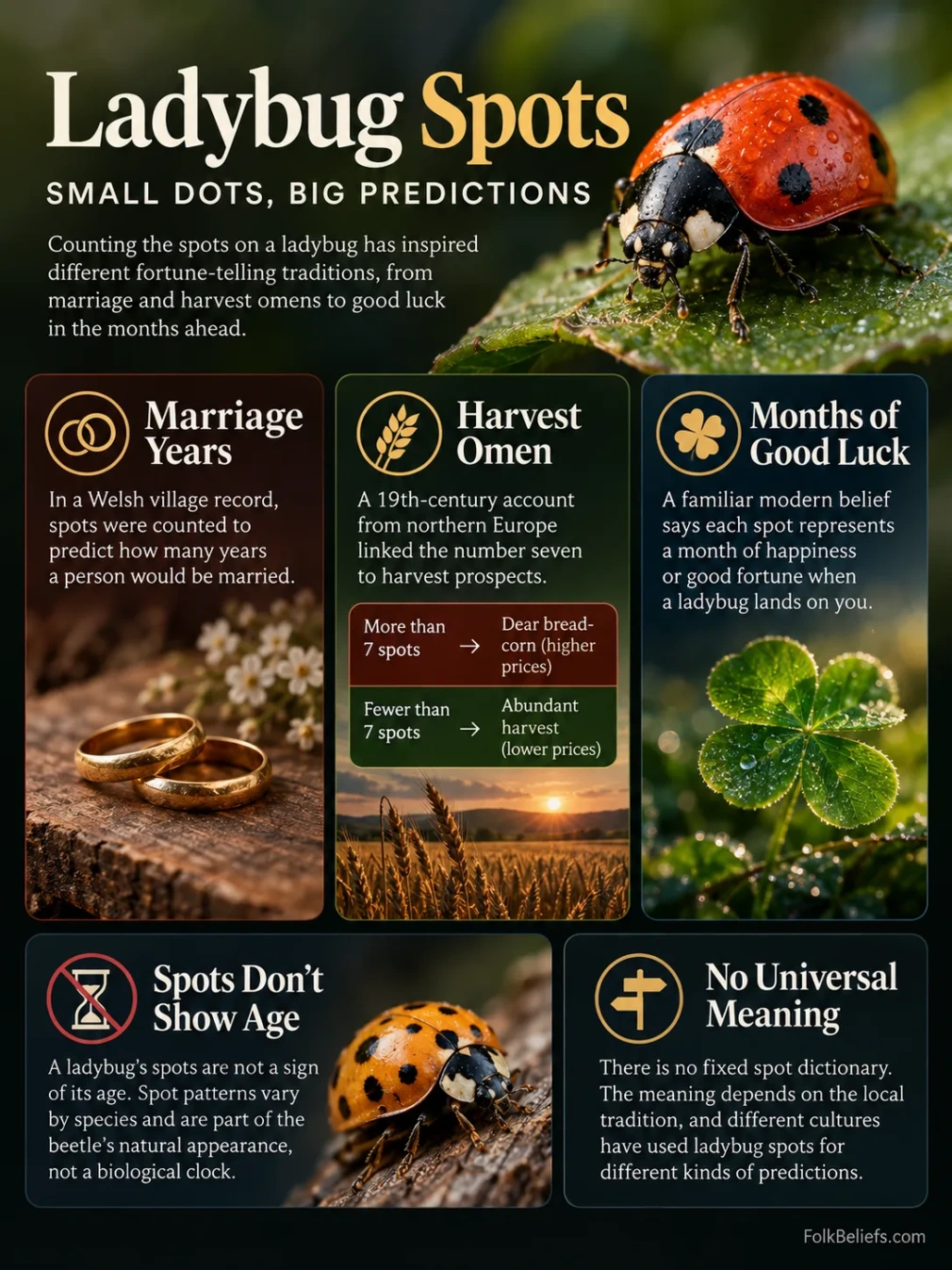
Counting the spots on a ladybug has been used for more than one kind of folk prediction. Historical records connect the count with marriage, harvest prospects, and other forms of fortune-telling, while a familiar modern version turns each spot into a period of expected good luck. These meanings do not form one universal system. Different records give the spots different jobs.
The variation matters. A spot count recorded in one Welsh village should not be treated as a rule followed throughout Britain, just as a nineteenth-century account of a northern European harvest omen does not establish what every community in that region believed.
When the Spots Counted Years of Marriage
One unusually clear record comes from Llanigon in Breconshire, Wales. In a collection published in Folklore in 1913, M. E. Hartland and E. B. Thomas reported material supplied by local informants. Anne Thomas was remembered as counting the spots on a ladybird’s back to determine how many years she should be married.[1]
This record is useful because it ties the act of counting to a named person and a particular village tradition. It does not say that ladybird spots had the same marital meaning everywhere in Wales. Even within the same short entry, another informant used the insect differently: William Thomas placed a ladybird on his hand and watched whether it flew or fell as a sign of fine weather or rain.
The ladybird therefore served as more than a general symbol of luck. Its visible features and movements could become separate tools of small-scale divination, depending on the local custom.
A Harvest Reading Based on Seven Spots
A different counting rule appeared in print several decades earlier. Frank Cowan’s 1865 Curious Facts in the History of Insects described a belief attributed to northern Europe in which the number seven acted as the dividing point. According to Cowan’s account, a ladybird with more than seven spots foretold dear bread-corn, while fewer than seven indicated an abundant harvest and lower prices.[2]
| Recorded Context | What Was Counted | Meaning Given to the Count |
|---|---|---|
| Llanigon, Breconshire; published 1913 | Spots on a ladybird | Number of years connected with marriage |
| Northern European belief described by Cowan; published 1865 | Whether the count was above or below seven | Harvest abundance and the expected price of bread-corn |
| Modern English-language telling described in 2022 | Total spots on a ladybug that lands on a person | Number of happy or lucky months ahead |
The harvest version is quite different from simply saying that “more spots mean more luck.” In Cowan’s account, a higher count could actually be the less desirable sign. That reversal shows why ladybug spot folklore cannot safely be reduced to a single numerical rule.
The Familiar “Months of Good Luck” Version
One contemporary version says that when a ladybug lands on someone, its spots can be counted to determine the number of happy or lucky months ahead. Entomologist Gene Kritsky described this spot-counting belief in a 2022 discussion of insect folklore, noting the association between a landing ladybug, good fortune, and the number of months represented by its spots.[3]
In this telling, the counting follows a ladybug landing on someone. Other landing superstitions focus on the insect’s movements, the direction in which it flies, or the person it approaches. Counting the spots is one possible response to the encounter, not a required part of every ladybug omen.
The 2022 account documents a modern popular interpretation rather than establishing the historical origin of the practice. The older Breconshire record concerns marriage years, while Cowan’s nineteenth-century account concerns harvest conditions. All three use the insect’s visible markings, but they assign different meanings to the count.
There is no fixed spot dictionary. A ladybug with five spots does not carry one documented folkloric meaning everywhere, and seven spots do not automatically promise seven months or seven years of anything. The interpretation depends on the particular tradition being followed.
Do Ladybug Spots Show the Insect’s Age?
No. The belief that a ladybug’s spot count reveals its age belongs to popular lore rather than insect biology. The U.S. National Park Service notes that ladybugs are beetles in the family Coccinellidae and occur in many colors and patterns. Their spotted outer wing covers are called elytra, and the agency specifically states that counting the spots does not tell a ladybird’s age.[4]
Entomologist M. E. N. Majerus also addresses this misconception in the opening chapter of A Natural History of Ladybird Beetles (2016). After a ladybird becomes an adult, its basic color pattern develops within about 24 hours, and the number of spots does not increase as the insect ages. The markings are part of its adult appearance rather than a record of elapsed years.[5]
This biological detail also explains a problem with treating spot counts as if every ladybug followed the same numerical scale. Different ladybug species can look very different. Some are familiar red beetles with black markings, while others have different colors, patterns, or levels of spotting. A count that people turned into an omen is therefore a human interpretation of an insect’s appearance, not a biological clock.
Why Spot Counting Works So Well as Folklore
Ladybugs offer something especially convenient for counting beliefs: the markings are visible without any special object or ceremony. A person can encounter the insect unexpectedly, count what appears on its back, and immediately turn that number into a prediction.
The resulting traditions resemble other everyday forms of folk divination in which an uncertain future is attached to something countable or observable. In the surviving ladybug records, the subject being predicted often reflects ordinary concerns: marriage, weather, crops, prices, or good fortune.
The number itself is not always the important part. Sometimes the tradition depends on whether the count falls above or below a threshold. Elsewhere each spot represents a unit of time. In still another setting, the count becomes connected with a personal future. These are related practices because they use the ladybug’s markings, but they are not interchangeable versions of one original rule.
Sources and Records
- ↑1 M. E. Hartland and E. B. Thomas, “Breconshire Village Folklore”,
- ↑2 Frank Cowan, Curious Facts in the History of Insects; Including Spiders and Scorpions,
- ↑3 Angelica Stabile, “Good luck omens! Why the praying mantis, butterfly and ladybug are thought to bring good things”,
- ↑4 U.S. National Park Service, “Ladybug”,
- ↑5 M. E. N. Majerus, “Ladybird, Ladybird…,” in A Natural History of Ladybird Beetles,
Documented Locations
Countries: United States
These labels identify where a version has been documented. They do not mean that everyone in the country, region, or community shares the belief.