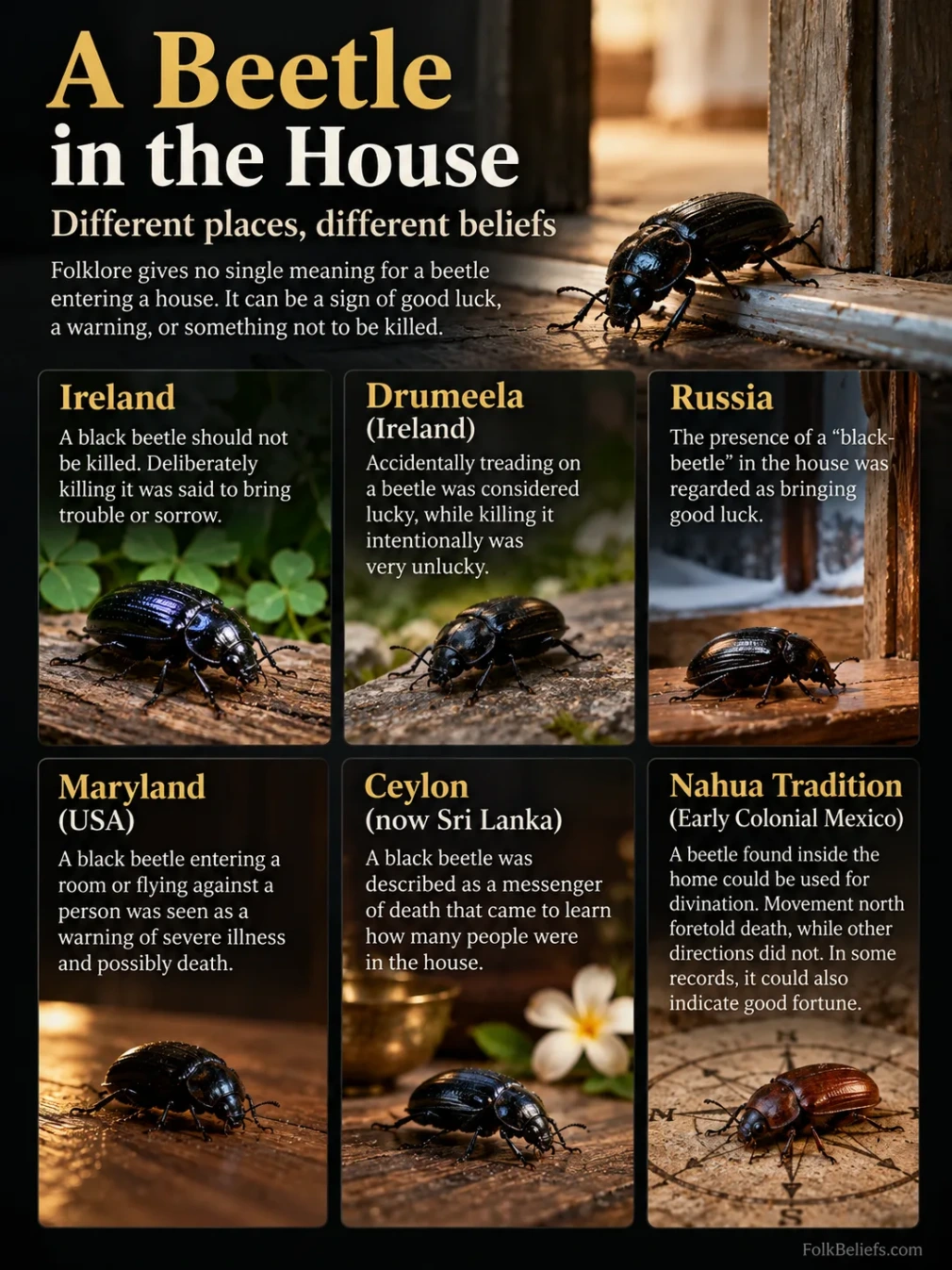
A beetle entering a house does not have one universal superstitious meaning. Surviving folklore records give sharply different interpretations: a household beetle could be treated as lucky, as something that must not be deliberately killed, as a warning of illness or death, or as an insect whose movements were used for divination. The meaning depended on the place, period, type of beetle, and what happened after it appeared.
Recorded Beliefs About Beetles Entering a House
The surviving records are more specific than the common idea that “a beetle in the house” is simply good or bad luck. In several cases, the belief concerned a black beetle; elsewhere it concerned a named or recognizable kind of beetle.
| Place or Record | Household Encounter | Recorded Meaning |
|---|---|---|
| Faythe school folklore collection, Ireland | A black beetle comes into the house | The beetle should not be killed. The record says that deliberately killing it would be followed by trouble or sorrow.[1] |
| Drumeela, County Leitrim, Ireland | A beetle comes into the house | Accidentally treading on it was recorded as lucky, while killing it deliberately was described as very unlucky.[2] |
| Russian household belief recorded in 1876 | The presence of a “black-beetle” in the house | Eugene Schuyler wrote that Russians regarded its presence as bringing good luck and described attempts to establish the insects in parts of eastern Siberia.[3] |
| Maryland belief recorded in 1865 | A black beetle enters a room or flies against a person | Frank Cowan recorded this as a warning of severe illness and possibly death, adding that he had heard the belief only in Maryland.[4] |
| Sinhalese folklore collection, Ceylon, 1917 | A black beetle appears in the household | The beetle was described as a messenger of death that came to learn how many people were in the house. The same record says it was seldom killed.[5] |
| Early-colonial Nahua tradition discussed in a 2026 study | A pinauiztli, identified as a chafer or red ox beetle, is found inside the home | The insect could be placed at the center of lines drawn toward the four directions. Movement north foretold death, while the other directions carried no such meaning. The study also notes another record in which the beetle could indicate good fortune.[6] |
Sometimes Killing the Beetle Mattered More Than Its Arrival
The two Irish records show why the action taken after the beetle appeared should not be separated from the omen itself. In the Faythe record, the black beetle entering the house is not explicitly said to bring sorrow on its own. The warning concerns killing it. The Drumeela record makes the distinction even sharper: accidental harm could be counted as lucky, while intentional killing was unlucky.
This means that a simplified statement such as “a beetle in an Irish house is bad luck” would go beyond what these local records support. They preserve beliefs from particular communities and collectors, not a rule shared by everyone in Ireland.
Good Luck and Bad Omens Could Exist Side by Side
The Russian record points in the opposite direction from the Maryland and Ceylon examples. Schuyler wrote in 1876 that the household presence of what he called the “black-beetle” was considered lucky. His wording belongs to nineteenth-century natural-history language and should not be treated as a precise modern species identification.
The Nahua material is more complex still. A beetle inside the household could become part of a directional reading rather than carrying one fixed meaning as soon as it crossed the threshold. Kelly S. McDonough’s 2026 study, drawing on early-colonial Nahuatl and Spanish sources, describes the pinauiztli as an insect whose movement could be interpreted after it was deliberately placed within a four-direction pattern. The same discussion notes that beetle encounters were not invariably ominous.[6]
It is therefore more accurate to speak of different household-beetle traditions than of a worldwide beetle omen.
Why the Death-Watch Beetle Is a Different Belief
Household beetle folklore is often mixed together with the famous death-watch tradition, but the two situations are not identical. The death-watch belief centers on a repeated clicking or tapping heard in wood, not simply on seeing a beetle walk or fly into a room.
Thomas Browne was already discussing the belief in the seventeenth century. In Pseudodoxia Epidemica, he described a clicking insect found in woodwork whose sound was interpreted as an omen that someone would die. Browne rejected the supernatural prediction and treated the noise as an ordinary insect behavior.[7]
The Natural History Museum identifies the beetle now commonly associated with this folklore as Xestobium rufovillosum. Adults produce a tapping sound on wood as a mating signal. The museum also explains why the sound became linked with death: in older houses it could be heard during quiet nighttime hours, including vigils when someone was ill.[8]
A beetle walking into a house and a death-watch tapping inside timber are separate folklore situations. A death-watch record should not automatically be used to interpret every beetle found on a floor, wall, window, or doorstep.
Does a Black Beetle in the House Mean Death?
Only in some documented traditions. The Maryland record collected by Cowan and the 1917 Sinhalese collection connect a black beetle with illness or death. The Irish records instead focus on whether the insect is deliberately killed, while the Russian record assigns good luck to its household presence.
Even within death-related traditions, the details differ. The Maryland account concerns a black beetle entering a room or striking a person. The Sinhalese record gives the beetle a messenger role. The Nahua pinauiztli could indicate death only after a directional divination in which movement toward the north supplied the relevant reading. Combining these into a single “black beetle means death” rule would erase the differences between the records.
Does a Beetle in the House Mean Good Luck?
There is evidence for that interpretation too. Schuyler’s nineteenth-century account explicitly describes household “black-beetles” as lucky in a Russian setting. The Nahua material discussed by McDonough also preserves a favorable interpretation alongside the divinatory one.
That does not make good luck the universal opposite of the death omen. Folk beliefs often vary from one locality to another, and the same broad category of animal can acquire very different meanings.
What About Scarabs, Rebirth, and Transformation?
Modern explanations of beetles in the house often connect any beetle encounter with Ancient Egyptian scarab symbolism. There is a real historical basis for the sacred status of scarabs, but the household claim needs more care.
The Natural History Museum describes the ancient Egyptian association between scarab beetles and Khepri, the deity connected with the morning sun. Scarabs appeared in Egyptian art, jewellery, religious imagery, and other material contexts.[8] That evidence supports scarab symbolism. It does not by itself establish a traditional rule that a live beetle unexpectedly entering someone’s house was a message of rebirth, personal transformation, or an approaching life change.
For a household-beetle belief, evidence that actually describes a beetle entering or appearing inside a dwelling is stronger than transferring the wider symbolism of scarabs to every indoor beetle encounter.
Why the Kind of Beetle and the Exact Encounter Matter
Historical records use terms such as “black beetle,” “death-watch,” and pinauiztli, but these labels do not all refer to the same insect. Some beliefs also depend on behavior rather than appearance: entering a room, flying against someone, making a tapping noise, being deliberately killed, or moving in a particular direction can change the recorded interpretation.
- Entering the house: can be lucky, unlucky, or only become meaningful after another action.
- Being deliberately killed: is the central unlucky act in some Irish records.
- Flying against a person: appears in Cowan’s Maryland death-omen record.
- Tapping from wood: belongs to the death-watch tradition rather than a general house-entry belief.
- Moving in a chosen direction: forms part of the documented Nahua pinauiztli divination.
These records document what particular people and communities were reported to believe. They do not show that a beetle predicts luck, illness, death, or future events. A beetle entering a home can have an ordinary biological explanation even when the encounter also has a place in local folklore.
Sources and Records
- ↑1 National Folklore Collection, UCD, “Common Beliefs,” Faythe, The Schools’ Collection,
- ↑2 National Folklore Collection, UCD, “Omens and Superstitions Gathered from Pupils of Drumeela”,
- ↑3 Eugene Schuyler, Turkistan: Notes of a Journey in Russian Turkistan, Khokand, Bukhara, and Kuldja, Volume II,
- ↑4 Frank Cowan, Curious Facts in the History of Insects; Including Spiders and Scorpions,
- ↑5 Arthur A. Perera, Sinhalese Folklore Notes: Ceylon,
- ↑6a ↑6b Kelly S. McDonough, “What ‘Counts’ as Reliable Data? Nahua Science and the Tlapohualiztli (Reading) of Earth and Sky”,
- ↑7 Thomas Browne, Pseudodoxia Epidemica, Book II, Chapter VII, “Of some Insects, and the properties of several Plants”,
- ↑8a ↑8b Natural History Museum, London, “Interesting Beetles: Omens, Ornaments and Obsession”,
Documented Locations
These labels identify where a version has been documented. They do not mean that everyone in the country, region, or community shares the belief.