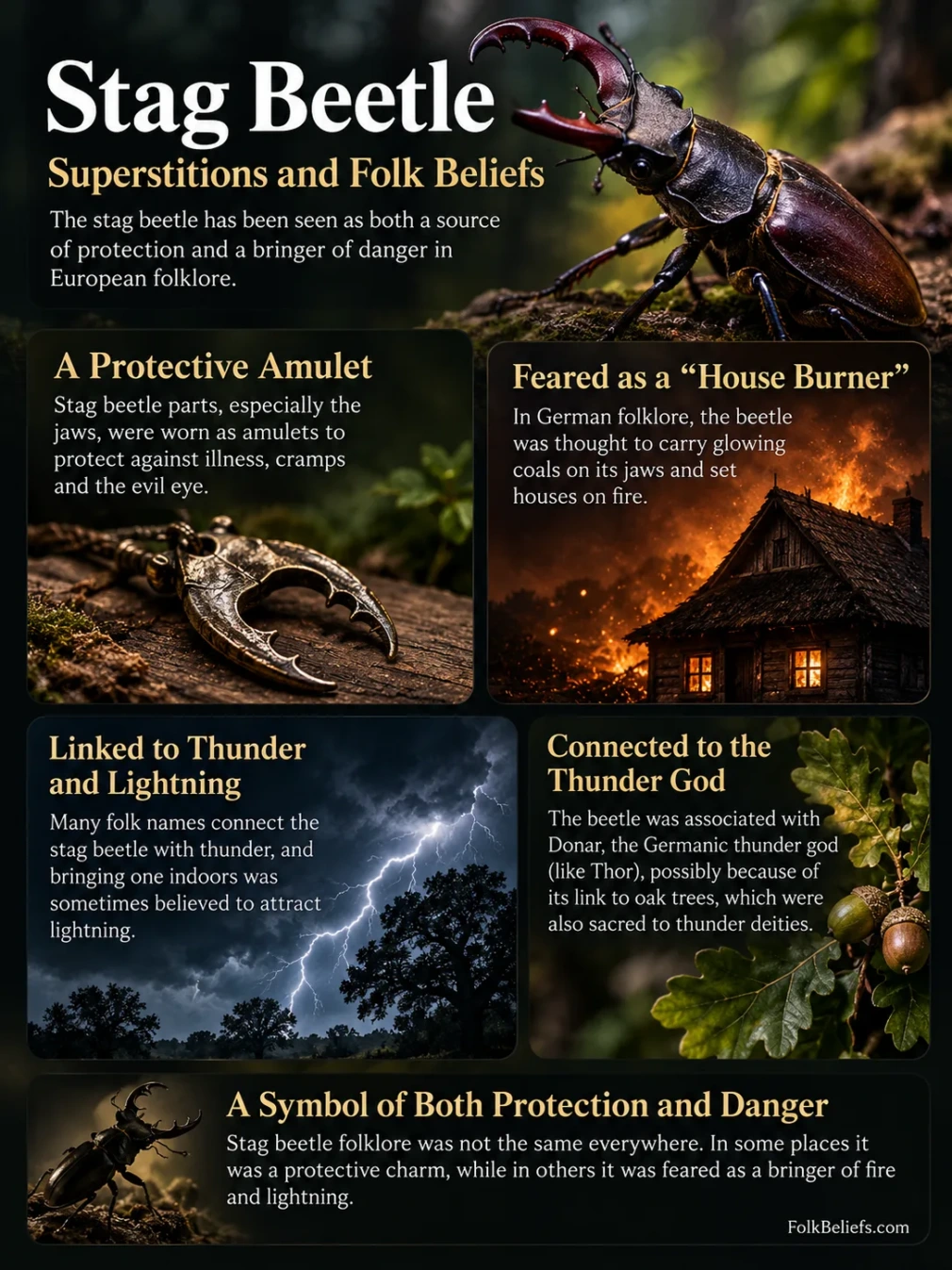
Stag beetle folklore does not point to one universal meaning. Historical records about the European stag beetle, Lucanus cervus, place it on both sides of supernatural danger: the insect or its parts could serve as a protective amulet in one setting, while elsewhere the beetle was blamed for attracting lightning or carrying fire into houses.
The best-documented beliefs come from European written sources. They belong to particular periods and places, so a German fire belief or a French protective custom should not be treated as something believed throughout Europe.
Protective Amulets: Illness, Cramps, and the Evil Eye
One of the oldest written references appears in Pliny the Elder’s Natural History. In Book XI, Pliny describes a large horned beetle whose jaws form pincers and says that these beetles were hung around the necks of infants as a remedy against certain illnesses. He adds that Nigidius called them lucani. The passage is commonly identified with the stag beetle tradition.[1]
This use as an amulet continued in several later European records, although the claimed purpose changed by place and period. Eva Sprecher-Uebersax’s study of stag beetles in European art and mythology records stag beetle pincers worn in Austria’s Vorarlberg region against cramps. It also describes Ferrante Imperato’s account of a stag beetle mounted in gold or silver and worn for pain and leg cramps.[2]
These are records of historical folk medicine and protective belief. They are not evidence that stag beetles or their body parts can prevent or treat illness.
A different protective use was recorded in the Vosges region. There, a stag beetle head worn on a hat was said to protect the wearer from lightning and the evil eye.[2] This is especially notable because other European traditions treated the same insect as something that attracted lightning rather than repelled it.
The Stag Beetle as a “House Burner”
German folk names preserve a much less protective image. Jacob Grimm recorded names including Feuerschröter, associated with fire, and Hausbrenner, literally “house burner.” He also recorded the belief that the beetle carried glowing coals on its horns or jaws into roofs and set buildings alight.[3]
The belief fits the exaggerated appearance of the male stag beetle, whose enlarged mandibles look capable of gripping and transporting objects. The folklore should not be confused with the insect’s actual behavior. Stag beetles do not carry burning coals into roofs.
In this tradition, bringing the beetle indoors could also have supernatural consequences. Grimm records a belief that lightning would strike a house into which a stag beetle had been carried.[3] The insect therefore became associated with two household dangers that were closely linked in everyday experience: lightning and fire.
Why Was the Stag Beetle Linked with Thunder?
Several old German names connect Lucanus cervus directly with thunder. Grimm gives forms such as Donnergueg, Donnerguge, and Donnerpuppe. Later accounts also record Donnerschröter, usually rendered as “thunder beetle” or “thunder spreader.”
This vocabulary helped produce a connection between the stag beetle and Donar, the Germanic thunder god corresponding to Thor. The Natural History Museum in London also notes this association and points to the beetle’s relationship with oak woodland. Oak had its own long-standing associations with thunder deities, while stag beetle larvae develop in decaying wood and are often linked with old broadleaved trees.[4]
The surviving evidence needs careful wording. Folk names and recorded lightning beliefs are well documented. A claim that every stag beetle tradition descended directly from an ancient cult of Thor goes beyond what those records alone can establish. Sprecher-Uebersax likewise presents the Donar connection as an interpretation attached to the thunder and oak traditions rather than as a single uniform belief shared across German-speaking Europe.[2]
Protection and Danger Could Exist Side by Side
Stag beetle folklore is a good example of how folk belief does not always follow a single logical rule. In one location, contact with the beetle could supposedly invite lightning into a house. In another, wearing part of the beetle was supposed to guard a person from lightning.
The apparent contradiction is part of the record: the stag beetle could be treated as a bearer of dangerous forces and also as a talisman against those same forces. The meaning depended on the local custom, the use being made of the insect, and the source recording it.
That distinction matters when modern descriptions call the stag beetle simply a symbol of “luck,” “protection,” or “bad luck.” Historical sources support all of those directions only in specific contexts. They do not support one fixed spiritual meaning for every sighting of a stag beetle.
Storm Beliefs Survived in British Accounts
British wildlife sources also preserve the beetle’s older association with threatening weather. The New Forest National Park Authority records a European folk belief in which stag beetles were connected with bad luck and were thought to summon thunderstorms.[5]
Such records are better read as evidence for the persistence of storm lore than as proof of a single British rule about what seeing a stag beetle meant. Local names, oral traditions, antiquarian collections, and later natural-history writing often preserve different pieces of the tradition.
What Does Seeing a Stag Beetle Mean in Folklore?
There is no historically supported universal omen for encountering one. Depending on the documented tradition, a stag beetle could be associated with:
- protection from illness through an amulet recorded in classical writing;
- relief from cramps or pain in later European folk practice;
- protection from lightning or the evil eye in the Vosges tradition;
- house fires through the German belief that the beetle carried glowing coals;
- lightning entering a house if the beetle was brought indoors;
- thunder and storm forces, reflected in old names connected with thunder.
Modern claims that a stag beetle appearing at a window predicts money, romance, death, or a precise future event should therefore be separated from the older records unless a source documents that particular interpretation. The historical material is more local, more varied, and often more contradictory.
Sources and Records
- ↑1 Pliny the Elder, Natural History, Book XI, Chapter 34,
- ↑2a ↑2b ↑2c Eva Sprecher-Uebersax, “The Stag Beetle Lucanus cervus (Coleoptera, Lucanidae) in Art and Mythology”,
- ↑3a ↑3b Jacob Grimm, Deutsche Mythologie, Chapter VIII: Donar,
- ↑4 Natural History Museum, London, “Interesting Beetles: Omens, Ornaments and Obsession”,
- ↑5 New Forest National Park Authority, “Stag Beetle”,