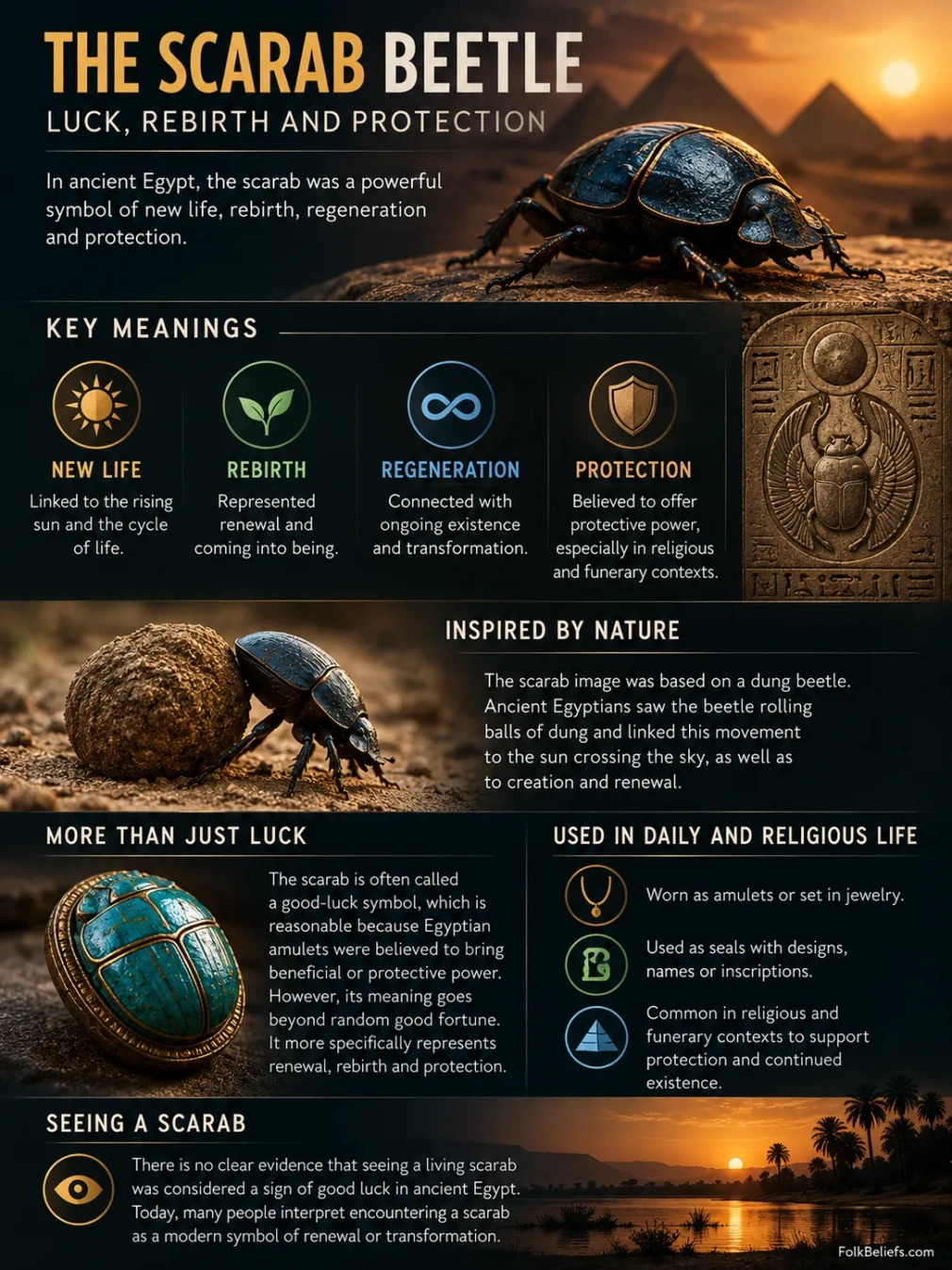
A scarab beetle is often described as an Egyptian good-luck symbol, but the documented belief is more specific. Ancient Egyptian scarab amulets were strongly connected with new life, rebirth, regeneration, and protection. British Museum educational material places the scarab among Egyptian “good luck amulets” while identifying its particular meaning as new life and rebirth.[1]
For that reason, calling the scarab “lucky” is reasonable as a broad description, but it can hide the more specific ideas behind the symbol. The scarab was not simply an ancient equivalent of a charm promising random good fortune.
Why the Scarab Became a Positive Symbol
The Egyptian scarab image was based on a dung beetle. Ancient Egyptians observed beetles moving balls of dung and connected that movement with the sun crossing the sky. They also associated the appearance of beetles from the ground or dung balls with spontaneous creation and renewal.
These ideas linked the scarab with the rising sun and with the Egyptian concept expressed by kheper, relating to becoming or coming into being. The result was a symbol closely associated with renewal, regeneration, and rebirth.[2]
| Association | What the Historical Evidence Supports |
|---|---|
| Good luck | A useful broad description for the beneficial role of Egyptian amulets, including scarabs. |
| Rebirth | One of the clearest and most consistently documented scarab meanings. |
| Regeneration | Connected with the beetle, the rising sun, and renewed existence. |
| Protection | Scarab amulets could carry protective power, especially in religious and funerary settings. |
| Becoming or renewal | Related to Egyptian word associations surrounding the scarab and the idea of coming into being. |
Was the Scarab Really a Lucky Charm?
In a broad sense, yes. An amulet could be worn because people believed it offered beneficial or protective power. UCL’s Digital Egypt resource describes Egyptian amulets as objects worn for protection through their religious associations and notes that their meaning could vary according to the object, user, and circumstances.[3]
That makes the modern phrase “good-luck charm” understandable, but “luck” should not be treated as the scarab’s only meaning. A person wearing a scarab could be invoking protection, renewal, divine associations, or continued existence rather than hoping for an unpredictable lucky event.
Protection Was Different From Random Fortune
Some scarab imagery directly emphasized protection. A New Kingdom scarab in the Metropolitan Museum of Art, for example, depicts winged beetles. The museum explains that the wings strengthen the beetle’s protective meaning because enclosing wings were themselves a protective motif in Egyptian art. The same object also connects scarab imagery with creation and rebirth.[4]
This distinction matters when interpreting scarab luck beliefs. Protection from harm and the hope for renewed life are positive outcomes, but they are more precise than saying that the beetle simply “brings luck.”
Does Seeing a Scarab Beetle Mean Good Luck?
The surviving museum and Egyptological evidence used here focuses on scarab-shaped amulets, seals, religious symbolism, jewelry, and funerary objects. It does not establish a general ancient Egyptian rule that unexpectedly seeing a living scarab meant good fortune was about to arrive.
Claims such as “a scarab crossing your path means money is coming” or “seeing a scarab predicts success” therefore need a separate source from a specific folk tradition. They should not automatically be presented as ancient Egyptian beliefs.
A safer historical interpretation is that encountering a scarab can be given a modern symbolic meaning of renewal or transformation because of the beetle’s older associations. That personal interpretation is different from documenting an ancient omen.
Scarabs Could Be Worn, Carried, and Used as Seals
Scarab amulets became extremely common in Egypt. Some examples were incorporated into rings or other jewelry, while many had flat undersides carrying designs, names, signs, or inscriptions. Scarabs could serve as both amulets and seals, so two objects that look similar today did not necessarily have exactly the same use.
The Metropolitan Museum records scarab amulets over a long span of Egyptian history and notes their use as seals as well as amulets during the Middle and New Kingdoms. Their lasting popularity reflects the flexibility of the symbol rather than a single fixed luck formula.[2]
Heart Scarabs Had a Special Funerary Role
A heart scarab should not be treated as ordinary lucky jewelry. UCL’s Digital Egypt records heart scarabs from the mid-Thirteenth Dynasty onward and notes that they became common in elite New Kingdom burials and later periods. Their undersides were often inscribed with Chapter 30 of the Book of the Dead.[5]
Their presence shows why scarab meanings have to be read in context. A small wearable scarab, a seal, a winged funerary scarab, and a heart scarab could share imagery while serving different purposes.
What a Scarab Amulet Can Historically Represent
When scarab jewelry or a scarab charm is described today using meanings drawn from ancient Egyptian evidence, the strongest associations are:
- Rebirth — renewed existence and the return of life.
- Regeneration — becoming renewed rather than remaining unchanged.
- Protection — an amuletic function found in Egyptian religious practice.
- Creation and becoming — connected with the scarab’s Egyptian linguistic and religious associations.
- The rising sun — linked with the daily renewal of the sun and the deity Khepri.
These meanings explain why the scarab later fits so easily into the broader category of a lucky or beneficial charm. They also provide a firmer historical basis than modern claims about attracting wealth, winning games, granting wishes, or guaranteeing success.
Claims About Scarab Luck That Need Caution
- “Every scarab brings good luck.” Ancient scarab objects had different forms, inscriptions, settings, and functions.
- “Seeing a living scarab predicts good fortune.” The Egyptian evidence discussed here concerns symbolism and amuletic objects rather than a general sighting omen.
- “Scarabs were mainly money charms.” Rebirth, regeneration, protection, and solar symbolism are much better documented than a specific association with financial gain.
- “All scarabs meant exactly the same thing.” Their function could change according to object type and context, especially between everyday amulets, seals, and funerary scarabs.
For a historically grounded reading, a scarab worn as a “lucky” symbol is best understood as a charm of beneficial renewal and protection. The familiar language of good luck captures part of that idea, while rebirth, regeneration, and coming into being preserve more of the meaning documented in ancient Egyptian material.
Sources and Records
Documented Locations
These labels identify where a version has been documented. They do not mean that everyone in the country, region, or community shares the belief.