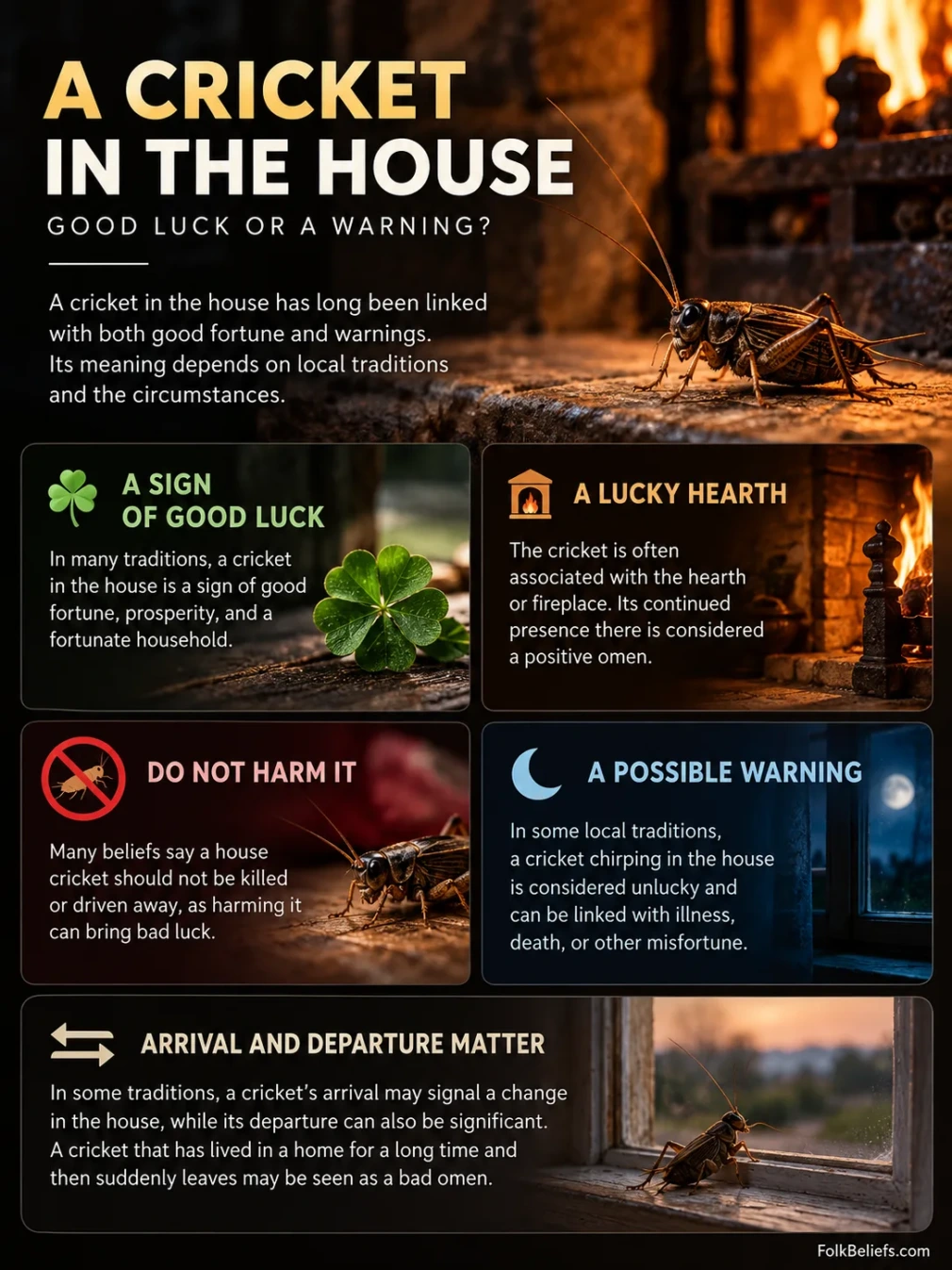
A cricket inside the house is often described as a good-luck visitor, especially when it settles near the hearth. Historical folklore, however, does not give the insect one fixed meaning. American records preserve beliefs that a house cricket brings good fortune and should not be harmed, while records from Britain and Ireland also include warnings about crickets arriving, leaving, or chirping under particular circumstances.[1][2]
Why a Cricket in the House Can Mean Good Luck
The lucky interpretation is well documented in North American folklore collections. Records held by the University of Detroit Mercy include statements such as a cricket in the house bringing good luck, a cricket on the hearth being lucky, and advice to leave the insect where it is rather than remove or kill it.[1]
The hearth matters in many versions of the belief. Before central heating, the fireplace was one of the warmest and most continuously occupied parts of a home. A cricket living there could become a familiar household presence rather than a brief visitor. Folklore consequently attached meanings not only to seeing the insect, but also to whether it stayed, sang, disappeared, or was harmed.
Good Fortune
A cricket living indoors may be interpreted as a sign of luck, prosperity, or a fortunate household.
A Lucky Hearth
Some recorded versions specifically place the cricket at the hearth or fireplace, making its continued presence part of the omen.
Do Not Harm It
Several traditions connect the lucky cricket with a warning that killing or harming it can bring bad luck.
Why Killing a House Cricket Is Said to Be Unlucky
The belief that a cricket should not be killed appears alongside the good-luck interpretation in both older and later records. One University of Detroit Mercy entry states that harming a cricket will be followed by bad luck while also describing a cricket in the house as a good-luck sign.[3]
An 1865 compilation by Frank Cowan likewise described the house cricket as an insect that could be considered lucky and noted the belief that destroying crickets brought misfortune. Cowan also preserved an explanation that treated killing the insect as a kind of violation of hospitality because it had taken refuge in the home.[4]
This does not amount to a universal folklore rule. It is better understood as a recurring pattern: where the resident cricket represents household luck, harming the cricket can be interpreted as harming or driving away that luck.
Not Every House Cricket Was a Good Omen
Older records show that cricket beliefs could reverse completely from one locality to another. A house cricket might be welcomed in one tradition while its unexpected appearance or unusual chirping could be treated as a warning elsewhere.
A record in the National Folklore Collection of Ireland, collected through the Schools’ Collection, states that a cricket chirping in the house was considered unlucky and was associated locally with an impending death.[5] This is a local recorded belief, not evidence that Irish folklore as a whole assigned crickets the same meaning.
Another Schools’ Collection record from County Cavan gives a different interpretation. It says that crickets were associated with a change in the house: their arrival marked one change, while their departure marked another. The same record also preserves a warning against killing a cricket.[2]
Arrival and Departure Could Matter More Than the Cricket Itself
Some older British material distinguishes between a cricket that has lived peacefully in a home for a long period and a sudden change in that pattern. Cowan recorded a Dumfriesshire belief that when crickets deserted a house they had long inhabited, misfortune could follow, sometimes interpreted as a death in the family. Their presence or return, by contrast, could be considered fortunate.[4]
This produces an important distinction within cricket folklore:
- A resident cricket: often treated as lucky or welcome.
- A cricket suddenly leaving: sometimes interpreted as a warning.
- A cricket unexpectedly appearing: lucky in some records, ominous in others.
- Unusual chirping: capable of carrying a separate meaning in local traditions.
- Killing the cricket: repeatedly recorded as unlucky where the insect is regarded as a fortunate household presence.
The Cricket’s Song Could Carry Its Own Meaning
The sound of a cricket made it especially noticeable inside a quiet house. Nineteenth-century folklore writing describes the cricket’s song as connected with both favorable and unfavorable predictions. T. F. Thiselton Dyer wrote that crickets in a house were commonly associated with cheerfulness and plenty, but he also collected literary and folk references in which cricket sounds accompanied ideas of death or approaching trouble.[6]
The contrast matters because it shows why a simple statement such as “a cricket means good luck” loses part of the historical picture. In some traditions the insect’s ordinary presence was welcome, while an alteration in its behavior carried the omen. In others, the chirping itself was the warning.
The folklore meaning depends on the recorded context. A cricket in the house has been associated with good luck, household prosperity, change, misfortune, and death omens in different collections. These meanings should not be combined into a single universal belief or treated as predictions of real events.
How the Main Recorded Variants Differ
| Recorded Situation | Folklore Interpretation | Documented Context |
|---|---|---|
| Cricket living in the house | Good luck | Multiple U.S. folklore records |
| Cricket on the hearth | Good luck; should not be killed | U.S. folklore records and older British material |
| Killing or harming a cricket | Bad luck | Recorded in American and British folklore sources |
| Crickets leaving a long-inhabited house | Misfortune or death omen | Recorded Dumfriesshire/British tradition |
| Cricket chirping indoors | Death omen in one local record | Schools’ Collection, Ireland |
| Crickets arriving or departing | A change in the household | County Cavan Schools’ Collection record |
For someone encountering the superstition today, the historically supported answer is therefore conditional. A cricket in the house is often a good-luck sign, but the meaning changes by locality and by what the cricket is doing. The hearth cricket that remains quietly in the home is commonly the lucky version. Sudden arrival, sudden departure, unusual chirping, or killing the insect can carry very different meanings in particular recorded traditions.
Sources and Records
- ↑1a ↑1b University of Detroit Mercy Libraries, James T. Callow Computerized Folklore Archive,
- ↑2a ↑2b National Folklore Collection, UCD, “Superstitions about Crickets,” The Schools’ Collection,
- ↑3 University of Detroit Mercy Libraries, James T. Callow Folklore Archive, “Harm a Cricket, Bad Luck Will Follow”,
- ↑4a ↑4b Frank Cowan, Curious Facts in the History of Insects; Including Spiders and Scorpions,
- ↑5 National Folklore Collection, UCD, “Pagan Customs – Pisreoga,” The Schools’ Collection,
- ↑6 T. F. Thiselton Dyer, Folk-lore of Shakespeare,
Documented Locations
Countries: Argentina, Bahamas, Barbados, Chile, Italy, United States
These labels identify where a version has been documented. They do not mean that everyone in the country, region, or community shares the belief.