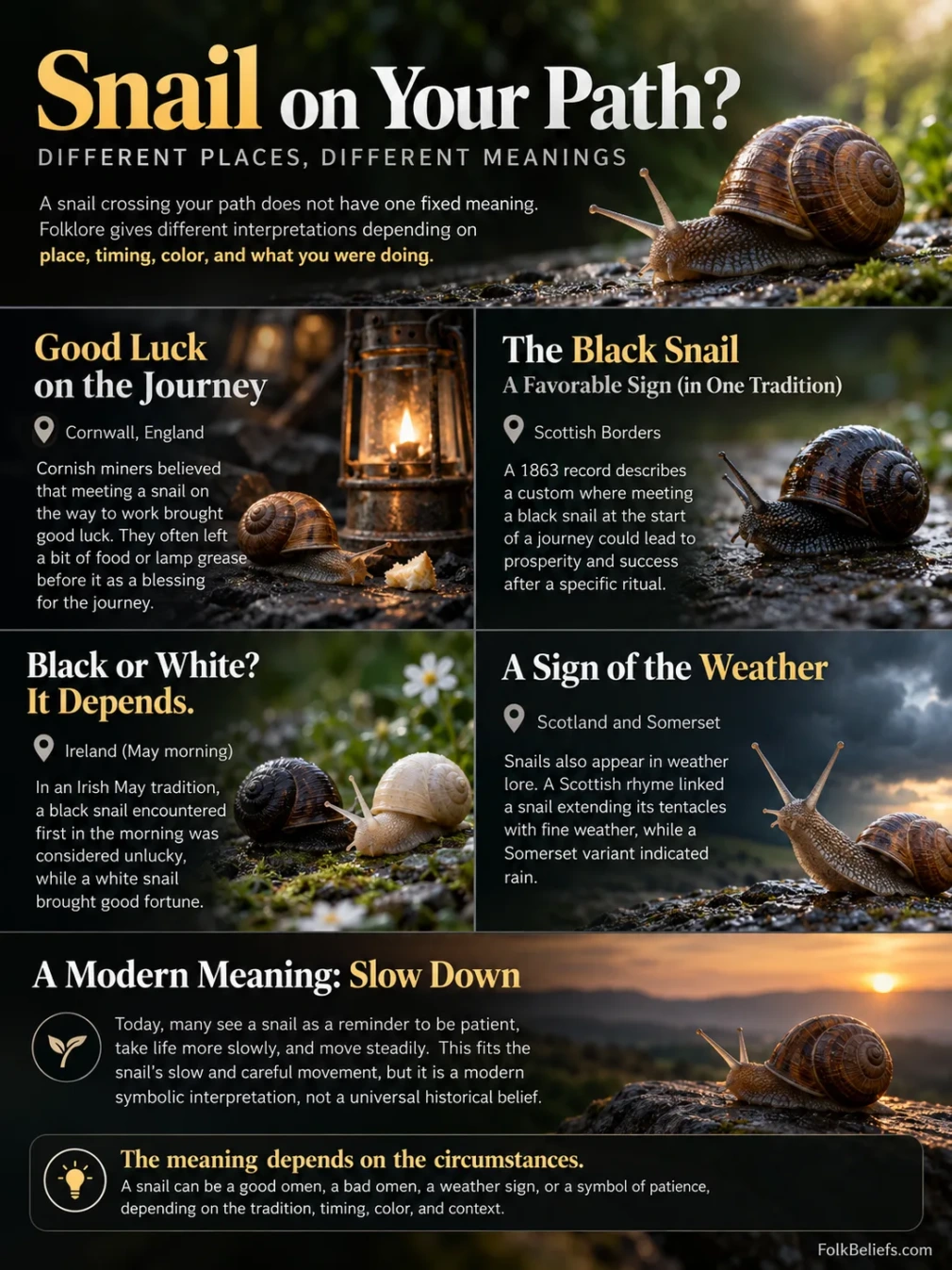
A snail crossing your path does not have one fixed traditional meaning. Recorded folklore gives the encounter different meanings depending on place, timing, color, and what the person was doing. In some Cornish and Scottish records, meeting a snail on the way somewhere was connected with good luck. An Irish May-morning tradition could treat a black snail as unlucky and a white snail as fortunate. Scottish snail rhymes also linked the animal with weather prediction.
The familiar modern idea that a snail tells you to “slow down” fits the animal’s appearance and movement, but it should not be treated as the universal historical meaning of a snail crossing the road or path.
Recorded Snail Encounters and Their Meanings
| Recorded Setting | Encounter | Folklore Meaning |
|---|---|---|
| Cornwall, England | Miners met a snail while going to work | The encounter was associated with good luck; a small portion of food or lamp grease was traditionally left before the snail.[1] |
| Scottish Borders | A black snail was met at the beginning of a journey | An 1863 record describes a customary response intended to make the journey prosper.[2] |
| Ireland, May morning | A black or white snail was the first snail encountered | Lady Wilde recorded the black snail as unlucky in this particular setting, while a white snail brought good fortune.[3] |
| Scotland | A snail extended its tentacles after being addressed in a rhyme | The response could be read as a sign of fine weather.[4] |
These records are not interchangeable. A belief documented among Cornish miners does not establish a rule for all of Cornwall, and a May-morning belief recorded in Ireland does not mean every Irish snail encounter was considered unlucky or lucky.
When a Snail on the Path Was Considered Lucky
One of the clearest path-related records comes from nineteenth-century Cornwall. Margaret Ann Courtney wrote that miners called snails bullhorns. When miners encountered one while going to work, they left a little of their dinner or some grease from a lantern before it for good luck. Courtney also recorded a broader Cornish saying that associated the presence of snails with blessing or luck in the home.[1]
The important detail is the setting. This was not simply “any snail crossing anyone’s path.” Courtney described a custom attached to miners travelling to work. The encounter and the journey belonged together.
Evidence note: Historical records often say that someone “met” a snail on a path or journey. That wording should not automatically be expanded into a belief about every snail that physically crawls across a person’s route.
The Black Snail at the Start of a Journey
A Scottish Borders record printed in the Kelso Chronicle in 1863 gives another journey-related belief. It says that meeting a black snail when setting out could be followed by a customary act intended to secure prosperity on the journey and success in its purpose.[2]
This makes the black snail favorable within that particular record, but only after the prescribed response. It also shows why color alone cannot determine the meaning of a snail omen. Another collection gives black and white snails very different roles.
Black and White Snails in an Irish May Tradition
Lady Wilde recorded several May divination customs in Ireland. One involved looking at snail trails before sunrise and interpreting a mark in the trail as the initial of a future lover. In the same passage, she wrote that a black snail encountered first in the morning was considered unlucky, while a white snail was associated with good fortune.[3]
The timing matters here. This was part of a cluster of May-morning beliefs and divinations rather than a general rule that a dark snail is always a bad omen. It also differs sharply from the Scottish Borders record, where a black snail encountered at the beginning of a journey could become part of a good-luck custom.
So is a black snail lucky or unlucky? Historical folklore supports both answers in different settings. The Scottish Borders journey record is favorable; Lady Wilde’s May-morning record is unfavorable. Neither should be turned into a universal rule.
Snails as Weather Signs
Not every snail encountered outdoors was interpreted as a personal omen. Snails also appear in British weather lore. A Scottish rhyme asked a snail to extend its “horns” and indicate whether the following day would be fine. A Somerset variant instead called for rain.[4]
There is a simple reason snails and wet weather are easily associated in everyday observation. The Natural History Museum notes that snails and slugs need moist conditions and are especially likely to be seen when it is raining.[5] That biological behavior helps explain why encounters with snails can become attached to weather lore, but it does not make the traditional rhymes literal forecasting methods.
Does a Snail Crossing Your Path Mean “Slow Down”?
Patience, steady movement, and taking life slowly are common ways to interpret the snail today. There is an older literary parallel for that symbolism. John Bunyan’s seventeenth-century poem Upon the Snail describes the snail as moving softly yet surely and uses its pace as a moral image of steady progress.[4]
That does not establish an old folk belief that a snail crossing the road means “slow down.” Bunyan’s poem is literary symbolism, while the path and journey records above concern particular regional customs. A modern reader may still choose to see a slowly moving snail as a reminder of patience, but that is better described as a personal or modern symbolic reading rather than a universal traditional superstition.
Is Seeing a Snail Good Luck or Bad Luck?
The documented answer depends on the tradition:
- Good luck: Cornish records connect snails with luck, including a custom among miners who encountered one on their way to work.
- Journey luck: A Scottish Borders record gives a favorable outcome to a ritual connected with meeting a black snail when setting out.
- Bad luck in a narrow setting: Lady Wilde recorded a black snail as unlucky when encountered first on a May morning.
- Good fortune in the same Irish record: a white snail carried the opposite meaning.
- Weather: Scottish and Somerset rhymes treated snail behavior as a sign connected with fine weather or rain rather than personal fortune.
A snail crossing a path therefore cannot be classified simply as a good omen or a bad omen without knowing which tradition is being referenced. The circumstances are part of the belief.
These meanings belong to recorded folklore and historical custom. They are not evidence that a snail can predict future events, relationships, luck, or weather.
Sources and Records
- ↑1a ↑1b Margaret Ann Courtney, Cornish Feasts and Folk-lore,
- ↑2a ↑2b J. G. S., “Random Notes Anent the Antiquities, Traditions, Superstitions, and Old Manners and Customs of the Borders — VIII. Omens, or Freits”,
- ↑3a ↑3b Lady Jane Wilde, Ancient Legends, Mystic Charms, and Superstitions of Ireland, “The May Festival”,
- ↑4a ↑4b ↑4c A. E. Ellis, “The Snail in Nursery Rhymes”,
- ↑5 Beth Askham, “For the Love of Snails and Slugs”,