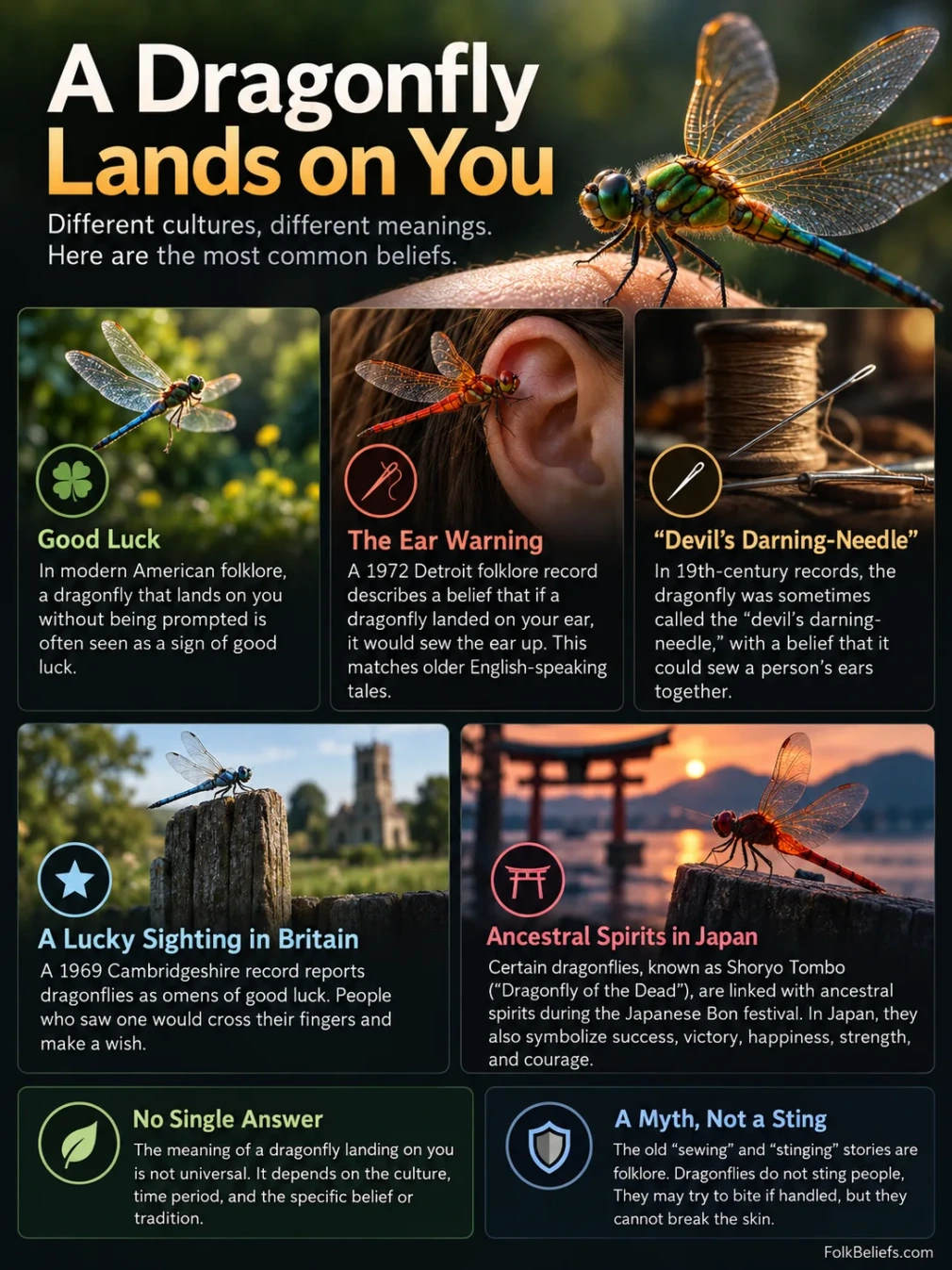
A dragonfly landing on you does not have one fixed meaning in folklore. The interpretation changes with place, period, and the exact version of the belief. Modern American popular lore often treats an unprompted landing as lucky, while older English-speaking records include the much less friendly idea that a dragonfly could “sew” a person’s ears or mouth. Japanese material adds another association: certain dragonflies have been linked with ancestral spirits, but that tradition is not the same as saying every dragonfly that lands on someone is a personal message from the dead.
Recorded Meanings of a Dragonfly Landing on You
Good Luck in Modern American Popular Lore
The Old Farmer’s Almanac states that many Americans regard a dragonfly landing on a person without prompting as good luck. This records a current popular belief, but it should not be stretched into a rule shared by every community or every period of American folklore.[1]
A Landing on the Ear in a Detroit Folklore Record
The James T. Callow Folklore Archive at the University of Detroit Mercy preserves a belief learned in Detroit and dated February 15, 1972: if a dragonfly landed on a person’s ear, it would sew the ear up. The collector noted that the informant had been told the tale as a child and had once thought it was probably true.[2]
The Older “Darning Needle” Fear
The Detroit record belongs to a wider English-speaking tradition. In 1886, folklorist Fanny D. Bergen described the child-name “devil’s darning-needle” and reported a belief from parts of eastern Massachusetts that the dragonfly could sew a person’s ears together if given the chance.[3]
A Lucky Sighting in Cambridgeshire
Not all older British material was fearful. A 1986 note in the Journal of the British Dragonfly Society, citing a 1969 Cambridgeshire record, reports that dragonflies were treated there as omens of good luck; a person who saw one was said to cross their fingers and make a wish. This record concerns seeing a dragonfly rather than being landed on, so it supports a regional lucky association without creating a separate landing rule.[4]
Japanese Ancestral Associations
The Minneapolis Institute of Art describes Shoryo Tombo, the “Dragonfly of the Dead,” in connection with the Japanese Bon festival. In the tradition summarized by the museum, these dragonflies carry spirits of the dead back to their families during the period when ancestors are honored. The same museum resource also notes wider Japanese associations with success, victory, happiness, strength, and courage.[5]
Is a Dragonfly Landing on You a Good or Bad Omen?
There is no single folklore answer. A person using the modern American good-luck version may read the landing positively. Someone raised with the older “darning needle” story might remember it as a warning, especially if the insect comes close to the face or ears. A Japanese ancestral association belongs to a different cultural setting again.
The safest folklore reading is local, not universal. A documented belief should stay attached to the community, record, or tradition that actually supports it. A lucky American landing belief, a Detroit childhood warning, and a Japanese Bon association are related because they concern dragonflies, but they are not interchangeable versions of one worldwide superstition.
Does a Landing Mean a Deceased Loved One Is Visiting?
Some present-day spiritual interpretations describe a dragonfly as a visitor or message from someone who has died. Japanese dragonfly tradition provides a documented connection between certain dragonflies and returning ancestral spirits during Bon. It does not, however, state that every dragonfly landing on an individual is a deceased relative making personal contact. That stronger interpretation goes beyond what the museum record supports.[5]
Does the Landing Place or Color Change the Meaning?
The ear is the clearest body-part example in the archival material used here. The reviewed records do not provide comparable historical rules for a dragonfly landing on the hand, shoulder, head, or chest. They also do not establish a stable color code in which blue, green, red, or black dragonflies carry fixed meanings when they land on a person.
Color and body-location interpretations may still appear in newer spiritual systems, family traditions, or personal belief. They should be identified that way rather than presented as old or universal folklore without a named record behind them.
The old sewing and stinging stories are folklore, not zoology. The British Dragonfly Society states that dragonflies do not sting people. Large dragonflies held in the hand may try to bite, but the society notes that they fail to break the skin; the insect’s egg-laying structure is not used as a stinger.[6]
Sources and Records
- ↑1 George and Becky Lohmiller, “Facts About Dragonflies and Damselflies: Symbolic Meaning, Life Cycle, Habitat, and More!”,
- ↑2 University of Detroit Mercy Libraries, James T. Callow Folklore Archive, “A Belief”,
- ↑3 Fanny D. Bergen, “Animal and Plant Lore I”,
- ↑4 D. A. Sheppard, “Notes on the Folklore of Dragonflies”,
- ↑5a ↑5b Minneapolis Institute of Art, “Insects in Art”,
- ↑6 British Dragonfly Society, “Frequently Asked Questions”,