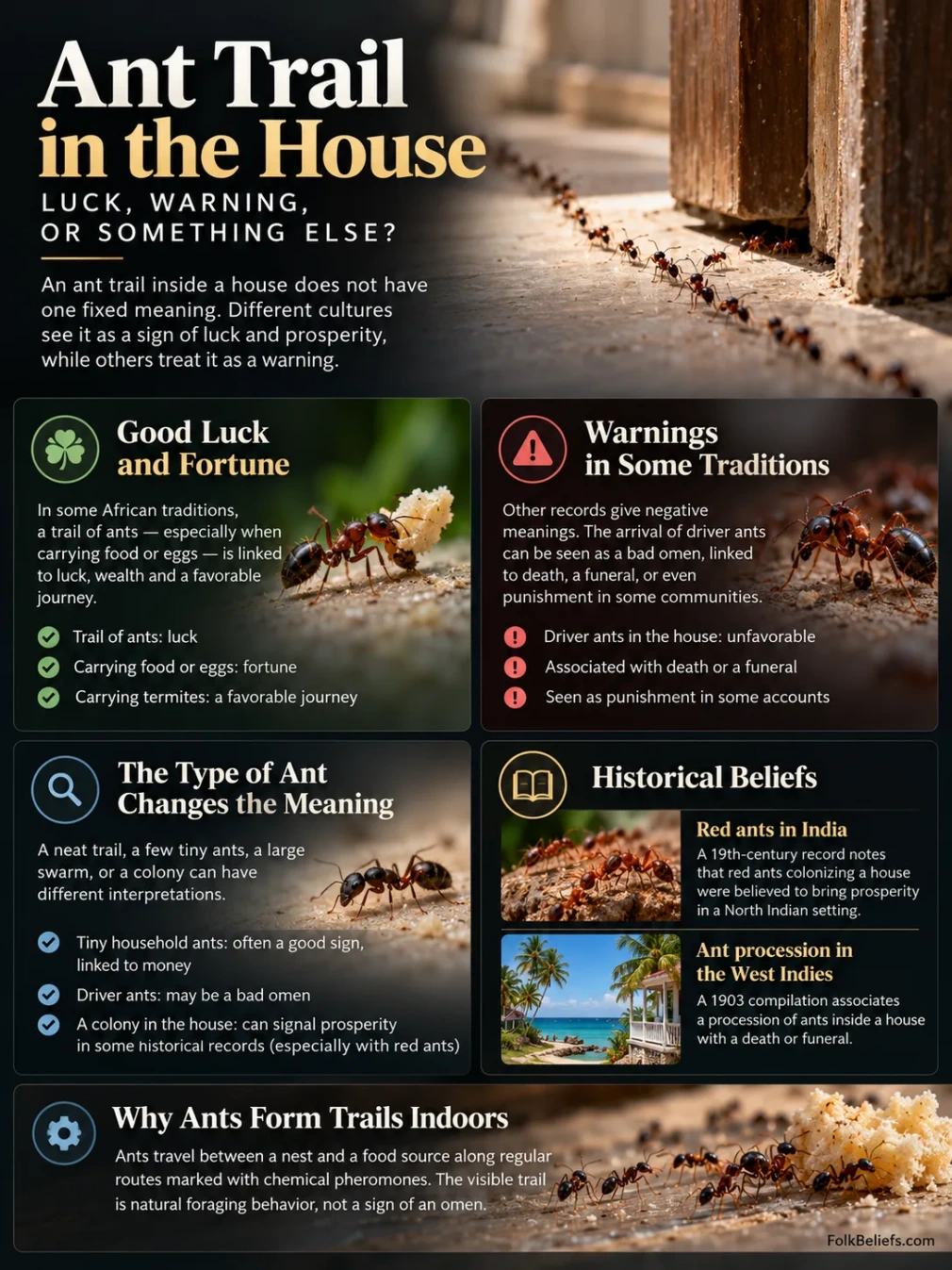
An ant trail inside a house does not have one fixed superstition. Documented beliefs give it several meanings. A moving line of ants can be associated with luck or material fortune in some traditions, while the arrival of particular kinds of ants can be treated as a warning elsewhere. Older records also distinguish between ants passing through a home, carrying food, and forming a colony there.
Is an Ant Trail in the House Good or Bad Luck?
For an actual trail of moving ants, some of the clearest comparative evidence comes from an ethno-entomological study published in 2021. The study records a favorable reading among Chaga informants in Tanzania, where encountering an ant trail could be associated with luck. Other recorded traditions paid attention to what the ants were carrying: food or eggs could turn the trail into a sign of fortune in accounts from several named communities in Chad, Tanzania, Togo, Zambia, and Zimbabwe.[1]
| Recorded Setting | Ant Activity | Folklore Meaning |
|---|---|---|
| Chaga, Tanzania | Encountering a trail of ants | Luck |
| Goulaye, Chad; Iraqw, Tanzania; Akebu and Cotocoli, Togo; several named Zambian communities; Shona, Zimbabwe | Ants in a trail carrying food or eggs | Fortune |
| Tiv, Nigeria | An ant trail in which the ants are carrying termites | A favorable journey |
These records belong to the communities and informants identified by the source. They should not be expanded into national rules for Tanzania, Nigeria, Zambia, or any of the other countries named.
The Type of Ant Activity Changes the Meaning
A neat trail, a few tiny ants, a large moving swarm, and a colony established inside a building are not interchangeable in folklore. The same 2021 study illustrates this clearly. Tiny ants appearing in a house were described as a good sign, often connected with money, in records involving Bariba and Nagot informants in Benin, Ngambaye in Chad, Songhai in Mali, and Yoruba in Nigeria. A Fon record from Benin instead links ants in the house with twins and protection of the household.
The study also preserves opposite readings. Driver ants coming to a house could be regarded as unfavorable in a Yoruba record from Nigeria, while accounts associated their arrival with a family death among Busoga, Ganda, and Nyoro informants in Uganda and Lozi informants in Zambia. A Luo record from Kenya interpreted such an arrival as punishment.[1]
This contrast matters when interpreting a search for an “ant trail superstition.” A belief about an orderly trail of foraging ants cannot automatically be applied to a mass arrival of driver ants, and neither should be treated as a rule for every household in the same country.
A Historical Prosperity Belief About Red Ants
One older South Asian record gives a favorable meaning to ants establishing themselves around a home. In Observations on the Mussulmauns of India, first published in 1832, Meer Hassan Ali wrote that she had seen Hindu men and women leave small portions of sugar near ants’ nests as an act of charity. She also recorded an opinion in her North Indian setting that prosperity attended a house where red ants colonized.[2]
The record is useful because it is dated and describes something the author said she observed and heard during her residence in India. It does not show that every Indian community shared the interpretation then, or that the belief has the same meaning in households today.
A Different Historical Reading in the West Indies
Not every historical account treats an indoor procession of ants favorably. A 1903 folklore compilation records a West Indian belief in which a procession of ants inside a house was associated with a death or funeral.[3]
This is a period compilation rather than evidence of a uniform West Indian custom. The geographical label covers many islands and communities, and the entry does not establish how broadly the belief was held. It is best read as a preserved historical variant, not as a general Caribbean rule.
Why There Is No Universal Meaning
Recorded ant beliefs depend on details that simplified superstition lists often remove:
- Movement: a trail may carry a different meaning from a swarm entering a house.
- What the ants carry: food, eggs, or termites can affect the interpretation in particular records.
- Ant type: small household ants and driver ants are treated differently in some traditions.
- Location: a belief documented among one community does not automatically describe neighboring communities.
- Period: an nineteenth- or early twentieth-century record documents a belief at that time; it does not prove current practice.
For that reason, claims such as “ants in the house always mean money” or “an ant trail always predicts bad luck” go beyond the surviving evidence. Both favorable and unfavorable interpretations are documented.
Why Ants Actually Form Trails Indoors
Outside folklore, the visible line has an ordinary biological explanation. Ants commonly travel between a nest and a food source along regular routes marked with chemical pheromones. University of Minnesota Extension notes that following these routes can even help locate where the ants are nesting or entering a building.[4]
An indoor ant trail therefore shows ant foraging behavior, not evidence that an omen is causing future events. The luck, money, protection, journey, or warning meanings belong to the cultural interpretation placed on that everyday behavior.
Sources and Records
- ↑1a ↑1b Arnold van Huis, “Cultural aspects of ants, bees and wasps, and their products in sub-Saharan Africa”,
- ↑2 Meer Hassan Ali, Observations on the Mussulmauns of India,
- ↑3 Cora Linn Daniels and C. M. Stevans, eds., Encyclopaedia of Superstitions, Folklore, and the Occult Sciences of the World, Volume II,
- ↑4 University of Minnesota Extension, “Ants”,
Documented Locations
Countries: Benin
These labels identify where a version has been documented. They do not mean that everyone in the country, region, or community shares the belief.