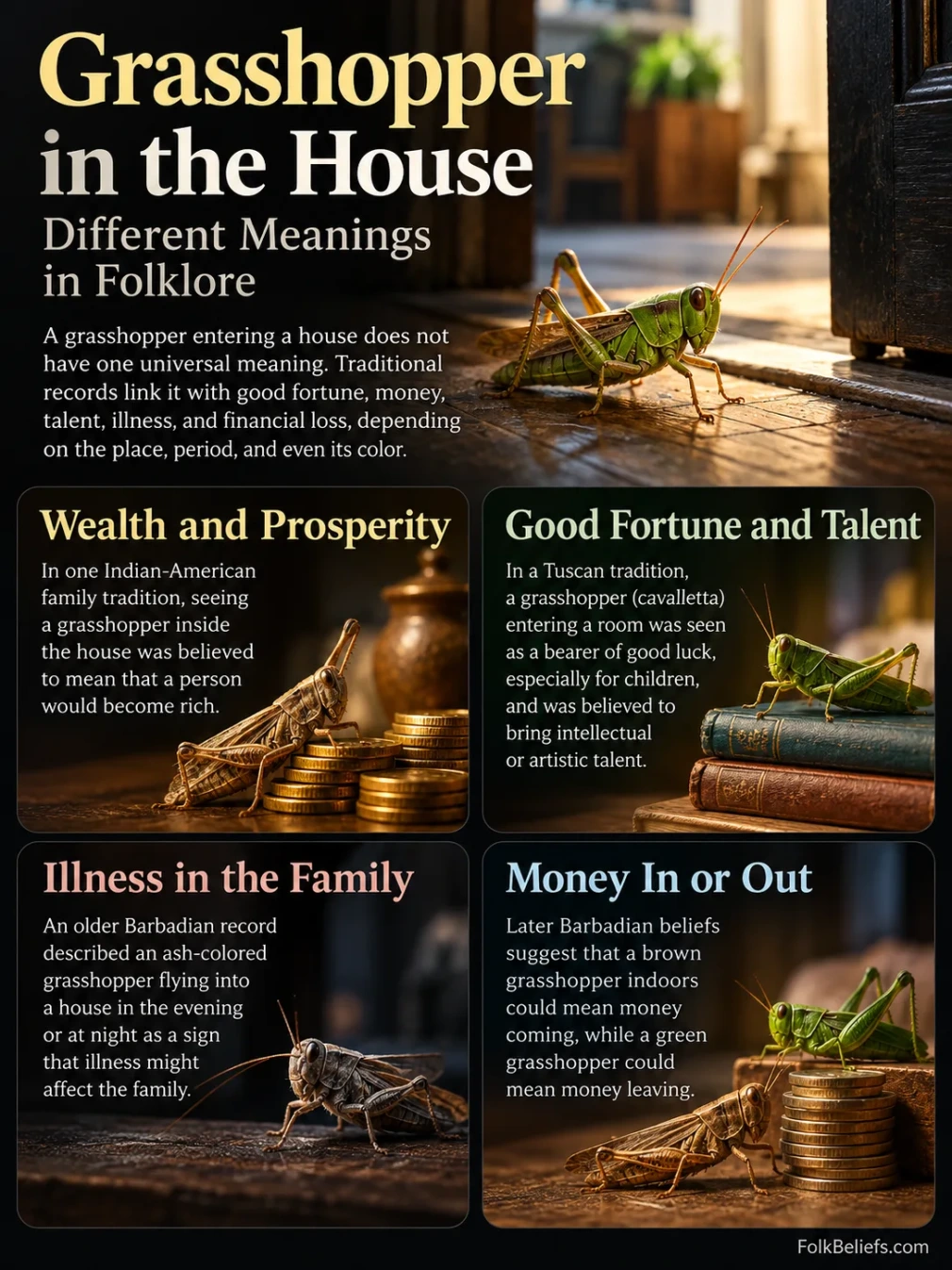
A grasshopper entering a house does not have one universal meaning in folklore. Documented records connect the event with money, good fortune, talent, illness, and financial loss, depending on the place, period, insect description, and even its color. The safest reading is therefore not “grasshoppers always mean good luck” or “grasshoppers always mean bad luck,” but that several distinct household omens have been recorded.
Is a Grasshopper Entering the House Good Luck or Bad Luck?
| Recorded Context | Meaning of the Indoor Grasshopper |
|---|---|
| One Indian-American family record | Seeing a grasshopper in the house was associated with becoming rich.[1] |
| Romagna/Tuscan tradition recorded by Charles Godfrey Leland | A cavalletta entering a room, especially where a child was sleeping, was treated as a bearer of good fortune and talent.[2] |
| Older Barbados record repeated in an 1865 insect-lore collection | An ash-colored grasshopper flying into a house in the evening or at night was connected with fear of illness in the family.[3] |
| Later recorded Barbadian belief | A brown grasshopper indoors could mean money coming, while a green grasshopper could mean money leaving.[4] |
These records show why the question cannot be reduced to a single lucky or unlucky interpretation. Even beliefs documented in the same island can differ by period, description, or color.
Grasshoppers as Signs of Money and Prosperity
A modern folklore archive at the University of Southern California contains a narrowly documented wealth belief. An Indian-American informant described customs learned from his parents and said that seeing a grasshopper inside the house meant a person would probably become rich. The archive does not establish this as a belief shared throughout India; it records what one informant reported about his family’s tradition.[1]
A different good-fortune tradition was recorded by Charles Godfrey Leland in nineteenth-century Italy. His account of la cavalletta describes a green jumping insect entering a room as a favourable visitor. Its presence was especially valued when children were sleeping there, because the insect was believed capable of bringing luck and intellectual or artistic talent.[2]
The location matters. These are separate recorded traditions. The Indian-American family belief should not be presented as a rule for all Indian households, and Leland’s account belongs to a particular Italian folk setting rather than to every Italian community.
The Tuscan Cavalletta Was More Than a Simple Luck Omen
Leland’s record gives the indoor encounter a much more specific meaning than the modern idea that any grasshopper simply represents “abundance.” The insect was welcomed because it was thought to leave good fortune in the home and to favour children with talent.
The historical custom included temporarily attaching the insect by a thread near the child’s bed and later releasing it through an open window. This describes a period folk practice rather than something that needs to be repeated today. The part of the record that matters for understanding the superstition is the belief that the creature’s voluntary arrival inside the room brought beneficial influence.[2]
Barbados Preserves Very Different Grasshopper Omens
One of the clearest examples of variation comes from Barbados. Frank Cowan’s 1865 Curious Facts in the History of Insects, referring back to Griffith Hughes’s eighteenth-century description of Barbados, reports an ash-colored grasshopper whose arrival inside a house during the evening or night caused apprehension about illness in the family.[3]
Later Barbadian folklore provides another pattern. Material associated with G. Addinton Forde’s Folk Beliefs of Barbados, published by the National Cultural Foundation in 1988, distinguishes the omen by color: a brown grasshopper in the house is associated with incoming money, while a green one is associated with money leaving.[4]
This is a useful example of how folklore changes and accumulates. An older record connected one described grasshopper with illness, while another recorded tradition interprets brown and green grasshoppers through household finances. Neither version should be treated as the only Barbadian belief ever held.
Does a Green Grasshopper in the House Mean Good Luck?
Not necessarily. Color symbolism is one area where unsupported generalizations are especially easy to make. In the later Barbadian record, a green grasshopper has the less favourable financial meaning, while a brown one carries the money-coming interpretation. In Leland’s Italian record, by contrast, the cavalletta is described as green and is treated favourably.
The same color can therefore carry opposite meanings in different records. A claim that green grasshoppers universally predict wealth, growth, or good fortune does not match the documented variation.
Why Old Sources Do Not Always Mean the Same Insect by “Grasshopper”
Historical insect names can complicate these beliefs. Leland himself explained that the creature called cavalletta could be translated as a locust or grasshopper, yet he thought the animal described in his account was closer to what an American reader would call a katydid. His discussion also notes how grasshoppers, crickets, cicadas, and related jumping insects could overlap in older folk terminology.[2]
That distinction matters when comparing traditions. A belief preserved under the English word grasshopper may originally have referred to a locally named insect that does not match a modern biological use of the word exactly.
Why a Grasshopper May Enter a House Without Any Folk Meaning
Folklore assigns meaning to an unusual encounter, but the insect itself can enter a building for ordinary environmental reasons. In 2026, an entomologist at Ondokuz Mayıs University explained that grasshoppers may occasionally enter homes because of factors such as light, warmth, dry conditions, wind, or nearby food sources. They do not normally establish nests or reproduce inside houses.[5]
If one gets indoors, opening a door or window or gently moving it outside in a container is enough. The presence of the insect can be understood as part of a local folk tradition without treating the associated prediction as a biological fact.
Sources and Records
- ↑1a ↑1b USC Digital Folklore Archives, “Indian home rituals and customs related to luck”,
- ↑2a ↑2b ↑2c ↑2d Charles Godfrey Leland, Etruscan Roman Remains in Popular Tradition, “La Cavalletta”,
- ↑3a ↑3b Frank Cowan, Curious Facts in the History of Insects,
- ↑4a ↑4b SuperstitionsMap, “Barbadian Superstitions”,
- ↑5 Ondokuz Mayıs University, “Large Grasshoppers Seen in Türkiye Reflect Seasonal Conditions, Not an Outbreak, Says OMU Expert”,
Documented Locations
Countries: Barbados
These labels identify where a version has been documented. They do not mean that everyone in the country, region, or community shares the belief.