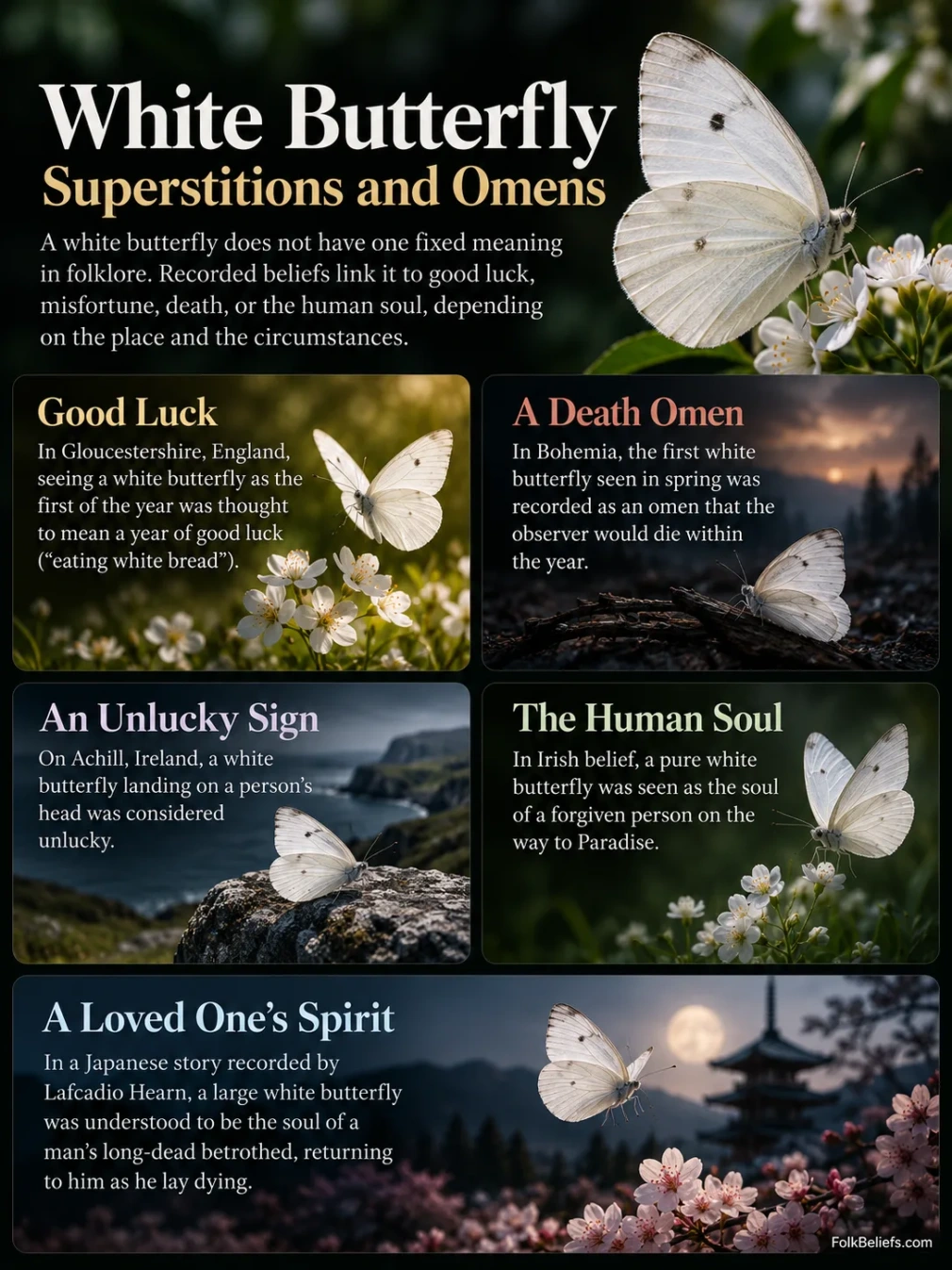
A white butterfly does not carry one fixed omen in folklore. Recorded beliefs give it sharply different meanings: good luck, a favorable year, an unlucky encounter, a death omen, or the visible form of a human soul. The details matter. A belief about the first butterfly of spring is not the same as one about a butterfly landing on a person or appearing beside someone near death.
Recorded White Butterfly Omens
| Place or Record | What Happens | Recorded Meaning |
|---|---|---|
| Gloucestershire, England | The first butterfly seen in the opening year is white | The observer will metaphorically “eat white bread” for the rest of the year, which the 1880 source explains as good luck.[1] |
| Bohemia | The first butterfly seen in spring is white | A nineteenth-century folklore compilation records this as an omen that the observer will die within the year.[2] |
| Achill, Ireland | A white butterfly settles on a person’s head | A local record in the National Folklore Collection lists the event as unlucky.[3] |
| American oral record, 2017 | A white butterfly is seen | One recorded tradition identifies it with good luck; a related family version limits the luck to the first butterfly seen that year being white.[4] |
| Irish belief recorded in 1896 | A pure white butterfly is encountered | The butterfly is described as the soul of one of the forgiven dead on the way to Paradise.[5] |
| Japanese material recorded by Lafcadio Hearn | A large white butterfly repeatedly approaches a dying man | In Hearn’s story, it is understood as the soul of the man’s long-dead betrothed, Akiko.[6] |
The First White Butterfly Can Mean Opposite Things
Some of the clearest white-butterfly omens concern the first butterfly seen after winter. The same basic event could be read in completely different ways in different places.
In Gloucestershire, an English folklore collection published in 1880 says that seeing a white butterfly first meant that the observer would eat white bread for the rest of the year. The source directly interprets this as a way of saying that good luck would follow. A brown first butterfly carried the contrasting image of brown bread and misfortune.[1]
Yet an 1893 work describing beliefs about souls and butterflies gives a much darker version from Bohemia: a person whose first butterfly of spring was white was said to be destined to die before the year ended.[2]
Folklore varies locally: these two records use almost the same trigger—a first white butterfly—but attach opposite outcomes to it. Neither should be treated as a universal European rule.
White Butterflies and the Human Soul
Not every white-butterfly belief is an omen about something that will happen next. Some records treat the butterfly as an identity: the insect is interpreted as a soul rather than as a prediction.
An Irish Soul Belief
Alexander Francis Chamberlain’s 1896 The Child and Childhood in Folk-Thought records an Irish belief in which a pure white butterfly represented the soul of a person considered sinless and forgiven, travelling toward Paradise. The same passage assigns a different condition to spotted butterflies.[5]
This is narrower than the modern claim that every white butterfly seen in Ireland was believed to be a deceased loved one. The historical record supports a particular soul interpretation, not a single rule shared by every Irish community.
The White Butterfly in Hearn’s Japanese Story
Lafcadio Hearn included a striking white-butterfly episode in Kwaidan. A large white butterfly repeatedly settles near the dying Takahama. After it flies toward a cemetery and disappears at the tomb of Akiko, the woman to whom Takahama had been betrothed many years earlier, his family interprets the butterfly as Akiko’s soul coming for him.[6]
Hearn also discusses a broader Japanese belief that a butterfly could represent the soul of either a living or dead person. The white color belongs to this particular narrative, so the story should not be turned into a claim that every white butterfly had the same meaning throughout Japan.
When a White Butterfly Lands on Someone
A record from Achill shows how the butterfly’s behavior could alter the interpretation. In an entry collected for Ireland’s Schools’ Collection, a list of local unlucky signs includes the belief that a white butterfly lying on a person’s head is unlucky.[3]
The Schools’ Collection was assembled from local tradition recorded by schoolchildren across the Irish Free State between 1937 and 1939. A single Achill entry therefore documents a belief circulating in that setting; it does not establish the same omen for Ireland as a whole.
White Butterflies as Good Luck in a Modern Oral Record
The USC Digital Folklore Archives preserves a 2017 account in which an informant was told that a white butterfly indicated good luck. When she repeated the belief to her mother, her mother supplied a narrower version: the white butterfly brought good luck only when it was the first butterfly seen during the year.[4]
This record is useful because it shows folklore changing even between two people discussing the same sign. One version makes any white butterfly lucky; the other makes season and order essential.
The Details That Change the Meaning
- First of the year or spring: recorded traditions can read the first white butterfly as either lucky or ominous.
- Landing on a person: an Achill record makes contact with the head specifically unlucky.
- Appearing near death: Hearn’s white-butterfly narrative connects the insect with the soul of a deceased person rather than ordinary everyday luck.
- Local tradition: a Gloucestershire belief, a Bohemian belief, an Achill record, and a Japanese story should remain attached to their own documented settings.
These are records of folk belief, not evidence that a butterfly predicts luck, death, messages, or future events. A white butterfly seen outdoors has no single folklore meaning unless a particular tradition supplies the context.
Sources and Records
- ↑1a ↑1b T. F. Thiselton-Dyer, English Folk-Lore,
- ↑2a ↑2b T. F. Thiselton-Dyer, The Ghost World,
- ↑3a ↑3b National Folklore Collection, UCD, The Schools’ Collection, “Unlucky Omens”,
- ↑4a ↑4b USC Digital Folklore Archives, “Good Luck Butterflies”,
- ↑5a ↑5b Alexander Francis Chamberlain, The Child and Childhood in Folk-Thought,
- ↑6a ↑6b Lafcadio Hearn, Kwaidan: Stories and Studies of Strange Things, “Butterflies”,
Documented Locations
Countries: Brazil, Chile, Estonia, France, Spain, Uruguay
These labels identify where a version has been documented. They do not mean that everyone in the country, region, or community shares the belief.