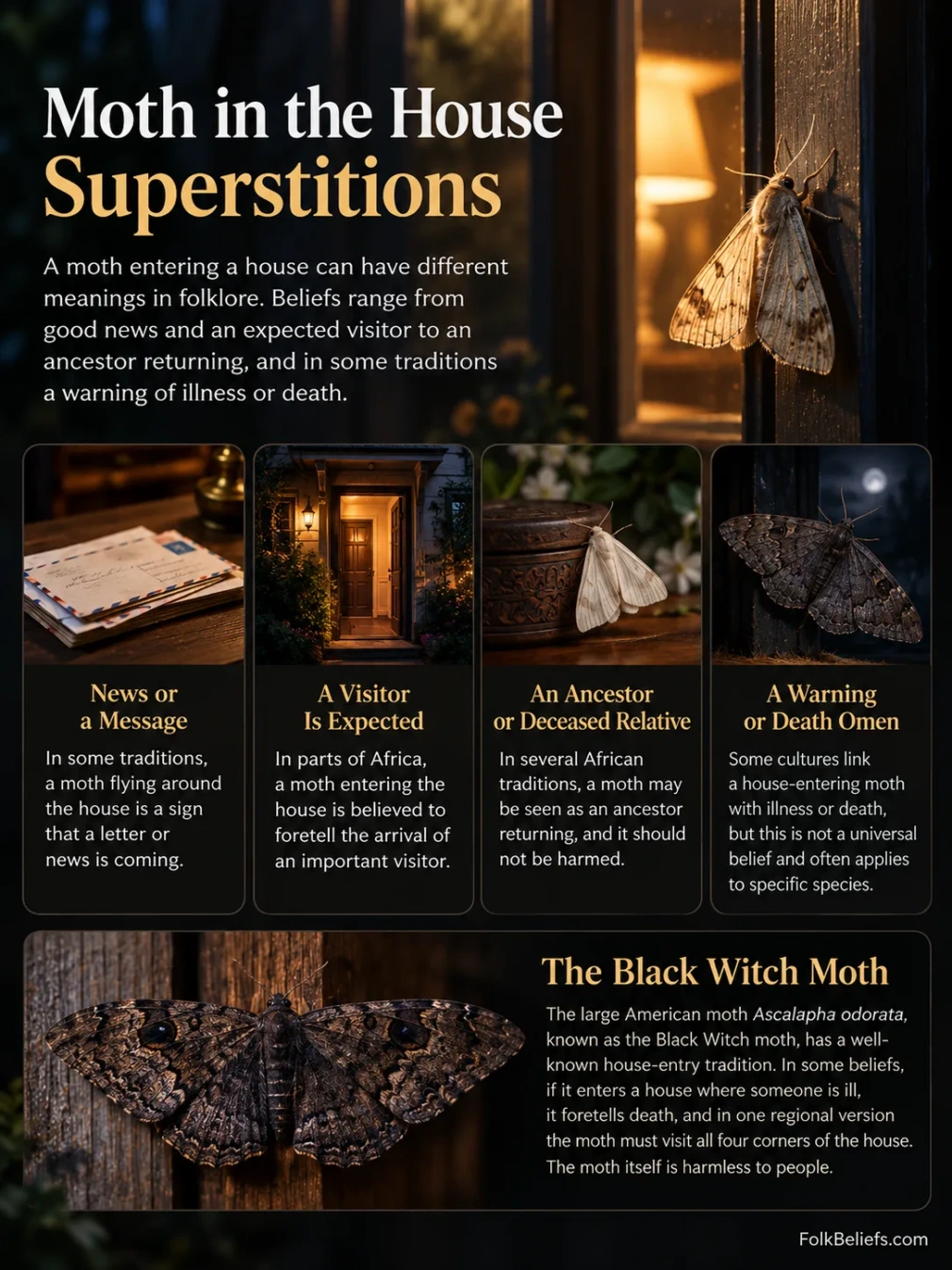
A moth entering a house does not have one fixed meaning in folklore. Documented beliefs range from news or an expected visitor to an ancestor returning, good fortune, illness, or death. The interpretation changes with the community, the moth involved, the time of day, and what the insect does after entering.
This variety matters because modern explanations often turn several unrelated traditions into a single claim that “a moth in the house means death.” The historical and ethnographic record is much less uniform.
What Does a Moth Entering the House Mean?
One of the clearest lessons from recorded folklore is that the act of crossing into the home can carry different meanings even in traditions that otherwise look similar.
News or a Message
An Irish record from County Leitrim says that when a moth flies around the house and strikes a person, it is a sign that a letter is coming. Other Irish Schools’ Collection records connect a moth around a lamp with the arrival of a letter as well.[1]
A Visitor Is Expected
Ethno-entomological research in sub-Saharan Africa recorded beliefs among several Cameroonian groups in which a butterfly or moth entering the house foretells the arrival of an important visitor. The same study found very different readings elsewhere, showing why this belief should not be presented as a rule for an entire continent.[2]
An Ancestor or Deceased Relative
The same African study records beliefs among Serer respondents in Senegal and Mbaye respondents in Chad in which a butterfly or moth entering the home may be understood as an ancestor, with the associated instruction that the insect should not be killed.[2]
A Warning or Death Omen
Death-omen traditions also exist, but some belong to a particular species rather than moths generally. The best-documented example is the large American Ascalapha odorata, commonly called the Black Witch moth.[3]
The Black Witch Moth Has Its Own House-Entry Tradition
The Black Witch moth is an important reason that moths and houses are sometimes linked with death online. It should not, however, be treated as proof that every dark moth carries the same folklore.
The University of Colorado Museum of Natural History identifies the Black Witch as Ascalapha odorata, a large nocturnal moth native to the Americas. Its museum account records a Mexican belief that if the moth enters a house where someone is ill, the sick person will die. A related version from the Lower Rio Grande Valley of southern Texas requires the moth to visit all four corners of the house before the omen applies.[3]
The details are part of the belief. In these records, the omen is not simply “a black moth entered the house.” The species, the presence of an ill person, and in one regional version the moth’s movement through four corners all matter.
Dark appearance has also helped generate fear around this species. Costa Rica’s National Museum describes Ascalapha odorata as a nocturnal moth surrounded by myths and legends and notes that people sometimes kill it when it appears indoors. The museum also states that the moth itself is harmless to people.[4]
Some House Moth Beliefs Are Positive
Not every indoor moth is an omen of misfortune. Arnold van Huis’s study of Lepidoptera traditions across sub-Saharan Africa recorded several sharply different interpretations.
| Recorded Context | Folklore Meaning |
|---|---|
| Yoruba respondents in Nigeria | A butterfly or moth entering during the day could be regarded as a good omen; one example concerned safe delivery for a pregnant woman. |
| Ebibio respondents | An entrance during the night was described as a bad omen. |
| Bafia, Bakoka, Bamileke, Bassa and Yambassa respondents in Cameroon | An entering butterfly or moth could mean an important visitor was expected. |
| Black butterfly or moth in the cited Cameroonian material | Associated with death. |
| Serer respondents in Senegal and Mbaye respondents in Chad | The entering insect could be regarded as an ancestor and therefore should not be killed. |
These records came from named groups and respondents rather than from a single “African superstition.” The study itself stresses the qualitative nature of the material and identifies the communities connected with each account.[2]
Moths as Returning Family Members
A more personal version of the ancestor belief appears in the USC Digital Folklore Archives. One 2019 record documents an informant describing a belief learned through a Moroccan grandmother: moths that entered her home were not to be harmed because deceased family members could return in moth form. The family response described in that particular account was to leave the moth alone and regard its presence with respect.[5]
This is useful evidence of a family-transmitted Moroccan folk belief, but it should not be expanded into a claim that all Moroccan households interpret moths this way. A recorded family tradition supports the family tradition itself, not an automatic national rule.
Does the Color of the Moth Change the Meaning?
Color matters in some documented traditions, but there is no dependable universal chart in which white, brown, and black moths always carry the same meanings.
Black coloration is relevant in the Cameroonian material summarized above, where a black butterfly or moth was connected with death, and it is obviously central to the name and reputation of the Black Witch moth in the Americas.[2][3]
That evidence does not establish a worldwide rule that every black moth is a death omen. Likewise, popular modern claims assigning fixed meanings to every white, brown, gray, or yellow moth should be treated separately unless a specific tradition and source can be identified.
Does a Moth Flying Around a Lamp Have a Different Meaning?
It can. In Irish archival material, the important action is sometimes not simply entering the building. A moth flying around a lamp, flying around the house, touching a person, or resting on clothing can be connected with the expectation of a letter.[1]
There is also an ordinary biological reason for finding moths near household lights. Penn State entomologist Mike Saunders explains that many nocturnal moths use distant natural light for orientation, while nearby artificial lighting can interfere with that navigation and cause repeated circling around a lamp.[6]
Folklore records what communities have understood an encounter to mean. A moth entering a home or circling a light is not scientific evidence that a death, visitor, letter, or other predicted event will occur.
Why the Same Encounter Can Mean Opposite Things
A moth crossing the household threshold can be interpreted as incoming news in one record, an expected guest in another, a deceased relative in another, and a warning in a different regional tradition. Even time of day can reverse the interpretation in some recorded material.
For that reason, the most accurate answer to “Is a moth entering the house good luck or bad luck?” is that folklore supports both possibilities. The meaning depends on the tradition being discussed. There is no single moth-in-the-house superstition shared across cultures.
Sources and Records
- ↑1a ↑1b National Folklore Collection, UCD, “Superstitions,” Drumlease, Co. Leitrim,
- ↑2a ↑2b ↑2c ↑2d Arnold van Huis, “Cultural Significance of Lepidoptera in Sub-Saharan Africa”,
- ↑3a ↑3b ↑3c University of Colorado Museum of Natural History, “Black Witch Moth”,
- ↑4 Museo Nacional de Costa Rica, “Mariposa de la lotería”,
- ↑5 USC Digital Folklore Archives, “Moroccan: Tino Moths and Rebirth”,
- ↑6 Penn State University, “Probing Question: Why Are Moths Attracted to Light?”,
Documented Locations
Countries: Argentina, Brazil, Cuba, Ghana, Panama
These labels identify where a version has been documented. They do not mean that everyone in the country, region, or community shares the belief.