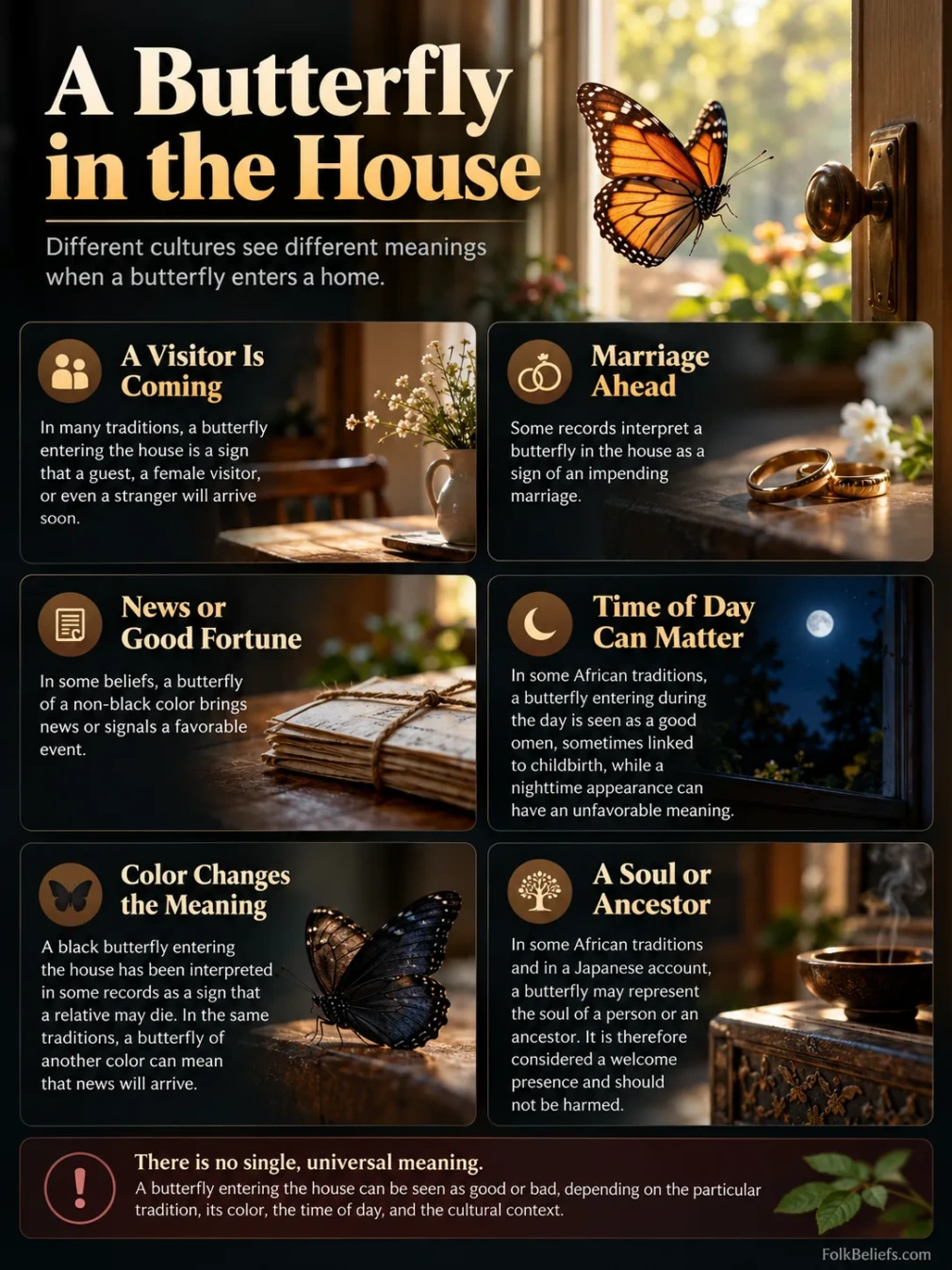
A butterfly entering the house does not have one fixed meaning in folklore. Documented versions interpret the event as a sign of an approaching visitor, marriage, news, a favorable event, or the presence of a soul or ancestor. Other records give darker meanings when the butterfly is black or when the appearance happens under particular circumstances. These are recorded folk beliefs rather than reliable predictions of future events.
When an Indoor Butterfly Means a Visitor Is Coming
One of the clearest documented interpretations is that a butterfly entering the home announces company. Harry Middleton Hyatt’s collection of folklore from Adams County, Illinois, records several closely related versions: a butterfly entering and landing on someone meant company could be expected; another version predicted a female visitor; and another said a stranger would soon visit the house.[1]
A historical Japanese account gives the visitor belief a different explanation. F. Hadland Davis’s Myths & Legends of Japan, published in 1912, records a belief that a butterfly could represent the soul of a living person. If the butterfly entered a guest room and settled behind a bamboo screen, the person represented by it was expected to appear at the house shortly afterward. The same account describes the presence of a butterfly indoors as a favorable omen, although the interpretation depended on the person believed to be represented.[2]
The visitor meaning therefore appears in more than one source, but the surrounding explanation is not the same everywhere. In the Illinois material, the butterfly functions mainly as an omen of company. In the Japanese account, the arrival is tied to the idea that the butterfly can embody or represent a person.
Marriage Is Another Recorded House-Butterfly Omen
The James T. Callow Folklore Archive at the University of Detroit Mercy preserves a short record collected in 1968 stating that a butterfly flying into the house foretells an impending marriage. The archive identifies the immediate source as a newspaper, The Macomb Daily.[3]
This record shows why a house-butterfly superstition should not automatically be reduced to either “good luck” or “a visitor.” Marriage belongs to the documented range of meanings, but the surviving archive item does not establish it as a belief shared across an entire country or community.
Color Can Change the Meaning
Some versions distinguish between a black butterfly and butterflies of other colors. A 1968 Callow Archive record identified as learned in Guadeloupe states that a black butterfly entering the house meant that a relative would die, while a butterfly of another color meant that news would soon arrive.[4]
Black does not have a universal folklore meaning. The Guadeloupe record documents one particular version. It should not be turned into a rule that every black butterfly entering every home predicts death.
The same distinction matters when interpreting modern lists of “butterfly color meanings.” A color association is strongest when a source actually records that color as part of the belief. Meanings assigned to white, yellow, brown, orange, or other butterflies should not be added to the house-entry superstition unless the underlying tradition connects those details.
Time of Day Matters in Some African Records
A 2019 ethnobiological study based on interviews and literature research across sub-Saharan Africa records several house-entry beliefs involving butterflies and moths. Among Yoruba respondents in Nigeria, an insect entering the house during the day could be interpreted as a favorable omen, with childbirth given as one example. The study also records an unfavorable nighttime interpretation in another Nigerian tradition. In several Cameroonian groups, the entrance of a butterfly or moth was associated with the expected arrival of an important visitor; a black one could carry a death-related interpretation.[5]
These records show that the event alone may not determine the meaning. Time of day, color, and the community in which the belief was documented can all change the interpretation. The study itself identifies the communities connected with the individual records rather than presenting them as beliefs shared by all people in a country.
The Butterfly as an Ancestor or Soul
The idea of a butterfly as more than an ordinary visitor also appears in African material. The same 2019 study reports that among Serer respondents in Senegal and Mbaye respondents in Chad, a butterfly or moth entering the house could be regarded as an ancestor. In those recorded versions, the insect was therefore not supposed to be killed.[5]
This ancestor interpretation is related in theme to the Japanese account of a butterfly representing a soul, but the traditions should not be treated as one shared belief with a single origin. The available records come from different places, periods, and cultural settings.
Is a Butterfly Entering the House Good or Bad Luck?
The source-backed answer is that it can be either, depending on the particular tradition. Some records are favorable and connect the butterfly with guests, marriage, news, or a welcome arrival. Others become unfavorable because of color, nighttime appearance, or a locally documented association with death.
Without a specific family, regional, or cultural tradition to provide context, there is no documented universal rule for what a butterfly entering a house “means.” The strongest interpretation is the one that matches the actual record rather than a generalized color chart or a single superstition presented as worldwide folklore.
Sources and Records
- ↑1 Harry Middleton Hyatt, Folk-lore from Adams County, Illinois,
- ↑2 F. Hadland Davis, Myths & Legends of Japan,
- ↑3 University of Detroit Mercy Libraries, James T. Callow Computerized Folklore Archive, Butterfly and Insect Records,
- ↑4 University of Detroit Mercy Libraries, James T. Callow Computerized Folklore Archive, Guadeloupe Butterfly Record,
- ↑5a ↑5b Arnold van Huis, “Cultural Significance of Lepidoptera in Sub-Saharan Africa”,
Documented Locations
Countries: Brazil, Colombia, Costa Rica, Indonesia, Philippines, Vietnam
These labels identify where a version has been documented. They do not mean that everyone in the country, region, or community shares the belief.