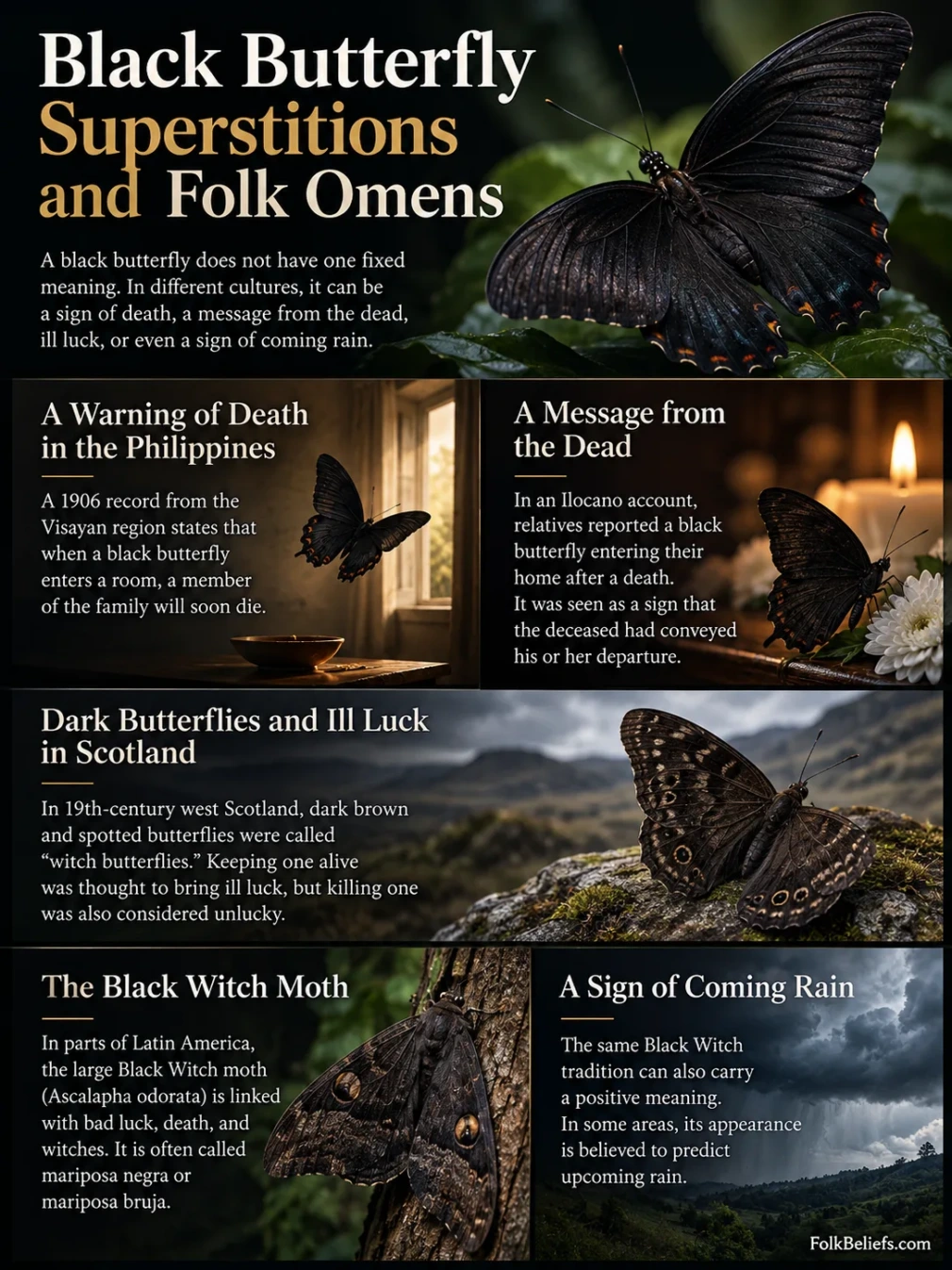
A black butterfly does not carry one fixed folk meaning. In documented traditions, its appearance may be interpreted as a warning of death, a sign connected with someone who has already died, an omen of ill luck, or even a sign of coming rain. The meaning changes with the place, the community, and sometimes the insect itself.
This last point matters. Several well-known “black butterfly” beliefs concern large dark moths that are called butterflies in ordinary speech. Treating every version as the same superstition can erase very different local traditions.
A Black Butterfly Entering the House in Visayan Folklore
One of the clearest historical records comes from the Philippines. W. H. Millington and Berton L. Maxfield recorded a Visayan belief in 1906 stating that when a black butterfly enters a room, a member of the family will soon die.[1]
The location and action are part of the omen. The record does not merely assign an abstract meaning to the color black. It describes a black butterfly coming into the room, making the household encounter itself the portent.
This source concerns a recorded Visayan belief from the early twentieth century. It should not be expanded into a claim that every Filipino community traditionally interpreted black butterflies in exactly the same way.
When the Butterfly Represents Someone Who Has Already Died
An Ilocano cultural account preserves a related but noticeably different interpretation. In descriptions of wakes and burial customs, relatives arriving from distant places were said to report that a black butterfly had suddenly entered their living room. In this setting, the butterfly was taken as a sign that the deceased had conveyed his or her departure.[2]
The distinction is useful: the 1906 Visayan record treats the butterfly as a warning that a death will occur, while the Ilocano account connects its arrival with a death that has already happened. One is predictive; the other is closer to a farewell or notification from the dead.
This difference helps explain why a black butterfly near a bereaved household is sometimes remembered as frightening and sometimes as a meaningful visit. Similar-looking encounters can occupy different places in local mourning traditions.
Dark “Witch Butterflies” in West Scottish Folk Belief
Color also shaped butterfly lore outside the Philippines. In James Napier’s 1879 collection of beliefs from the west of Scotland, ordinary white butterflies were described favorably, while dark brown and spotted butterflies were called “witch butterflies.” Keeping one alive was associated with ill luck. Yet killing one was also considered unlucky, with evil expected to befall the person before evening.[3]
Napier did not describe these insects simply as “black butterflies,” so the record should not be rewritten as a black-butterfly death omen. It does, however, show a historical tradition in which darker butterflies received a more ominous classification than white ones.
The belief also contains an interesting dilemma: possessing the insect was unlucky, but destroying it was not presented as a safe way to cancel the omen. Folk rules do not always work as simple cause-and-remedy systems.
Why a “Black Butterfly” May Actually Be a Black Witch Moth
Some of the strongest modern evidence for black-insect omens concerns Ascalapha odorata, the Black Witch moth. It is a large, dark member of the moth family Erebidae. Moths and butterflies both belong to the order Lepidoptera, but the Black Witch is a moth, not a butterfly. Local common names can blur this distinction, and the insect may be described with expressions equivalent to “black butterfly” or “witch butterfly.”
This overlap in naming also matters for beliefs about moths entering the house. An indoor moth encounter may carry its own recorded interpretation, depending on the species, local tradition, and what the insect does after entering. Such accounts should not automatically be treated as ordinary butterfly sightings or assigned the same meaning solely because the insect is dark.
A 2025 ethnobiological study in Miraflores, Boyacá, Colombia examined local perceptions of this species. Interview responses included beliefs linking the insect with bad luck, death, and witches. Traditional names reported by participants included mariposa bruja and mariposa negra. Some respondents described the insect as a watcher or messenger associated with witches.[4]
These findings document beliefs among people interviewed in two areas of Miraflores. They do not establish one Colombian meaning for the insect, much less a universal Latin American rule.
The Same Dark Moth Can Carry a Rain Omen
The Black Witch tradition also provides a useful counterexample to the idea that a large dark butterfly or moth must mean death. Karen Bassie-Sweet’s discussion of Maya ethnographic records notes the Yucatec term x manhan nai, “house borrower,” for a dark insect described in earlier sources as a black butterfly and associated with hiding indoors from rain. The creature was viewed as a sign of rain. Later records identify the Black Witch moth with this house-entering behavior. They also suggest that ominous meanings reported elsewhere in Mexico may not have been shared in the same form among Yucatec Maya communities, although the available ethnographic documentation is limited. Large black moths in parts of Campeche have likewise been recorded as announcing rain.[5]
This is why “a black butterfly entered my house” cannot be assigned one traditional interpretation without knowing which folklore record is being used. A house visitor may be a death warning in one source, a departed relative in another, and a weather sign in another.
Does a Black Butterfly Mean Death?
It can mean death within particular folk traditions, but it is not a universal death omen. The 1906 Visayan record gives a direct death prediction. The Ilocano account instead links a black butterfly with the departure of someone already dead. West Scottish material associates darker butterflies with witchcraft language and ill luck rather than a specific death prediction. Records surrounding the Black Witch moth range from death and bad-luck beliefs in some communities to rain omens in others.
The wording of the encounter also matters. Folk records distinguish between an insect that:
- enters a room or house,
- appears around the time of a death,
- remains inside a dwelling,
- is caught or killed,
- or appears in connection with changing weather.
Those details are not interchangeable. Removing them can turn a local belief into a much broader claim than the source supports.
Is Seeing a Black Butterfly Bad Luck?
There is no source-based reason to treat every sighting as bad luck. Some traditions do give dark butterflies or moths an ominous role, but the documented rain belief provides a clear example of a different interpretation.
Dark butterflies may also be given personal symbolic meanings involving endings, remembrance, change, or renewal. Such interpretations can be meaningful to individuals, but they should not automatically be presented as old folk beliefs unless a historical or ethnographic record supports that connection.
Black-butterfly omens belong to folklore rather than verified prediction. A butterfly or moth entering a building does not provide evidence that a death, misfortune, visitor, or other human event will occur. The recorded beliefs describe how particular communities have interpreted unusual insect encounters in relation to mourning, weather, luck, and the presence of the dead.
Sources and Records
- ↑1 W. H. Millington and Berton L. Maxfield, “Philippine (Visayan) Superstitions”,
- ↑2 Arnold Azurin with Hermilinda Lingbaoan-Bulong, Reynaldo A. Duque, Filonila M. Tupas, Angelito Santos, and Herminio S. Beltran Jr., “Ilocano”,
- ↑3 James Napier, Folk Lore: Superstitious Beliefs in the West of Scotland within This Century,
- ↑4 Mayra Alejandra Niño-Suárez, Camilo Alberto Marino-Valencia, David Camilo Romero-Martin, and Héctor Jaime Gasca-Álvarez, “Percepción sociocultural de la polilla bruja Ascalapha odorata (Linnaeus, 1758) (Lepidoptera: Erebidae) en Miraflores – Boyacá”,
- ↑5 Karen Bassie-Sweet, Maya Gods of War,
Documented Locations
Countries: Colombia, Spain, Uruguay
These labels identify where a version has been documented. They do not mean that everyone in the country, region, or community shares the belief.