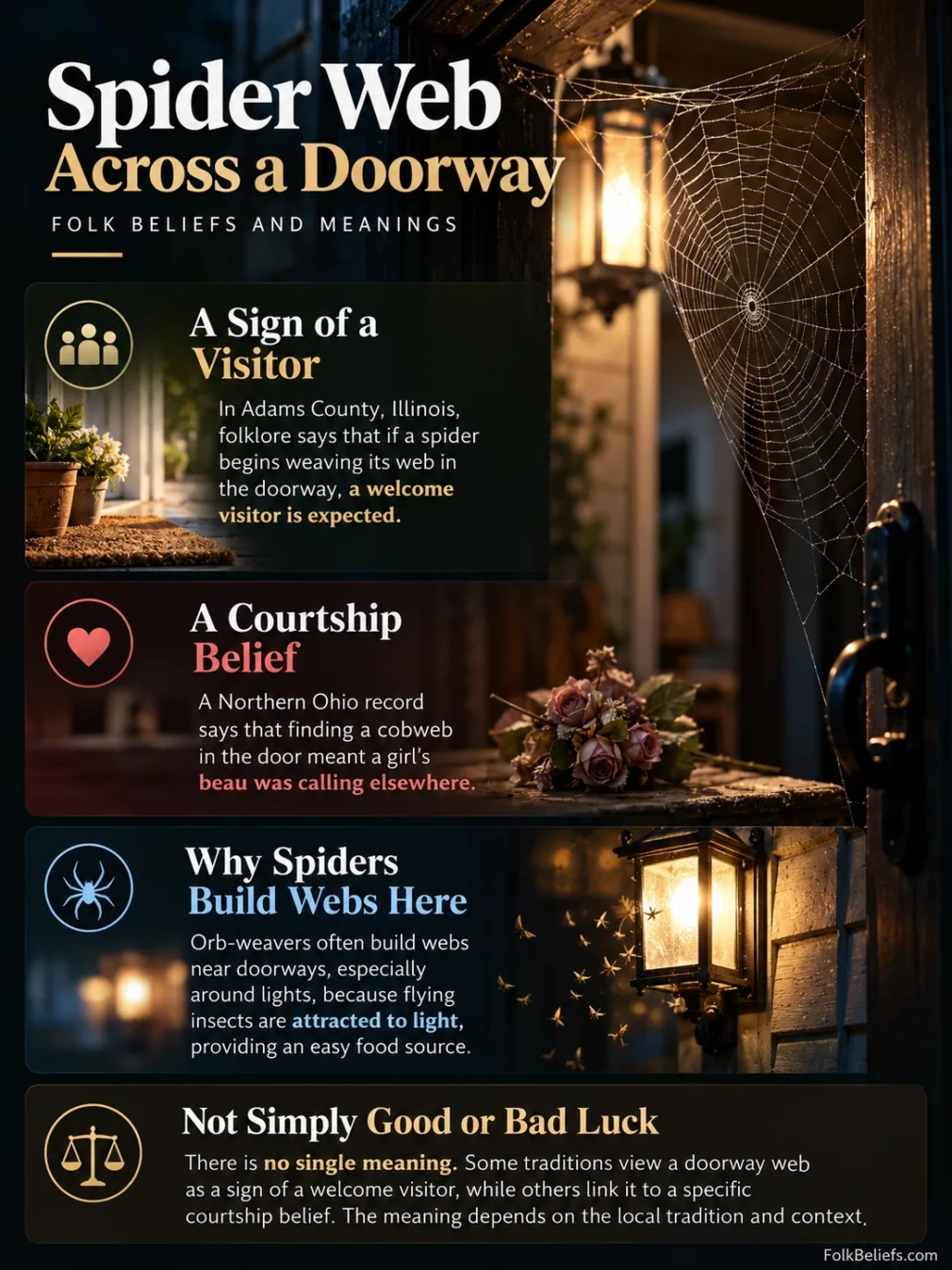
A spider web across a doorway does not have one fixed meaning in recorded folklore. Historical American collections preserve different doorway-related beliefs: one from Adams County, Illinois, connects a spider weaving in a doorway with an approaching welcome visitor, while a Northern Ohio record gives a courtship-related interpretation to finding a cobweb in a door.[1][2]
A Doorway Web as a Sign of a Visitor
Harry Middleton Hyatt’s Folk-Lore from Adams County, Illinois, published in 1935, records a cluster of spider beliefs connected with visitors and company. One entry says that a stranger will call if a spider crawls up the door. The next is even closer to the familiar image of a web stretched through an entrance: if a spider begins weaving its web in the doorway, a welcome visitor is expected.[1]
The surrounding entries matter because they show that the doorway belief was part of a broader local pattern. Spiders spinning or descending in front of a person could also foretell callers, guests, or news. Within this collection, the doorway web belongs mainly to the idea of someone arriving, rather than to danger or misfortune.
The Northern Ohio Courtship Interpretation
An earlier collection preserves a different meaning. Fanny D. Bergen’s 1896 Current Superstitions records the Northern Ohio belief that when a girl found a cobweb in the door, it meant that her beau was calling elsewhere. The entry appears among courting and wedding signs, alongside another belief from Boston that many cobwebs in a kitchen meant there was no courting there.[2]
This version is not a broad prediction of bad luck. Its meaning is narrower: the web is connected with romantic attention being directed somewhere else. Turning that local courtship sign into a universal warning about every spider web on every front door would go beyond what the record supports.
Is a Spider Web Across the Door Good or Bad Luck?
The surviving records do not support a simple good-luck or bad-luck rule. The Adams County belief is favorable because the expected caller is described as welcome. The Northern Ohio belief is unfavorable only within a particular courtship context.
Recorded meanings depend on the setting. A spider actively weaving in a doorway, a cobweb already present in a door, and walking into an outdoor web should not automatically be treated as versions of one superstition. Folklore collections often preserve different meanings for details that look similar today.
Why Spiders Build Webs Near Doorways
There is also an ordinary reason a spider may choose an entrance. Washington State University’s Pestsense notes that orb-weavers can build vertical webs in inconvenient places such as in front of entries. It also explains that webs are common around backlit areas because flying insects are drawn toward light, providing prey for the spiders.[3]
A porch, doorway, or path can therefore be an attractive web-building site without carrying any predictive meaning. The folklore belongs to the interpretation people gave the encounter; the web itself has a biological purpose.
These doorway beliefs are historical folklore records, not evidence that a spider web predicts visitors, relationships, luck, or future events.
Sources and Records
Documented Locations
Countries: United States
Regions: Northern Ohio (United States)
These labels identify where a version has been documented. They do not mean that everyone in the country, region, or community shares the belief.