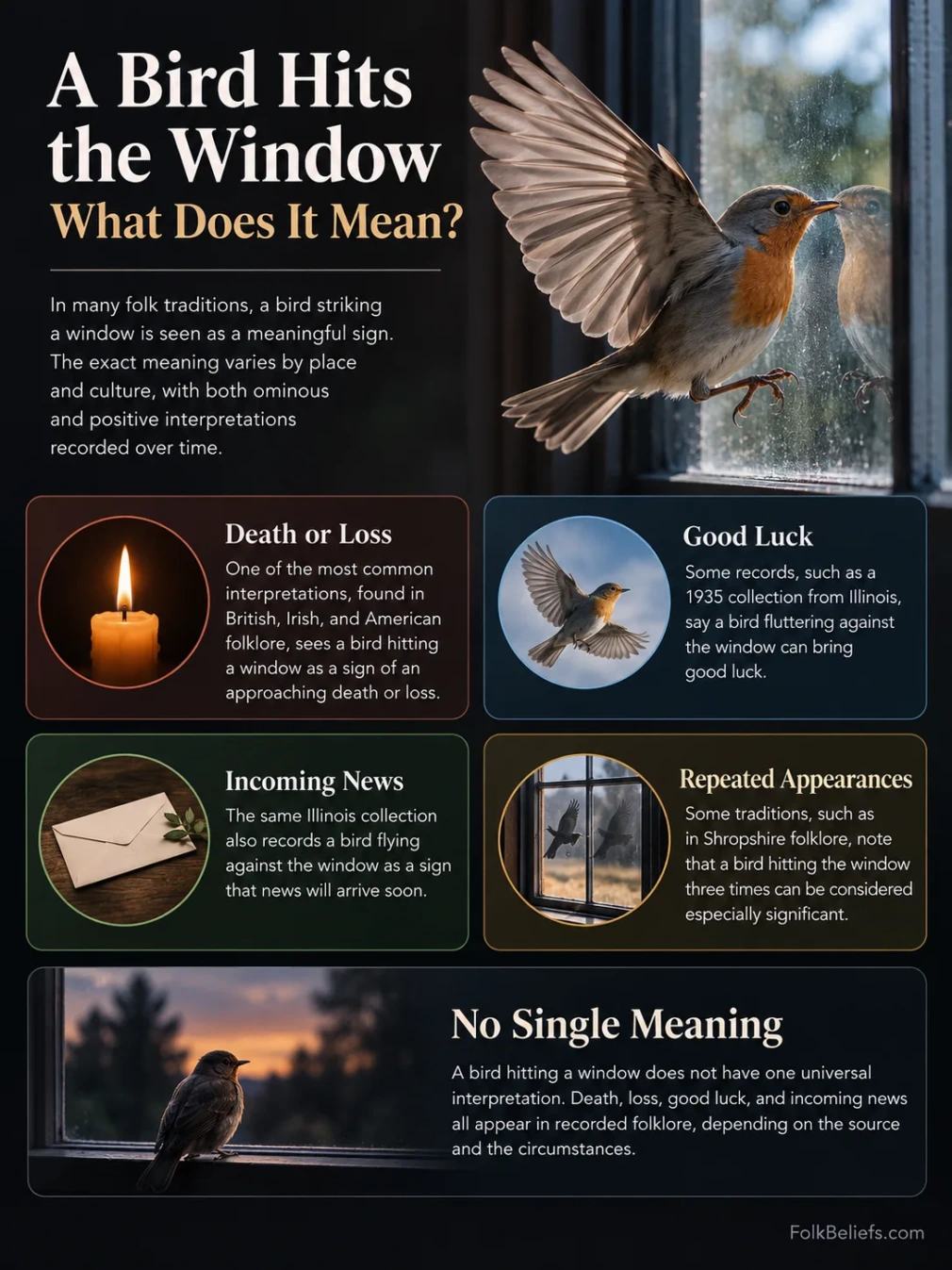
A bird hitting a window has been interpreted as an omen in several recorded folk traditions, but the surviving evidence does not give the event one fixed meaning. A nineteenth-century Shropshire collection connects a bird flying against a window with a death omen, while an Illinois collection records both good luck and approaching news for closely related window-strike events.[1][2]
These records document how particular informants and communities interpreted a collision with glass. They do not show that a window strike predicts death, news, luck, or any other future event.
What Does a Bird Hitting a Window Mean in Superstition?
One of the clearest older British records appears in Shropshire Folk-Lore. The collection describes a death omen that could extend to a bird flying against a window and notes that repeated appearances, especially three, could be treated as more ominous.[1]
An Irish Schools’ Collection record from Ballylongane, County Kerry, gives a similar local belief. Informant John Casey stated that if a bird flapped its wings against the window, it was considered a sign of death. The record belongs to one collected setting and should not be expanded into a rule for Ireland as a whole.[3]
American archive material preserves several related forms. One Michigan record states that a bird hitting a window meant someone close had died. Another entry, identified by its collector as a Ukrainian belief learned in Birmingham, Michigan, says that a bird hitting the window meant something bad was going to happen.[4]
The collision itself does not carry one universal folklore meaning. Death and bad luck are well represented, but other collected versions give very different interpretations.
Recorded Meanings Differ by Source
| Recorded Event | Place or Collection | Folklore Interpretation |
|---|---|---|
| A bird flies against a window | Shropshire folklore | Death omen |
| A bird flaps its wings against the window | Ballylongane, County Kerry | Sign of death |
| A bird flutters against the windows | Adams County, Illinois | Good luck |
| A bird flies against the window | Adams County, Illinois | News expected soon |
| A bird hits the window | Sterling Heights, Michigan archive record | Death of someone close |
| A bird hits the window | Michigan record identified by its collector as a Ukrainian belief | Something bad will happen |
Harry Middleton Hyatt’s Folk-Lore from Adams County Illinois is especially useful because two nearby entries give different outcomes. One associates a bird fluttering against the windows with good luck. The next connects a bird flying against a window with news arriving soon.[2]
The Illinois material prevents the death-omen interpretation from being treated as the only traditional answer. Folklore collections often preserve conflicting beliefs because they record what different people said rather than imposing one standardized meaning.
Does It Matter if the Bird Hits the Window More Than Once?
Repetition appears in some older material, but there is no dependable numerical rule. Shropshire Folk-Lore notes that a bird flying against a window could be regarded with particular concern if it came three times.[1]
That detail belongs to the Shropshire material. It does not establish that three impacts, three days, or three visits carry the same meaning in other traditions. Claims assigning a precise outcome to a particular number of window strikes need evidence from the tradition in which that count was recorded.
Does It Matter Whether the Bird Survives the Collision?
Many recorded beliefs do not require the bird to die. The impact itself is enough for the omen in the Shropshire, Kerry, Illinois, and Michigan examples.
A more specific variant appears in the James T. Callow Folklore Archive from Lucas County, Ohio. In that record, a bird flies into a window, dies from the collision, and the person standing closest to the window is said to have a loved one die.[5]
This is one archived variant, not a rule that a fatal bird collision carries a stronger or more certain supernatural meaning. Other records attach an omen to a strike even when no death of the bird is mentioned.
Does the Species or Color of the Bird Change the Meaning?
The window-strike records do not support a universal species or color code. The Shropshire text could apply the belief broadly to a bird flying against the window, while the Kerry, Illinois, and American archive examples also use general language rather than assigning a separate outcome to every species.
Individual birds such as robins, owls, doves, crows, and magpies have their own folklore traditions, but those traditions should not automatically be transferred to a window collision. A claim such as “a red bird means love” or “a black bird means death” needs its own documented source and setting.
Why Birds Actually Hit Windows
Bird-window collisions have a physical explanation unrelated to omens. The U.S. Fish and Wildlife Service explains that birds can fail to recognize glass as a barrier. Reflections of trees, plants, clouds, and open sky may look like real habitat, while transparent glass can appear to provide an open route through a structure.[6]
Glass can therefore produce a collision even when nothing unusual is happening in the surrounding environment. Exterior screens, visible patterns, films, and other treatments that interrupt reflections can help make windows easier for birds to detect.
Current Conservation Context
Bird-window collisions are a large wildlife conservation problem, separate from any folklore attached to them. The U.S. Geological Survey reports that collisions with glass kill up to two billion birds each year in the United States. It also notes that some birds may appear unharmed after a strike but later die from head trauma or other injuries.[7]
A 2024 field study based on 1,356 directly observed bird-window strikes found that 50% left no measurable evidence of a collision on or around the glass. Counts based only on dead birds, feathers, or visible marks beneath windows can therefore miss many collision events and understate their impact.[8]
A window strike can have a documented folklore interpretation and an ordinary physical cause at the same time. The historical record explains what people believed about the event; it does not establish that the collision foretells what will happen afterward.
Repeated Window Attacks Can Be a Different Behavior
A bird repeatedly returning to the same pane and striking or pecking at it at low speed may be reacting to its own reflection rather than failing to see the glass. Audubon describes this territorial behavior as especially common during the breeding season and notes that birds such as Northern Cardinals and American Robins may repeatedly confront the reflected bird as though it were a rival.[9]
That deliberate, repeated interaction should be distinguished from a bird crashing into a window during normal flight. The behaviors can look similar from inside a house, but their physical causes are different.
Sources and Records
- ↑1a ↑1b ↑1c Charlotte Sophia Burne, ed., Shropshire Folk-Lore,
- ↑2a ↑2b Harry Middleton Hyatt, Folk-Lore from Adams County Illinois,
- ↑3 National Folklore Collection, UCD, “Omens and Signs”,
- ↑4 University of Detroit Mercy Libraries, James T. Callow Folklore Archive, Bird Window Belief Records,
- ↑5 University of Detroit Mercy Libraries, James T. Callow Folklore Archive, Lucas County Bird-Window Record,
- ↑6 U.S. Fish and Wildlife Service, “Threats to Birds: Collisions (Buildings & Glass)”,
- ↑7 U.S. Geological Survey, “Bird Window Collisions”,
- ↑8 Daniel Klem Jr., Peter G. Saenger, and Brandon P. Brogle, “Evidence, consequences, and angle of strike of bird–window collisions”,
- ↑9 Andy McGlashen, “Why Birds Attack Windows and Mirrors—and How You Can Stop Them”,
Documented Locations
Countries: Peru, Russia, United States
These labels identify where a version has been documented. They do not mean that everyone in the country, region, or community shares the belief.