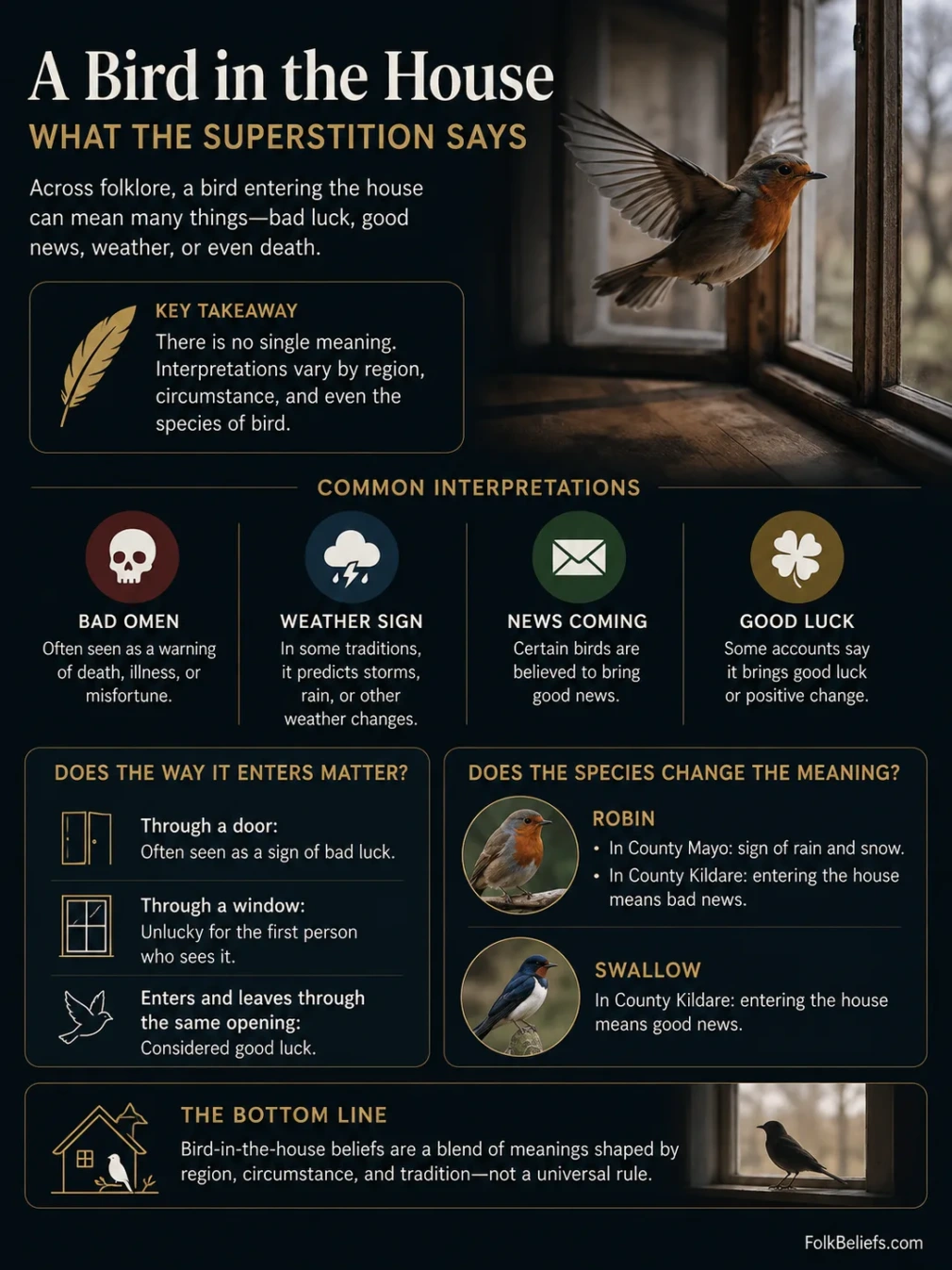
A bird flying into a house has often been treated as an omen, but documented folklore does not give the event one fixed meaning. Death and bad luck appear frequently in collected records, while other traditions connect an indoor bird with weather, news, or good luck. A University of Detroit Mercy folklore collection, for example, preserves several Michigan and Ohio records in which a bird entering a home foretells death or misfortune.[1]
The differences are not simply between countries. Records collected within the same region can disagree. In County Cavan, Ireland, one 1938 entry says a wild bird entering the house was sometimes interpreted as a sign of a storm and sometimes as a warning that someone in the house would die.[2] The superstition is therefore better understood as a family of related beliefs rather than a universal rule.
What Does a Bird Entering the House Mean in Superstition?
The most commonly documented ominous interpretation is that an unexpected bird inside the home warns of death, illness, bad luck, or another unwelcome event. Several records in the James T. Callow Folklore Archive associate a bird flying into a house with death in the family. One Detroit entry makes the warning especially strong when the bird is black, while a Cleveland record describes any uninvited bird inside the house as a bad omen.[1]
That interpretation was never the only one. Margaret Cannell’s 1933 collection of Nebraska folklore records both sides of the belief: one item says a bird flying into a room brings good luck, while another says a bird flying into the house brings bad luck.[3] Two contradictory meanings could therefore circulate within the same broad regional tradition.
| Recorded Setting | Bird Event | Folklore Meaning |
|---|---|---|
| Detroit and Cleveland records | A bird enters the house | Death, sickness, or bad luck |
| Crosserlough, County Cavan | A wild bird enters the house | Either a storm or a death in the household |
| Nebraska collection | A bird enters a room or house | Both good-luck and bad-luck versions were recorded |
| Adams County, Illinois | A bird enters through a door or window | The route of entry and departure changes the omen |
| Balla, County Mayo | A robin or another bird enters | Weather in one case, death in another |
| Kildangan, County Kildare | A swallow or robin enters | Good news for the swallow, bad news for the robin |
Does the Way the Bird Enters Matter?
Some traditions attach meaning not merely to the presence of the bird but to how it crosses the boundary of the house. Harry Middleton Hyatt’s Folk-lore from Adams County, Illinois preserves several closely related beliefs. A bird coming through a door was associated with bad luck. A bird entering through a window was also unlucky for the first person who saw it. Yet a bird that entered and then left through the same opening was said to bring good luck.[4]
This kind of variation explains why modern statements such as “a bird in the house always means death” are too broad. In some recorded beliefs, the doorway, window, direction of flight, or successful departure changes the interpretation.
Does the Species of Bird Change the Meaning?
Sometimes it does. A record from Balla in County Mayo distinguishes between a robin and an unidentified bird. In that account, a robin entering the house was taken as a sign of rain and snow, while a bird entering the house more generally was described as a sign of death.[5]
A different Schools’ Collection record from Kildangan in County Kildare gives another distinction. It says that a swallow coming in through the door meant the occupants would hear good news, while a robin entering meant bad news.[6]
These records do not establish a universal symbolic meaning for robins, swallows, blackbirds, or any other species. They show that species mattered in some local traditions, and that the meaning assigned to a particular bird could change from one community to another.
Is a Bird Flying Into the House a Death Omen?
It can be a death omen within certain recorded traditions. Death is one of the better-attested interpretations in British, Irish, and North American folklore collections. It appears in multiple independently collected records rather than coming from a single modern superstition list.
Even so, the evidence does not support treating the belief as a prediction. Folklore records document what people said, remembered, or believed in particular places and periods. They do not demonstrate that a bird entering a house causes or predicts a death.
Folklore meaning and real-world outcome are different things. An indoor bird may have carried an ominous meaning in a local tradition without the belief being a reliable forecast of what happens afterward.
Can a Bird Entering the House Mean Good Luck?
Yes. Although ominous interpretations are easy to find, good-luck versions are also documented. The Nebraska collection includes a belief that a bird flying into a room brings good luck, and the Adams County material says good luck may follow when a bird leaves through the same entrance it used to come inside.
Good news also appears as a separate interpretation. The Kildare record concerning a swallow entering through the door connects the visit with news rather than death or general luck. This illustrates an important feature of omen lore: closely related events can be assigned very different outcomes.
What If the Bird Is a Robin?
There is no single robin-in-the-house superstition. In the Mayo record, a robin indoors belongs to weather lore and indicates rain and snow. In the Kildare record, a robin entering the house means bad news.
That difference is useful because both records come from the National Folklore Collection’s Schools’ Collection in Ireland. Even within one national archive, the same bird and the same household event do not produce one consistent interpretation.
What If the Bird Flies Back Out?
Some folklore treats departure as part of the omen rather than as an unimportant ending. The Adams County collection specifically records good luck when the bird departs through the same entrance by which it came in.
Other collected traditions do not mention the bird’s exit at all. A belief that focuses only on entry should not automatically be expanded with later rules about whether the bird escaped, landed somewhere, circled the room, or stayed inside. Those details belong only to traditions in which they were actually recorded.
Why Are the Meanings So Different?
Folk beliefs are transmitted through households, neighborhoods, occupational groups, and local communities. Details change as a belief is remembered and retold. A warning of death in one record may become general bad luck elsewhere. Another community may associate the same event with weather or news.
Birds also differ within the traditions themselves. A general rule about “a bird” can exist alongside more specific rules for a robin, swallow, black bird, or another named species. The entrance may matter in one version but not another.
For that reason, the safest reading of the historical evidence is simple: a bird entering the house is a widely recorded omen motif with several competing meanings. Death and misfortune are prominent interpretations, but good luck, weather, and news are also documented. The exact meaning depends on the particular record rather than on a single rule shared everywhere.
Sources and Records
- ↑1a ↑1b University of Detroit Mercy Libraries, James T. Callow Folklore Archive: Bird and Bad-Luck Records,
- ↑2 National Folklore Collection, UCD, “Superstitions,” Crosserlough, County Cavan,
- ↑3 Margaret Cannell, Signs, Omens, and Portents in Nebraska Folklore,
- ↑4 Harry Middleton Hyatt, Folk-lore from Adams County, Illinois,
- ↑5 National Folklore Collection, UCD, “Bird-Lore,” Balla, County Mayo,
- ↑6 National Folklore Collection, UCD, “Bird-Lore,” Kildangan, County Kildare,
Documented Locations
Countries: Cuba, France, Ireland, Italy, Jamaica, Pakistan, Poland, Tonga, United Kingdom, United States
These labels identify where a version has been documented. They do not mean that everyone in the country, region, or community shares the belief.