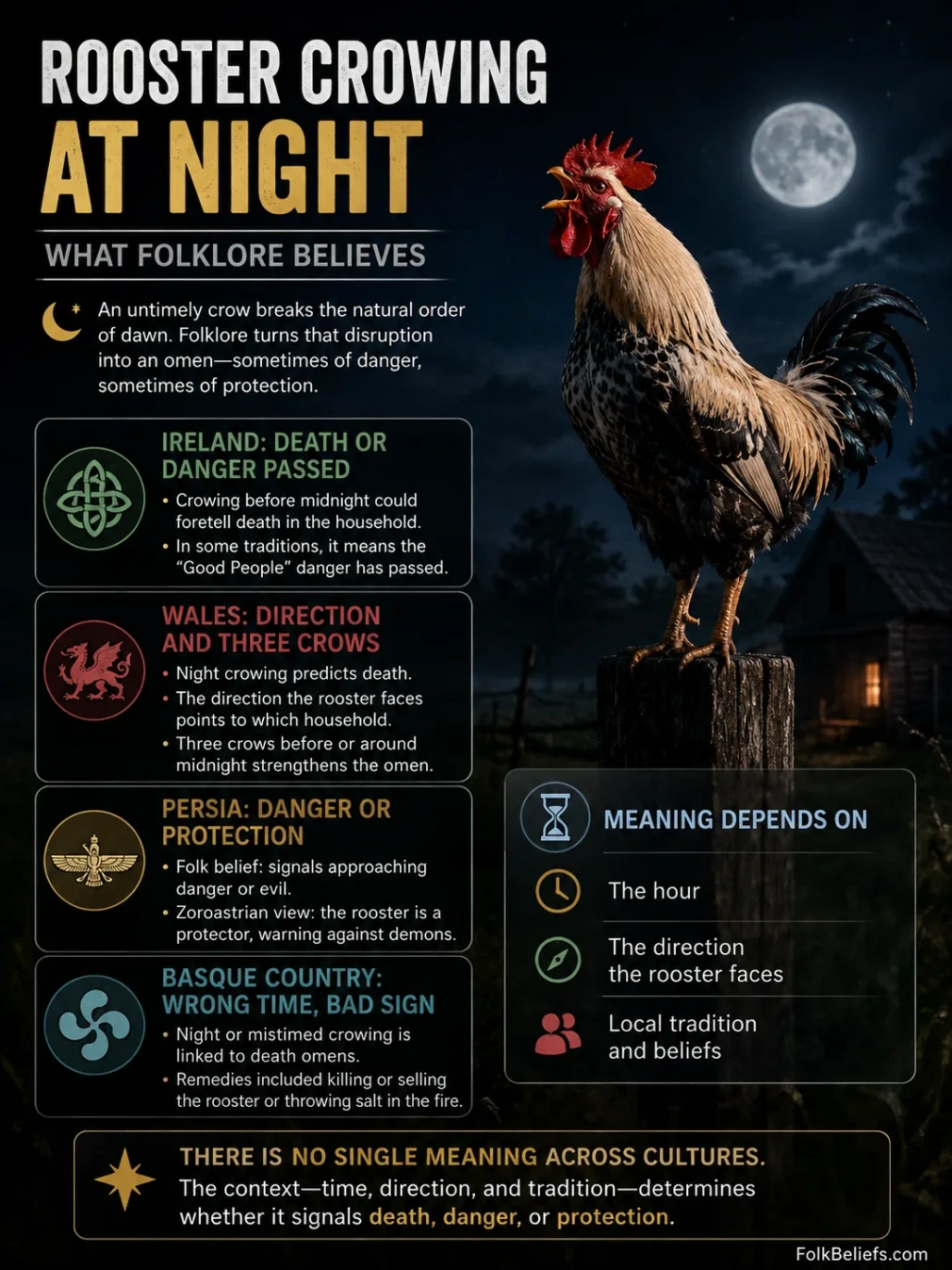
A rooster crowing in the middle of the night has been treated as an omen in several documented folklore traditions, but there is no single meaning shared across cultures. Some records connect an untimely crow with death or approaching trouble. Others treat the rooster as a warning bird whose call signals that a danger is nearby—or has already passed.
The exact interpretation can depend on the hour, the direction the rooster faces, and the local tradition in which the belief was recorded.
What Does Rooster Crowing at Night Mean in Superstition?
Many recorded beliefs treat night crowing as unusual because the rooster is closely associated with dawn. When the familiar dawn call occurs at an unexpected hour, folklore can turn that disruption into an omen.
Death and misfortune appear in several historical records, but they are not the only interpretations. Irish collections include both unfavorable readings and a version in which the crow means that a supernatural danger has passed. Persian sources preserve another contrast: an untimely crow could indicate danger in folk belief, while a Zoroastrian interpretation gave the rooster a protective role.
Irish Records: Death, Warning, and Danger Passed
A record collected at Kilmore in County Roscommon gives a very specific interpretation. If a cock crowed before midnight, people in the household were said to believe that someone in the house would die. The same account added another test: cold feet on the rooster were interpreted as supporting the death omen, while warm feet changed the meaning to good luck.[1]
That was not the only Irish version. A bird-lore record from Granagh in County Limerick says that a cock crowing at a time other than dawn was considered unlucky. Yet it also preserves a more protective interpretation of early-night crowing: the presence of the “Good People” was feared, but the cock’s crow was taken to mean that the danger had passed.[2]
These records show why “night crowing means death” is too broad as a description of Irish folklore. Even within the same national archive, the meaning changes from one locality to another.
Welsh Folklore: Direction and Three Crows
Elias Owen’s nineteenth-century collection of North Welsh folklore records a more elaborate death omen. A cock crowing at night was thought to foretell a death, but the expected victim depended on the direction in which the bird faced. If its head pointed away from the household and toward another home, the omen was understood to concern the neighboring household instead.
The same account says the prediction was considered stronger when the cock crowed three times in succession before or around midnight while facing the same direction.[3]
Here the sound alone was not enough. Number, direction, and time all helped determine how the event was interpreted.
Persian Traditions: Danger and Protection
Persian folklore also preserves an unfavorable meaning for crowing at the wrong hour. The Encyclopaedia Iranica records a belief in which a cock crowing at night signaled approaching danger or evil. It also connects untimely crowing with the Persian expression ḵorūs-e bī maḥal, referring to someone who speaks or acts at an inappropriate time.
The same source records a different interpretation among Zoroastrian clergy. In that setting, the rooster was associated with light, vigilance, and protection during the night. Night crowing could therefore be understood as a warning against the entrance of a demon rather than an evil act by the bird itself.[4]
This distinction matters. A warning of danger and a sign that the rooster is actively resisting danger may sound similar, but they assign very different roles to the bird.
Basque Records: Crowing at the Wrong Time
The Atlas Etnográfico de Vasconia records nighttime or otherwise mistimed rooster crowing among traditional death omens. In some documented local practices, a rooster associated with the omen was sold or killed, while another response was to throw salt into the fire.[5]
Such actions belonged to the belief surrounding the omen; they do not establish that the animal predicted an actual event.
Does the Time of the Crow Matter?
In some traditions, yes. “At night” can be too vague to describe the recorded belief accurately.
- In the Kilmore record, crowing before twelve at night was specifically linked with a death in the household.[1]
- In the Granagh record, an early-night crow had a supernatural warning context, yet the crow itself meant that the danger had passed.[2]
- In Owen’s Welsh account, the omen became more specific when the cock crowed three times before or around midnight while facing one direction.[3]
There is therefore no documented rule that makes 10 p.m., midnight, 2 a.m., or 3 a.m. carry the same meaning everywhere. The timing only has meaning when a particular tradition gives it one.
Why Can a Rooster Crow at Night?
Night crowing does not require a supernatural explanation. Research on rooster behavior has shown that crowing is strongly regulated by an internal circadian clock. Roosters tend to crow before dawn, but external cues can also trigger the behavior. Experiments found that light and the crowing of other roosters can induce crowing, with the response still influenced by the bird’s biological clock.[6]
A rooster heard during the night can therefore be behaving normally even when the timing seems unusual to a person who expects crowing only at sunrise. Folklore gives the event cultural meaning; the crow itself does not predict death, visitors, misfortune, or supernatural activity.
Sources and Records
- ↑1a ↑1b National Folklore Collection, UCD, “Cock Crowing”,
- ↑2a ↑2b National Folklore Collection, UCD, “Bird-Lore”,
- ↑3a ↑3b Elias Owen, Welsh Folk-Lore: A Collection of the Folk-Tales and Legends of North Wales,
- ↑4 James R. Russell and Mahmoud Omidsalar, “Cock,” Encyclopaedia Iranica,
- ↑5 Atlas Etnográfico de Vasconia, “Omens of Death”,
- ↑6 Tsuyoshi Shimmura and Takashi Yoshimura, “Circadian clock determines the timing of rooster crowing”,
Documented Locations
Countries: Argentina, Colombia, Estonia, France, Nigeria, Norway, Philippines, Turkey
These labels identify where a version has been documented. They do not mean that everyone in the country, region, or community shares the belief.