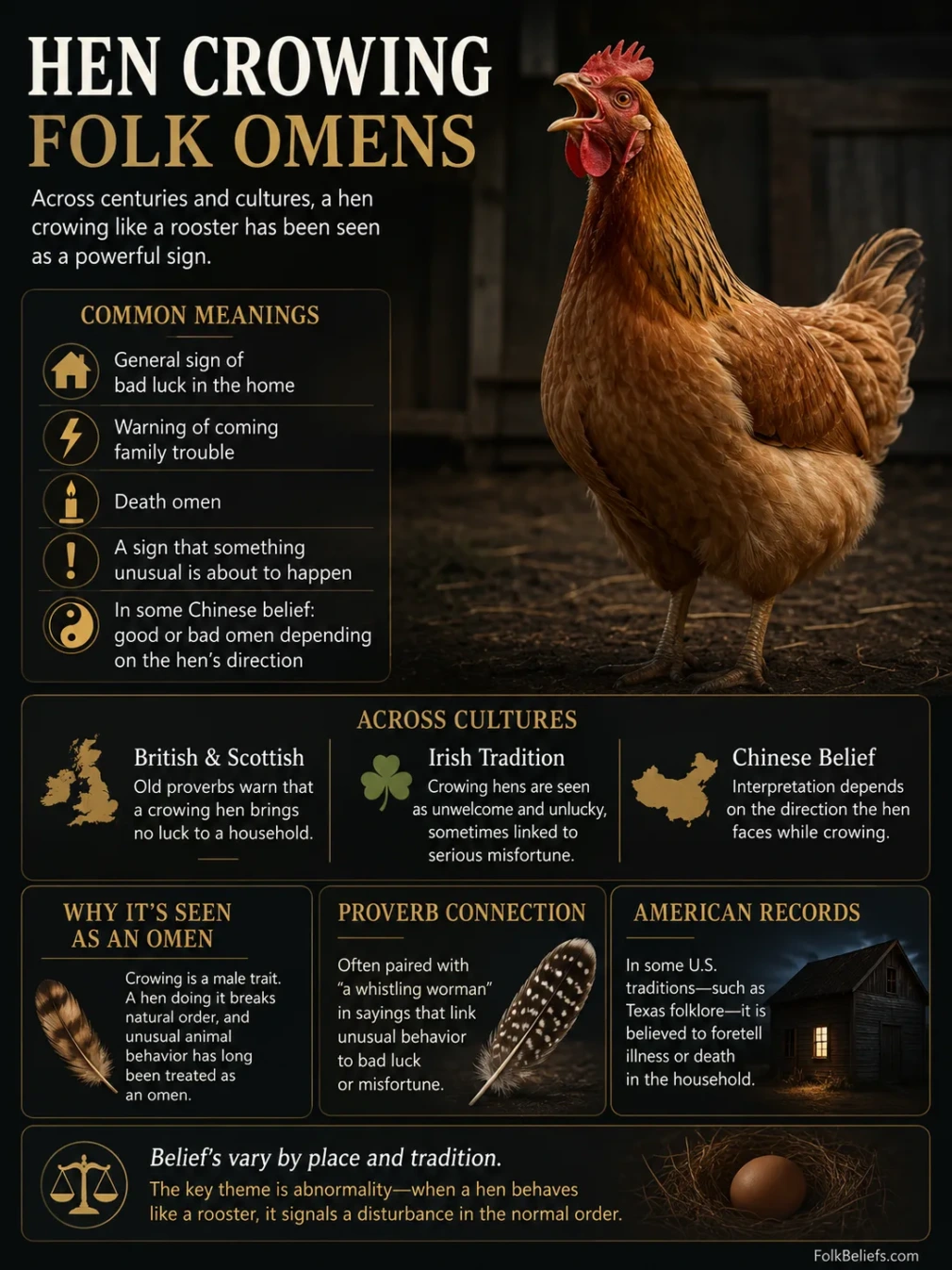
A hen crowing like a rooster has been treated in several recorded folk traditions as an unusual omen. British, Irish, and American records most often connect it with bad luck, household trouble, misfortune, or death. The meaning was not universal, however. A nineteenth-century account of Chinese folk belief records both favorable and unfavorable interpretations depending on the direction the hen faced while crowing.
What Did a Crowing Hen Mean?
One of the oldest clearly documented English-language versions of the belief appears in James Kelly’s 1721 collection of Scottish proverbs. The saying warns that “a crooning Cow, a crowing Hen, and a whistling Maid” brought no luck to a household.[1]
Later records preserve several related meanings rather than one fixed interpretation. Depending on the place and tradition, a crowing hen could be regarded as:
- a general sign of bad luck in the home;
- a warning of coming family trouble;
- a death omen;
- an indication that something unusual was about to happen;
- or, in one recorded Chinese system, either a good or bad omen according to the bird’s direction.
These meanings belong to particular folklore records. They should not be treated as beliefs shared by everyone in the countries or communities where collectors found them.
The Crowing Hen in Irish Folk Belief
Irish folklore collections contain many examples of uneasiness about hens that crowed. A record dated November 11, 1940 in the National Folklore Collection describes a crowing hen as an unwelcome presence in a house and says that having one nearby was not considered a good sign.[2]
Other Irish records vary in their details. Some simply call the bird unlucky. Others connect crowing hens with severe family misfortune or describe customs intended to remove the perceived bad luck. The variation matters: Irish archival material does not support a single nationwide rule about exactly what a crowing hen foretold.
The common thread is abnormality rather than one exact prediction. The hen was behaving in a way traditionally associated with a rooster, and that unexpected behavior could be interpreted as a disturbance in the normal order of the household.
Why Were Crowing Hens Considered Ominous?
Crowing was strongly associated with male chickens. A hen making the same sound therefore attracted attention in societies where poultry behavior was familiar from everyday life.
The association between unusual sex-linked animal behavior and omens is much older than the surviving British and Irish sayings. A modern historical study of zoological writing notes that a crowing hen appears among portents in the Roman playwright Terence’s Phormio. The same study also describes ancient observations of hens developing male-typical traits and crowing.[3]
This helps explain why the crowing hen could become such a strong folklore symbol. The bird displayed behavior that people associated with the opposite sex, and older societies often gave unusual animal behavior an omen-like meaning. That does not mean every crowing-hen belief had the same origin. Local traditions developed their own explanations and predictions.
The “Whistling Woman and Crowing Hen” Saying
The hen also became part of a proverb that circulated in several forms in Britain, Ireland, and later North America. In these sayings, a crowing hen is commonly paired with a woman who whistles.
The pairing reflects older social ideas about behavior considered appropriate for women and female animals. Both actions were presented as departures from expected roles, and the rhyme turned that perceived reversal into a warning about luck or misfortune.
The proverb remained in oral circulation well into the twentieth century. The University of Detroit Mercy’s James T. Callow Folklore Archive contains a version learned in Detroit in 1965 in which a whistling woman and a crowing hen are said to come to a bad end.[4]
The survival of the rhyme does not show that everyone repeating it literally expected disaster. Proverbs can continue as family sayings, warnings, jokes, or inherited expressions after the underlying belief has weakened.
Death Omens in American Records
Some American folklore gives the crowing hen a more specific meaning. The Handbook of Texas includes a hen crowing like a rooster among recorded signs said to foretell a death in the family.[5]
Similar beliefs appear in older collections from other English-speaking regions, but the prediction is not always death. Some traditions reduce the omen to bad luck or an approaching problem. This difference is a useful reminder that “a crowing hen means death” is too broad when stated without a location or source.
A Different Crowing-Hen Omen Recorded in China
An 1876 work by N. B. Dennys records a more elaborate interpretation attributed to Chinese popular belief of that period. According to the account, the crowing itself indicated that something unusual might happen to the family, but the meaning depended on the hen’s position.
- If the hen faced toward the front or outside of the premises while crowing, the omen was interpreted unfavorably and associated with poverty or other bad luck.
- If the hen faced toward the rear, it could instead indicate future prosperity.
Dennys also reported that families could remain uncomfortable with a crowing hen even when its direction suggested a favorable outcome.[6]
This record sharply differs from traditions in which crowing is automatically unlucky. It shows why the direction, place, date, and source of a folklore record matter when interpreting an omen.
Does a Hen Crowing Actually Predict Bad Luck?
No evidence shows that a hen’s crow predicts death, financial loss, or another future event. These interpretations belong to folklore.
Hens really can crow. Historical zoological descriptions record crowing and other male-typical traits in female chickens, and modern historical analysis treats such behavior as part of real biological variation rather than evidence of a supernatural warning.[3]
The folklore remains valuable for a different reason. Crowing-hen beliefs show how an unexpected animal sound could be interpreted through ideas about luck, death, household order, gendered behavior, and the boundary between ordinary and extraordinary events. The surviving records preserve several meanings rather than a single universal omen.
Sources and Records
- ↑1 Dictionaries of the Scots Language, Scottish National Dictionary: “Croon, v.², n.²”,
- ↑2 National Folklore Collection, UCD, “A Crowing Hen”,
- ↑3a ↑3b Ross Brooks, “Bounds of Diversity: Queer Zoology in Europe from Aristotle to John Hunter”,
- ↑4 University of Detroit Mercy Libraries, James T. Callow Computerized Folklore Archive,
- ↑5 Texas State Historical Association, “Folk Belief”,
- ↑6 N. B. Dennys, The Folk-Lore of China and Its Affinities with That of the Aryan and Semitic Races,
Documented Locations
Countries: Argentina, Bahamas, Colombia, Costa Rica, Croatia, Fiji, Greece, Jamaica, Peru, Philippines, Spain, Venezuela
These labels identify where a version has been documented. They do not mean that everyone in the country, region, or community shares the belief.