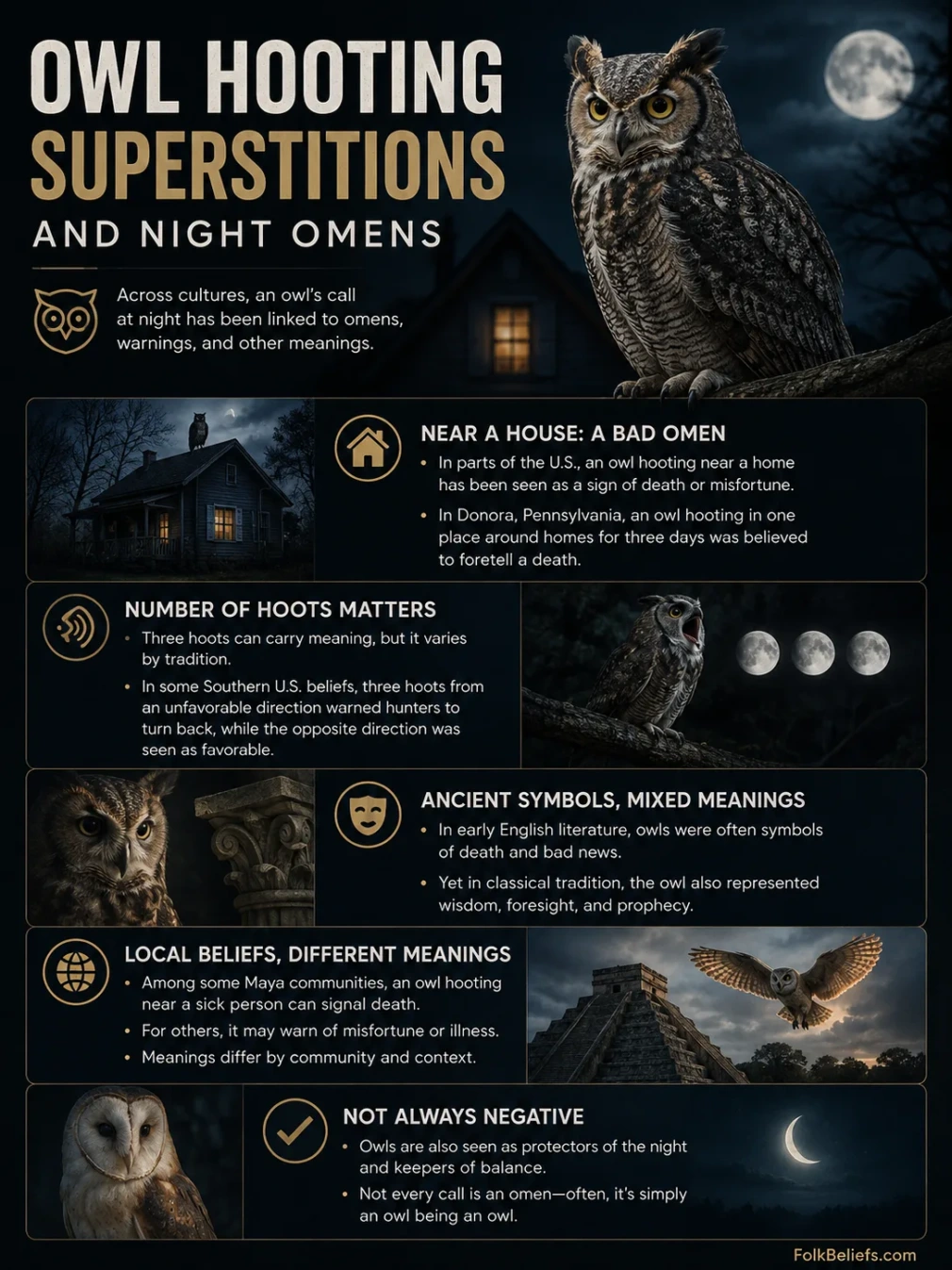
Hearing an owl hoot at night has no single folklore meaning. In some documented traditions, an owl calling close to a house was treated as a warning of death or misfortune. Other records connect the call with weather, direction, repetition, or a particular number of hoots. The sound, timing, direction, and local tradition can all change the interpretation.
These meanings belong to folklore. An owl’s call does not predict a future event.
When an Owl Hoots Near a House
Several American folklore records give special meaning to an owl heard close to a home rather than somewhere farther away.
The James T. Callow Folklore Archive at the University of Detroit Mercy contains a Nashville, Tennessee record learned in 1973 stating that an owl hooting near a house foretold the death of a family member. Another Tennessee record, from Columbia, connects an owl calling from the roof of a house where someone was already sick with the death of that person. The same archive preserves a personal narrative in which neighbors interpreted an owl heard close to a house during a man’s final illness as a death warning, although the narrator explicitly rejected the idea that the bird caused his death.[1]
A separate archive entry records a narrower version associated by the informant with Donora, Pennsylvania. In that account, an owl remaining in one place and hooting around nearby homes for three days was believed to mean that a death would soon occur in one of those homes.[2]
These are local records, not a rule shared by everyone in Tennessee, Pennsylvania, or the United States. The call near the house is part of each recorded situation.
Does the Number of Hoots or Screeches Matter?
Some owl superstitions attach meaning to a counted series of calls, but there is no universal number code.
Ernest Ingersoll’s 1923 Birds in Legend, Fable and Folklore describes a Southern U.S. belief involving three calls from a “hoot-owl.” The interpretation depended partly on the direction from which the calls came. In the hunting tradition he described, three hoots from an unfavorable direction could cause a hunter to abandon the trip, while the opposite direction received a better reading.[3]
Edgar Thurston’s 1912 collection from Southern India preserves a different system based on counted screeches. One screech was associated with death, two with success, six with arriving guests, and nine with favorable results. Other counts in the same passage carried still other meanings.[4]
The two records make the limitation clear. Three owl calls cannot be assigned one fixed meaning without knowing the tradition involved, and a counting system collected in one setting should not be applied to owl calls elsewhere.
Direction Could Matter as Much as the Number
Ingersoll’s example does not treat three hoots as a complete omen by themselves. Where the sound came from was part of the interpretation. The same sequence of calls could receive a different reading when heard from another direction.
This is why modern claims such as “three owl hoots mean death” are too broad when presented without a source. Older records sometimes combine number, direction, activity, time, and place into one belief.
Night Calls and Death Omens in Older English Sources
The ominous sound of an owl was also familiar in early modern English culture. The Folger Shakespeare Library notes that owls appear repeatedly as birds associated with death or bad news in Shakespeare’s works. An owl’s shriek accompanies the murder scene in Macbeth, while other plays place owl cries within ominous settings.[5]
This literary material is not a universal rule for English folklore. It shows that an owl’s nighttime voice could already carry ominous associations in early modern writing and popular imagination.
Owl Calls in Several Maya Community Records
Ethnographic material discussed by Karen Bassie-Sweet in Maya Gods of War gives several examples in which an owl’s vocalization receives a specific local interpretation. The records concern named communities rather than one belief shared by all Maya peoples.
- Among the Chuj, one cited record says that an owl hooting near a sick man foretold his death.
- A Mam record connects the owl’s hoot with misfortune affecting the family.
- In a cited Akatek tradition from San Miguel Acatán, vocalizing near a house was associated with the death of a family member.
- In a cited Q’eqchi’ record, a hooting owl was interpreted as a death omen.
These examples are best read as community-specific traditions. They do not support a single “Maya meaning” for every owl heard at night.[6]
Not Every Owl Call Was a Bad Omen
Even archived American material gives owl calls other meanings. A University of Detroit Mercy folklore record learned in Euclid, Ohio, in 1971 states that an owl hooting during the daytime meant rain was coming.[1]
A call beside a house at night, repeated hooting over several days, counted hoots from a particular direction, and a daytime call could therefore belong to different belief systems. The sound alone does not supply one traditional meaning.
Hooting, Screeching, and Other Owl Calls
The word hoot is useful for a broad search, but historical records do not always describe owl sounds in the same way. Collectors and informants use words such as hoot, screech, cry, howl, or sing. Different owl species also produce different vocalizations.
For folklore purposes, the wording in the original record should be preserved where it affects the belief. A superstition about counted screeches should not automatically be rewritten as a fixed number of hoots, and a record about hooting should not be treated as evidence for every sound an owl can make.
What an Owl’s Hoot Means in Nature
Owls use vocalizations for ordinary biological communication. The Cornell Lab of Ornithology describes the repeated low hoot of a male Flammulated Owl as a song used to advertise to potential mates and mark territory. The species also makes other sounds, including twitters, mews, hisses, moans, and screams.[7]
Repeated calls at night can therefore be normal owl behavior. Hearing a bird from the same direction on several nights may simply mean that its territory, roosting area, or regular activity occurs nearby.
Folklore records show how people interpreted owl calls in particular places and circumstances. They document traditions surrounding the sound; they do not establish that a hoot, screech, or repeated series of calls forecasts death, illness, weather, or luck.
Sources and Records
- ↑1a ↑1b University of Detroit Mercy Libraries, The James T. Callow Computerized Folklore Archive,
- ↑2 University of Detroit Mercy Libraries, The James T. Callow Computerized Folklore Archive, “Hooting Owls”,
- ↑3 Ernest Ingersoll, Birds in Legend, Fable and Folklore,
- ↑4 Edgar Thurston, Omens and Superstitions of Southern India,
- ↑5 Haylie Swenson, “Owls in the Early Modern Imagination: Ominous Omens and Pitiable Sages”,
- ↑6 Karen Bassie-Sweet, Maya Gods of War,
- ↑7 Cornell Lab of Ornithology, “Flammulated Owl Sounds”,
Documented Locations
Countries: Nepal
These labels identify where a version has been documented. They do not mean that everyone in the country, region, or community shares the belief.