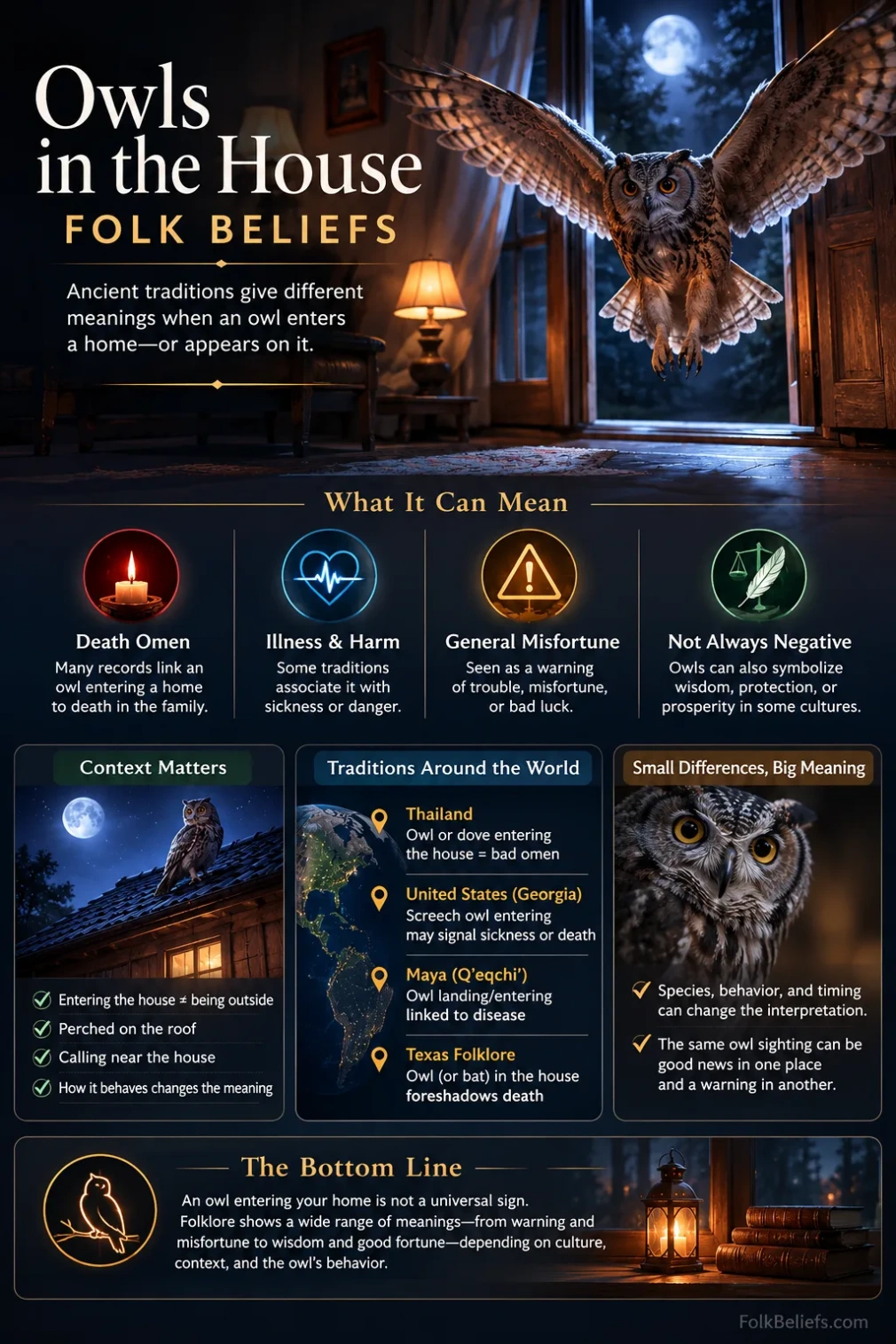
An owl flying into a house is treated as an ominous event in several documented folk traditions. Recorded meanings include death, illness, danger, or more general misfortune. These interpretations are not universal, and they should be understood as folk beliefs rather than predictions.
The details matter. An owl actually entering a room may carry a different meaning from one sitting on the roof, calling beside the house, or merely flying overhead. Folklore records often preserve these as separate omens rather than one worldwide rule.
Documented Meanings of an Owl Entering the House
Among the records that specifically describe an owl crossing into a home or room, unfavorable interpretations appear often. The exact feared event varies by place and source.
| Recorded Context | Owl Event | Folklore Interpretation |
|---|---|---|
| Northern Thai and Bamar respondents in parts of Tak and Mae Hong Son provinces, Thailand | An owl or dove flies into the house | The event was reported as a bad omen associated with someone dying.[1] |
| Central Georgia, United States, recorded in the late nineteenth century | A screech owl flies into a room | The entry was said to indicate sickness, death, or another form of evil. The same record warned against killing the owl.[2] |
| Q’eqchi’ material summarized in a modern scholarly study of Maya beliefs | An owl lands on a house or flies inside | The event was recorded as an omen of disease. Other Maya communities cited in the same discussion had related but different owl omens.[3] |
| Texas folklore collected in earlier Texas Folklore Society publications | An owl is inside the house | A collected death-omen tradition states that an owl or bat in the house foretells death. A more specific Kildare account describes particular fear of a horned, or “hoot,” owl entering and sitting at the foot of a bed.[4] |
Does an Owl in the House Always Mean Death?
No single interpretation applies everywhere. Death is one recurring meaning in the house-entry records, but sickness and more general misfortune also appear. Even closely related owl beliefs can change according to species, location, or what the bird does.
This distinction is especially useful when comparing an owl that enters a home with one that remains outside. Türkiye’s Ministry of Culture and Tourism records beliefs in which an owl hooting in front of a house could be associated with death or disaster, while an owl landing on a house could be regarded as bad luck.[5] Neither description requires the bird to enter the building.
Perching on the Roof Could Carry a Different Message
Older Greek folklore provides an example in which even the owl’s posture could alter the reading. Jivanji Jamshedji Modi’s study of owl folklore, drawing on John Cuthbert Lawson’s work, describes a brown owl sitting motionless on a house as a death omen. If the bird appeared alert, stayed only briefly, and flew away, the same encounter could instead announce the arrival and temporary stay of an acquaintance.[6]
This is one reason an “owl at the house” should not automatically be treated as identical to an “owl entering the house.” Traditional omen systems could assign meaning to where the owl appeared, how long it stayed, its call, and its behavior.
Can an Owl Be a Good Sign?
Broader owl symbolism is not uniformly negative. Modi notes the well-known association between the owl and wisdom in classical Greek tradition, even while documenting much darker owl omens elsewhere.[6]
Indian traditions also show why broad claims about “the meaning of an owl” can be misleading. Wildlife SOS notes that barn owls are associated in some Indian traditions with Lakshmi and may be respected as symbols of prosperity or blessing, while other beliefs regard an owl on a house with fear.[7] A favorable association with the owl itself therefore does not automatically establish a favorable superstition about an owl physically entering a home.
Folklore and real events are different. An owl entering a house does not scientifically predict death, illness, or bad luck. If a wild owl gets indoors, it should not be harmed because of an omen. Keep a safe distance and seek help from a local wildlife rehabilitator or animal-control service if the bird cannot leave safely.
Sources and Records
- ↑1 Kanokwan Suwannarong et al., “Beliefs, Taboos, Usages, Health Perceptions, and Practices Toward Wildlife Among Different Ethnicities in Tak and Mae Hong Son Provinces, Thailand”,
- ↑2 Roland Steiner, “Superstitions and Beliefs from Central Georgia”,
- ↑3 Karen Bassie-Sweet, Maya Gods of War, Chapter 3,
- ↑4 Mody C. Boatright, Wilson M. Hudson and Allen Maxwell, eds., The Best of Texas Folk and Folklore: 1916–1954, p. 240,
- ↑5 Republic of Türkiye Ministry of Culture and Tourism, “Good Luck–Bad Luck”,
- ↑6a ↑6b Jivanji Jamshedji Modi, “The Owl in Folklore”,
- ↑7 Wildlife SOS, “Things You Didn’t Know About: Barn Owls”,
Documented Locations
These labels identify where a version has been documented. They do not mean that everyone in the country, region, or community shares the belief.