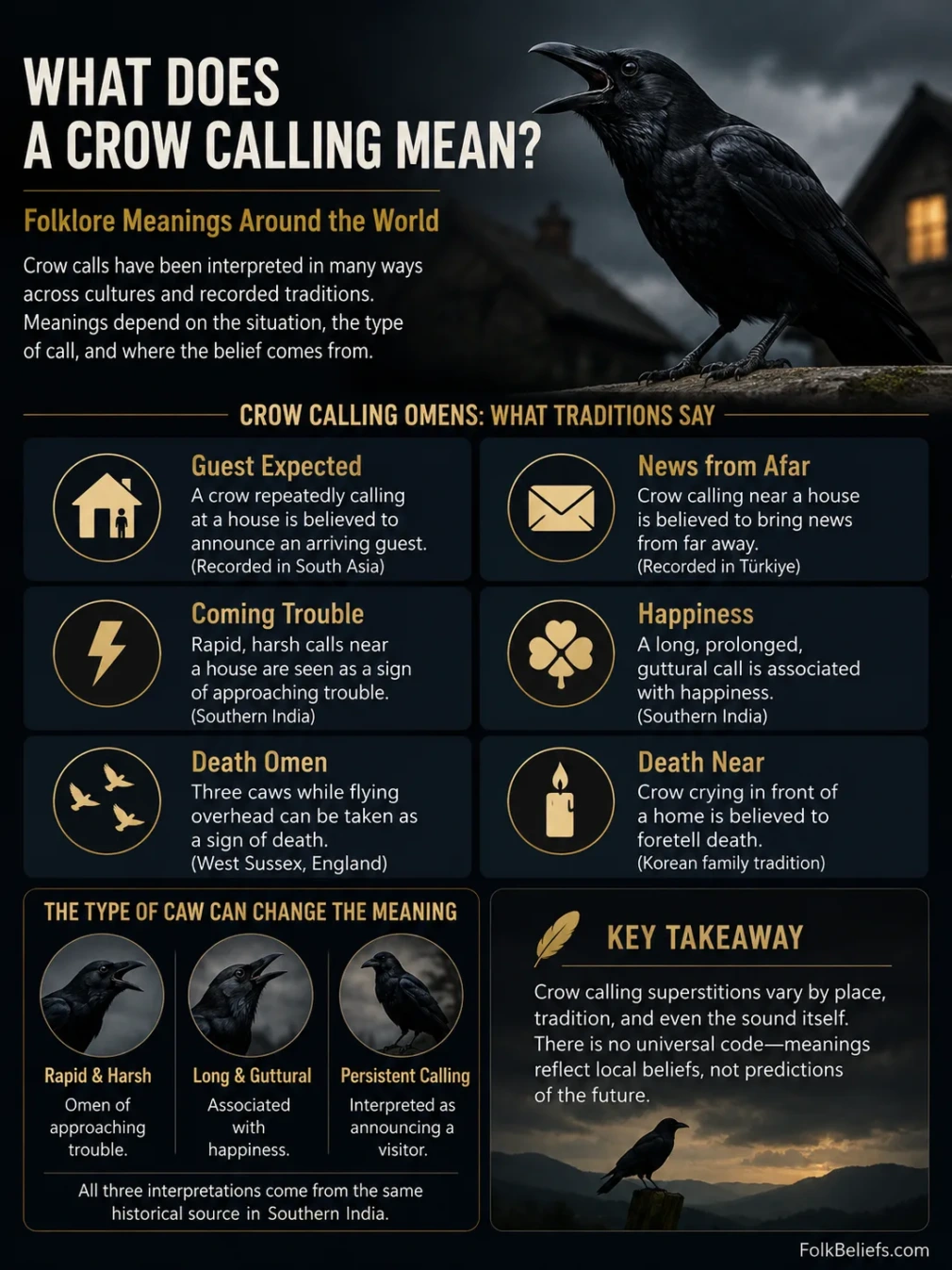
A crow calling near a house has no single folklore meaning. Surviving records give very different readings: an arriving guest, incoming news, happiness, bad luck, or death. In some traditions, even the sound of the call matters. A rapid harsh call can carry a different omen from a prolonged call, while elsewhere three repeated caws have their own local interpretation.
These meanings belong to particular records, places, families, and periods. They are folk interpretations of bird behavior, not reliable predictions of future events.
What Does a Crow Calling Mean in Superstition?
The most useful way to understand crow-calling folklore is to look at what the crow is doing and where the belief was recorded. Historical sources do not support a universal code in which every crow call has the same meaning.
| Recorded situation | Folklore meaning | Context |
|---|---|---|
| Crow repeatedly calling at a house | Guest expected | Recorded in Southern India and in other South Asian material |
| Rapid, harsh calls near a house | Coming trouble | Southern Indian record |
| Prolonged guttural call | Happiness | Same Southern Indian historical source |
| Three caws while flying overhead | Death omen | West Sussex record collected in the nineteenth century |
| Crow calling near a house | News from far away | Belief recorded by Türkiye’s Ministry of Culture and Tourism |
| Crow crying in front of a home | Death thought to be near | Family tradition collected from a Korean informant |
The Guest-Arrival Omen
One of the clearest documented meanings of persistent crow calling is that someone is coming to visit.
Edgar Thurston’s 1912 Omens and Superstitions of Southern India records several interpretations side by side. A crow repeatedly calling at a house was believed to announce a guest. Thurston added that the expectation could be taken seriously enough for some householders to prepare extra food.[1]
John Lockwood Kipling also described the Indian crow as a messenger in folk stories and wrote in Beast and Man in India that it was believed to announce approaching visitors.[2] These historical accounts support the visitor interpretation, but they should not be expanded into a claim that every community in India shared exactly the same belief.
A much later folklore collection provides a family-level example. An Indian-American informant told the USC Digital Folklore Archives that her grandparents in India interpreted a crow cawing outside a window as a sign that a guest would arrive.[3]
The Type of Caw Could Change the Omen
Not every recorded tradition interpreted all crow sounds alike. Thurston’s Southern Indian material is unusually specific about the bird’s voice.
Rapid and Harsh Calling
A crow approaching a house and giving its ordinary rapid, rough calls was recorded as an omen of approaching trouble.
A Long, Guttural Call
A prolonged guttural note received the opposite interpretation: it was associated with happiness.
Persistent Calling
Continuous cawing at the house was interpreted as announcing an expected visitor.
All three interpretations occur within the same historical source.[1] This is a useful warning against reducing crow folklore to a simple rule such as “cawing means bad luck.” In at least this recorded tradition, the character and persistence of the sound changed its meaning.
Three Caws as a Death Omen in West Sussex
A number-specific crow omen does appear in an English folklore record, but its scope is narrow.
Charlotte Latham collected beliefs around Fittleworth in West Sussex in the nineteenth century. One record describes a man who regarded three repeated caws from a carrion crow flying overhead as a token that a death had occurred. Latham also recorded a more general local saying that a crow cawing three times while flying over a house could signify death.[4]
This does not establish a universal “three caws” meaning. It documents a particular West Sussex belief collected in the nineteenth century. Modern lists that assign a fixed fortune to every possible number of crow calls should not be treated as universal historical folklore without evidence for each interpretation.
Crow Calls as Signs of News
Not every household omen predicts a physical visitor. Some traditions interpret the call as announcing information arriving from somewhere else.
An official collection of popular beliefs published by the Republic of Türkiye Ministry of Culture and Tourism records the belief that if a crow comes near a house and caws, the household will receive news from abroad. The same collection separately records crow calling as a sign that snow is coming.[5]
The two entries show how the same bird sound can belong to different omen categories even within one national folklore collection. One concerns human news; the other concerns weather. Neither should automatically be applied to every Turkish locality or community.
When Crow Calling Becomes a Death Warning
Death-related readings occur in several independent collections, although their details are not identical.
A Korean Family Tradition
A Korean informant in the USC Digital Folklore Archives recalled learning in Daegu that a crow crying in front of the house meant death was near. According to the collected account, his father would drive the bird away and advise caution after hearing it.[6]
This is evidence for a transmitted family belief associated with a particular informant and place. It should not be turned into a statement that all Korean crow folklore has this meaning.
American Folklore Archive Records
The James T. Callow Computerized Folklore Archive at the University of Detroit Mercy contains a Michigan record collected in 1967 stating that a crow sitting on a fence and cawing foretold a death in the family. Another entry from Allen Park, Michigan, recorded a crow flying over a house and calling as a bad omen.[7]
These records again show why location matters. The American examples do not reproduce the South Asian guest-arrival interpretation, and they do not establish a single American rule either.
Does the Number of Crows or Caws Have a Fixed Meaning?
Claims such as “one crow means bad luck, two mean good luck, three mean health, and four mean wealth” circulate widely in modern omen material. The historical records above do not support that sequence as a universal crow-calling tradition.
There is documented evidence for three caws carrying a death meaning in the West Sussex material, but that is a local record.[4] It should not be used to construct an assumed numerical system for one, two, four, five, or more calls.
Counting calls and counting birds are also different practices. A belief concerning three sounds from one crow is not automatically equivalent to folklore based on seeing a certain number of birds. Crow, raven, rook, and magpie traditions can also become mixed in later retellings even though historical sources may distinguish them.
Why a Crow May Actually Be Calling
Folklore gives human meanings to crow vocalizations, but crows themselves use calls as communication.
Cornell Lab research on American Crows describes caws in several behavioral settings, including territorial defense, food recruitment, predator mobbing, and alarm. The birds also produce many other vocalizations besides the familiar caw, and differences in pitch, duration, cadence, and intensity can carry information between crows.[8]
So a crow repeatedly calling from a roof, tree, fence, or garden does not provide evidence that a visitor, death, letter, or other predicted event will follow. The omen interpretation belongs to folklore; the audible call is part of ordinary crow behavior.
Why Crow-Calling Meanings Differ So Much
The records show a recurring idea: the crow acts as an announcer. What it announces changes with the tradition.
- A visitor may be approaching.
- News may be coming from far away.
- A particular kind of call may indicate happiness.
- A harsher call may be treated as a warning.
- Three caws may foretell death in one recorded English tradition.
- A call near the home may become a death omen in some family and regional records.
- In another context, the call may be read as a weather sign.
This variation is part of the folklore itself. There is no need to choose one interpretation as the “real” meaning. A crow calling outside a window can signify a guest in one recorded tradition and misfortune in another because the beliefs developed and circulated in different social settings.
Sources and Records
- ↑1a ↑1b Edgar Thurston, Omens and Superstitions of Southern India,
- ↑2 John Lockwood Kipling, Beast and Man in India,
- ↑3 USC Digital Folklore Archives, “Crow Cawing Outside a Window”,
- ↑4a ↑4b Charlotte Latham, “Some West Sussex Superstitions Lingering in 1868”,
- ↑5 Republic of Türkiye Ministry of Culture and Tourism, “Good Luck-Bad Luck”,
- ↑6 USC Digital Folklore Archives, “Korean Crow Superstition”,
- ↑7 University of Detroit Mercy Libraries, James T. Callow Computerized Folklore Archive,
- ↑8 Cornell Lab of Ornithology, “American Crow Sounds”,
Documented Locations
Countries: Bangladesh, China, Colombia, Croatia, Cyprus, Germany, Greece, India, Iran, Iraq, Jamaica, Jordan, Nepal, Pakistan, Paraguay, Philippines, Sri Lanka, Thailand, Tonga, Uzbekistan
These labels identify where a version has been documented. They do not mean that everyone in the country, region, or community shares the belief.