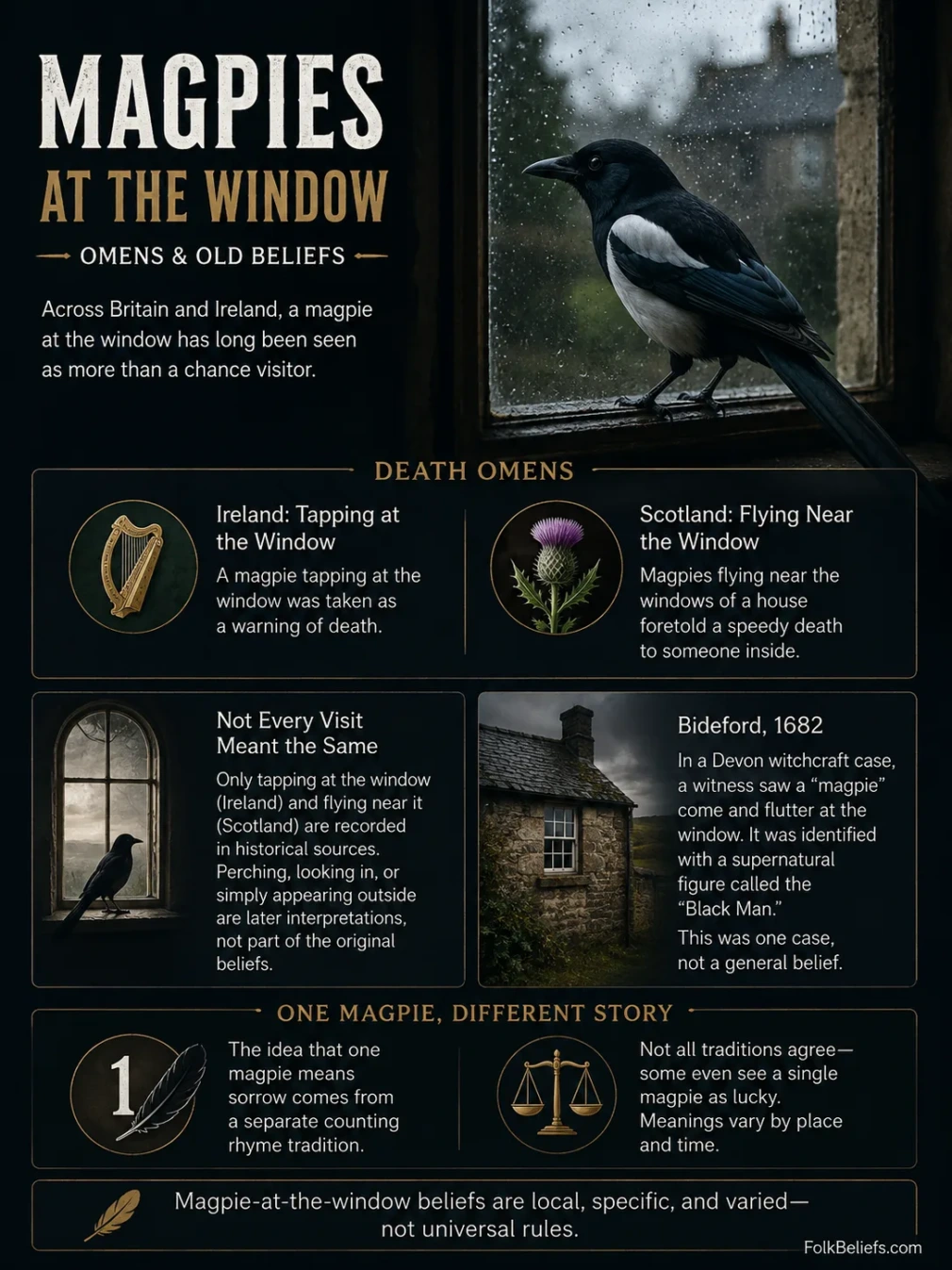
A magpie at a window does not have one fixed meaning across folklore. The clearest historical records are narrower: an Irish tradition describes a magpie tapping at a window as a warning of death, while a nineteenth-century account records a similar belief in Scotland about magpies flying close to a house’s windows. Other records connect the same scene with witchcraft, while familiar beliefs about one or several magpies belong to a separate counting tradition.
What the Window Superstitions Actually Say
One of the most direct records appears in H. Kirke Swann’s 1913 A Dictionary of English and Folk-Names of British Birds. In his entry for the magpie, Swann cites Charles Francis Keary’s earlier work when reporting that in Ireland, a magpie tapping at the window was taken as a death-warning.[1]
The wording matters. The record concerns a bird tapping at the window; it does not establish a rule that every magpie visible from a window carried the same meaning. It is also an attributed Irish belief from an older folklore source, not evidence that everyone in Ireland shared it.
A related record appears in T. F. Thiselton-Dyer’s Folk-lore of Shakespeare, published in 1884. Dyer wrote that a notion recorded in Scotland held that magpies flying near the windows of a house foretold a speedy death to one of its occupants.[2]
The most defensible reading is therefore local and specific: historical British and Irish material does contain death-omen traditions involving magpies and windows, but the surviving descriptions vary in action and place. They should not be turned into a universal rule about magpies.
Tapping, Fluttering, and Looking Through the Glass
Modern versions of the superstition often treat every encounter as equivalent: a magpie taps the glass, lands on the sill, stares through the window, or simply appears outside, and each event is given the same ominous interpretation. The older records are less uniform.
A Magpie Tapping at the Window
The strongest directly documented window form is the Irish record summarized by Swann: tapping was interpreted as a death-warning. This is the form most closely matched by the phrase magpie knocking on the window superstition.
A Magpie Flying Near the Window
The Scottish account does not require the bird to strike the glass. Dyer describes magpies flying near the windows of a house as the ominous action. The difference shows why later retellings should not be treated as one perfectly fixed tradition.
A Magpie Sitting Outside or Looking In
The historical sources above do not support automatically assigning the same death-warning to a magpie that merely sits on a sill, perches nearby, or looks through the glass. Those situations may be interpreted through newer family traditions, but they should be distinguished from the recorded tapping and near-window beliefs.
The Magpie at a Bideford Window in 1682
A much older window episode survives in records connected with the Bideford witchcraft prosecutions in Devon. A nineteenth-century publication preserving the historical depositions reports that Anne Wakely, who was attending the ill Grace Thomas, said that on the morning of 29 June 1682 she saw something in the shape of a magpie come to the chamber window. She was then asked about a bird coming and fluttering at that window. Within the witchcraft accusation, Temperance Lloyd reportedly identified the bird with the supernatural figure her interrogators called the “Black Man.”[3]
This case is useful because it shows how alarming a bird at a window could become within a particular seventeenth-century belief setting. It should not be rewritten as a general Devon superstition that every magpie at a window represented a witch or supernatural being. The surviving record concerns one accusation, one household, and one historical prosecution.
The Bideford episode and the later death-warning traditions are related by imagery, but they are not identical beliefs. In Bideford the magpie was interpreted within an accusation of witchcraft. In the Irish and Scottish records, the emphasis is on the bird as an omen associated with death.
Does One Magpie at the Window Mean Sorrow?
The familiar idea that one magpie means sorrow comes from a different branch of magpie folklore. Dyer recorded a northern English counting rhyme beginning with one bird for sorrow and two for mirth, with additional meanings assigned as the number increased.[2] Versions still vary in wording, number, and outcome.
Present-day British superstition also retains the practice of greeting or saluting a lone magpie, often as a way of neutralising the unlucky association attached to seeing one by itself.[4]
That means a person seeing one magpie at a window may encounter two traditions at once:
- the window-related belief in which certain magpie behaviour near the house was read as an omen;
- the counting tradition in which a single magpie acquired an unlucky or sorrowful meaning.
They can overlap in later storytelling, but the historical evidence does not require them to be treated as one original superstition.
Does a Pair of Magpies at the Window Change the Meaning?
In counting rhymes, two magpies commonly receive a more favourable meaning than one. That can lead to the modern interpretation that two birds outside a window cancel the ominous meaning associated with a solitary bird.
The window-specific records, however, do not establish such a rule. The Irish tapping tradition recorded through Swann concerns a magpie, while the Scottish account speaks more generally of magpies near windows. Neither provides a complete system in which every possible number of birds at a window has a defined outcome.
It is therefore more accurate to say that the number symbolism comes from magpie-counting folklore and may be applied to a window encounter by people who know that separate tradition.
Why Birds at Windows Became Ominous
Magpies were not the only birds associated with troubling window omens. Thiselton-Dyer’s Domestic Folk-lore describes a broader belief in which birds hovering around a house or tapping against a window-pane could be interpreted as signs of death. Ravens, crows and swallows appear among the examples, while the magpie is also mentioned among birds with an ominous reputation.[5]
This wider material helps place the magpie belief in context. The unusual event was not always simply “seeing a magpie.” A bird approaching the inhabited space, repeatedly fluttering beside a room, striking the pane or appearing unusually close to the household could be noticed and remembered as an omen.
That does not show that such events predicted anything. It shows how ordinary animal behaviour was interpreted within older systems of household signs and warnings.
Why a Magpie May Really Tap or Attack a Window
A repeated tap at the glass also has an ordinary behavioural explanation. Birds can see their reflection in windows and react to it as though another bird has entered their territory. The British Trust for Ornithology describes territorial birds becoming focused on a reflected “intruder” and recommends reducing or blocking the reflection when the behaviour becomes persistent.[6]
Audubon likewise notes that birds may repeatedly attack windows and mirrors during the breeding season because they mistake their own reflection for a rival. The behaviour can include tapping, fluttering and repeated returns to the same pane.[7]
Folklore and bird behaviour describe different things. A historical source can document that people interpreted a tapping magpie as an omen; ornithology explains why a living bird may actually interact with reflective glass. The physical event does not provide evidence that the traditional prediction will occur.
How the Meaning Changes by Record
| Recorded Setting | Magpie Behaviour | Folklore Interpretation |
|---|---|---|
| Ireland, reported through nineteenth- and early twentieth-century folklore writing | Tapping at a window | A death-warning |
| Scotland, nineteenth-century account | Flying near the windows of a house | A warning of a speedy death in the household |
| Bideford, Devon, 1682 | Coming to and fluttering at a chamber window | Interpreted within a specific witchcraft accusation as a supernatural agent |
| Northern English magpie-counting tradition | Seeing one or more magpies | The meaning changes with the number seen; this is not inherently a window belief |
| Ordinary bird behaviour | Repeated tapping, pecking or fluttering against reflective glass | A territorial response to a reflected bird can explain the behaviour without an omen |
A magpie appearing at a window can therefore carry several meanings depending on which tradition is being recalled. The historically documented window beliefs are mainly ominous in the Irish and Scottish examples, but they are regional records rather than a universal magpie rule. A bird simply sitting outside the glass is not automatically the same event as the tapping, fluttering or near-window behaviour described in those sources.
Sources and Records
- ↑1 H. Kirke Swann, A Dictionary of English and Folk-Names of British Birds,
- ↑2a ↑2b T. F. Thiselton-Dyer, Folk-lore of Shakespeare,
- ↑3 Paul Q. Karkeek, Devonshire Witches,
- ↑4 SuperstitionsMap, “English and UK-Wide Superstitions: Beliefs and Omens Across Britain”,
- ↑5 T. F. Thiselton-Dyer, Domestic Folk-lore,
- ↑6 British Trust for Ornithology, “Window Strikes”,
- ↑7 Andy McGlashen, “Why Birds Attack Windows and Mirrors—and How You Can Stop Them”,
Documented Locations
Countries: Afghanistan, Azerbaijan, Croatia, Russia
These labels identify where a version has been documented. They do not mean that everyone in the country, region, or community shares the belief.