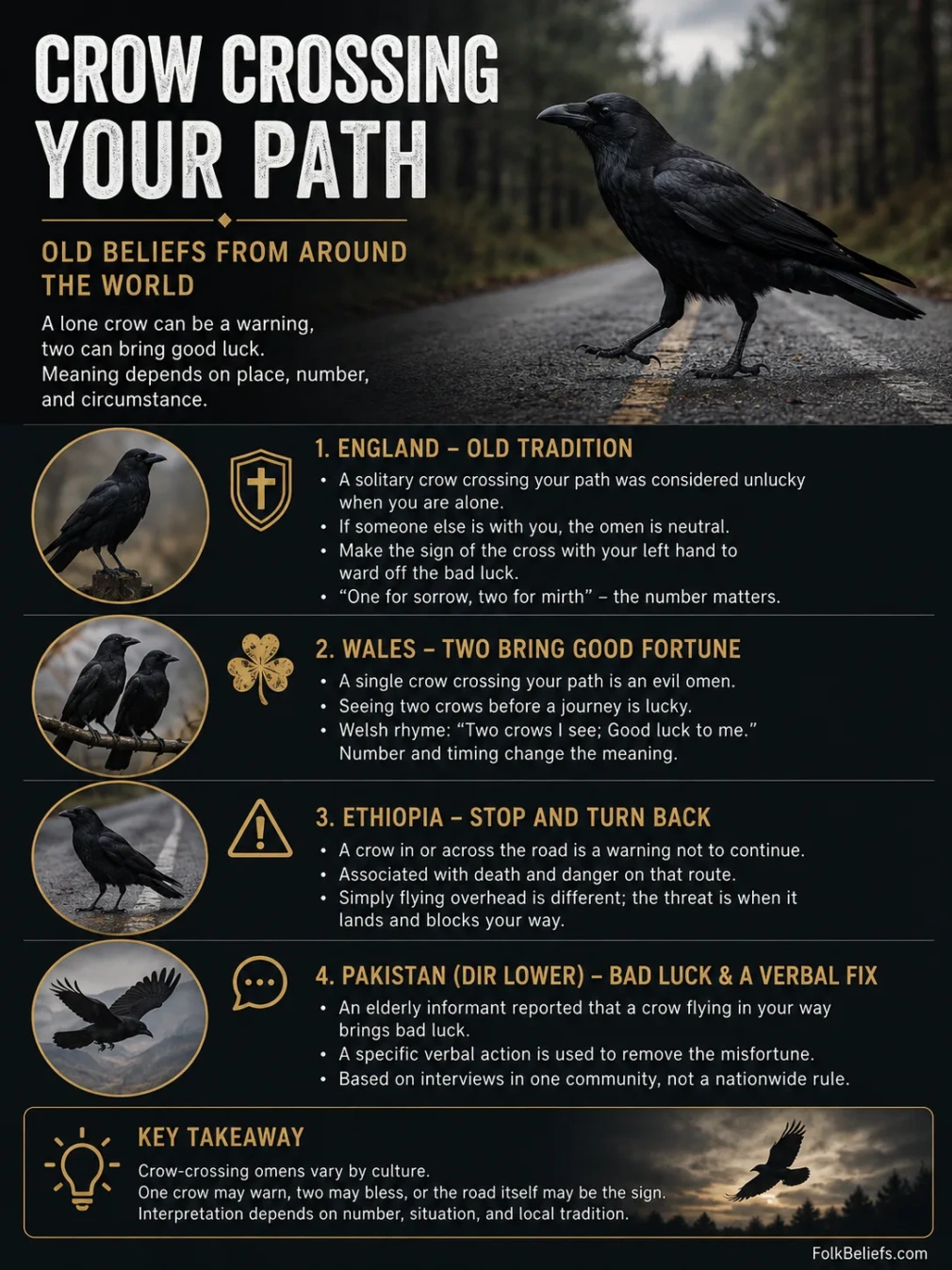
A crow crossing your path has no single fixed meaning in folklore. In several older British records, a lone crow crossing a traveler’s route was treated as unlucky, while the presence of a second crow could reverse the omen. Other documented versions depend on whether the traveler is alone, whether the crow is standing in the road, or on a local action meant to counter the warning.
Evidence note: The records below come from named folklore collections, an archived family account, and a small field study. Each source describes a particular place, collector, family, or group of participants. None should be treated as proof that everyone in the wider country or culture shares the belief.
An Older English Crow-Crossing Superstition
Sidney Oldall Addy’s 1895 collection of traditions from York, Lincoln, Derby, and Nottingham records a direct crow-crossing rule: a crow flying across a person’s path was considered unlucky. The belief was more detailed than a simple warning about seeing a black bird.
According to the collection, a solitary crow crossing the path was not considered unlucky if another person was present. A person traveling alone was instead instructed to make the sign of the cross on the left hand. The same passage connects crow crossings with the short counting formula “One for sorrow, two for mirth”, indicating that the number of birds could alter the interpretation.[1]
The Welsh Record Reverses the Luck With Two Crows
Marie Trevelyan’s 1909 Folk-lore and Folk-stories of Wales preserves a closely related but distinctly Welsh version. Her collection states that seeing two crows before setting out on a journey was fortunate, while a single crow crossing a person’s path was regarded as an evil omen.
The contrast also appears in the rhyme “Two crows I see; Good luck to me.” Here, the bird itself is not permanently lucky or unlucky. Number and circumstance change the reading: one crow crossing the route carries the negative meaning, while two crows can signal favorable luck before a journey.[2]
When the Road Becomes Part of the Omen
A much later record in the USC Digital Folklore Archives shows a different version centered on the road itself. In a 2015 interview, an informant with Ethiopian family background described a belief learned from her mother and grandfather. In her account, encountering a black crow in or across the road meant that the observer should not continue along that route.
She recalled that her grandfather, who had lived in Ethiopia, would stop while driving when he encountered such a crow. The family account associated the bird with death and treated continuing past it as dangerous. The informant also distinguished a crow simply flying overhead from a crow that had landed and obstructed the direction of travel.[3]
This archive entry is best read narrowly. It documents one informant’s inherited family belief and memories connected with Ethiopia; it does not establish a rule followed throughout Ethiopia.
A Crow Crossing the Way in Dir Lower
A 2024 qualitative study provides another localized example from Lal Qala in Dir Lower, Khyber Pakhtunkhwa, Pakistan. Researchers used interviews and participant observation with 23 purposively selected participants who practiced or followed the beliefs being studied.
During the section dealing with birds and luck, an elderly woman reported that a crow flying in a person’s way brought bad luck and also described a verbal action intended to remove the misfortune. Because the statement comes from a small field study in one community, it supports a Dir Lower record, not a general claim about Pakistani belief.[4]
Does a Crow Crossing Your Path Mean Death?
Death is one interpretation, but it is not present in every documented version. The USC family account explicitly connected the road omen with death. Addy’s English record instead describes the crossing as unlucky and gives methods for avoiding the bad luck, while Trevelyan’s Welsh collection calls the solitary crossing an evil omen without making every occurrence a fixed prediction of death.
For that reason, saying that a crow crossing your path always foretells death goes beyond the evidence. The surviving records include broader ideas of misfortune, interrupted journeys, and reversed luck as well as the more severe death-related interpretation.
Why One Crow and Two Crows Can Mean Different Things
The older English and Welsh material shows how easily crow-crossing beliefs become mixed with counting omens. A person may not simply ask whether a crow appeared. The tradition may also ask how many crows were present, whether the observer was alone, and whether the encounter occurred while beginning or continuing a journey.
This also explains why different versions of crow-counting rhymes should not be treated as one universal code. Addy’s collection links the crossing belief with one-for-sorrow and two-for-mirth wording, while Trevelyan records good fortune from two crows before departure. These are related patterns preserved in particular collections, not a worldwide system for interpreting every crow encounter.
Do Left-to-Right and Right-to-Left Crossings Have Different Meanings?
The records used here do not establish a general left-to-right or right-to-left rule for a crow crossing the path. Direction does matter in some bird-omen traditions, but applying a directional formula to crows without a matching record can accidentally import a belief associated with another bird, place, or tradition.
The clearest documented details in these crow records concern number, journey context, companionship, and whether the bird blocks or crosses the route, rather than a universal left-versus-right distinction.
Crows, Ravens, and Magpies Should Not Be Treated as the Same Omen
Older folklore collections frequently place crows beside ravens and magpies, and similar counting formulas can appear around more than one member of the corvid family. That overlap can cause later retellings to merge separate beliefs. Trevelyan, for example, discusses crow, raven, and magpie omens in the same part of her Welsh collection while still assigning particular observations to particular birds.[2]
A raven crossing a road in one source therefore should not automatically become a crow-crossing superstition, and a magpie counting rhyme should not be presented as uniquely about crows unless the record itself makes that connection.
Folklore note: These traditions record ways people have interpreted encounters with crows. A crow flying across a road, path, or walking route is ordinary bird behavior and does not demonstrate that a future event will occur.
Sources and Records
- ↑1 Sidney Oldall Addy, Household Tales with Other Traditional Remains,
- ↑2a ↑2b Marie Trevelyan, Folk-lore and Folk-stories of Wales,
- ↑3 USC Digital Folklore Archives, “Black Crows and Traffic Jams”,
- ↑4 Umar Daraz et al., “Myths and Realities: How Different Forms of Superstitious Beliefs Create Good and Bad Luck for People in Pakistan Through an Anthropological Lens”,
Documented Locations
Countries: Pakistan
These labels identify where a version has been documented. They do not mean that everyone in the country, region, or community shares the belief.