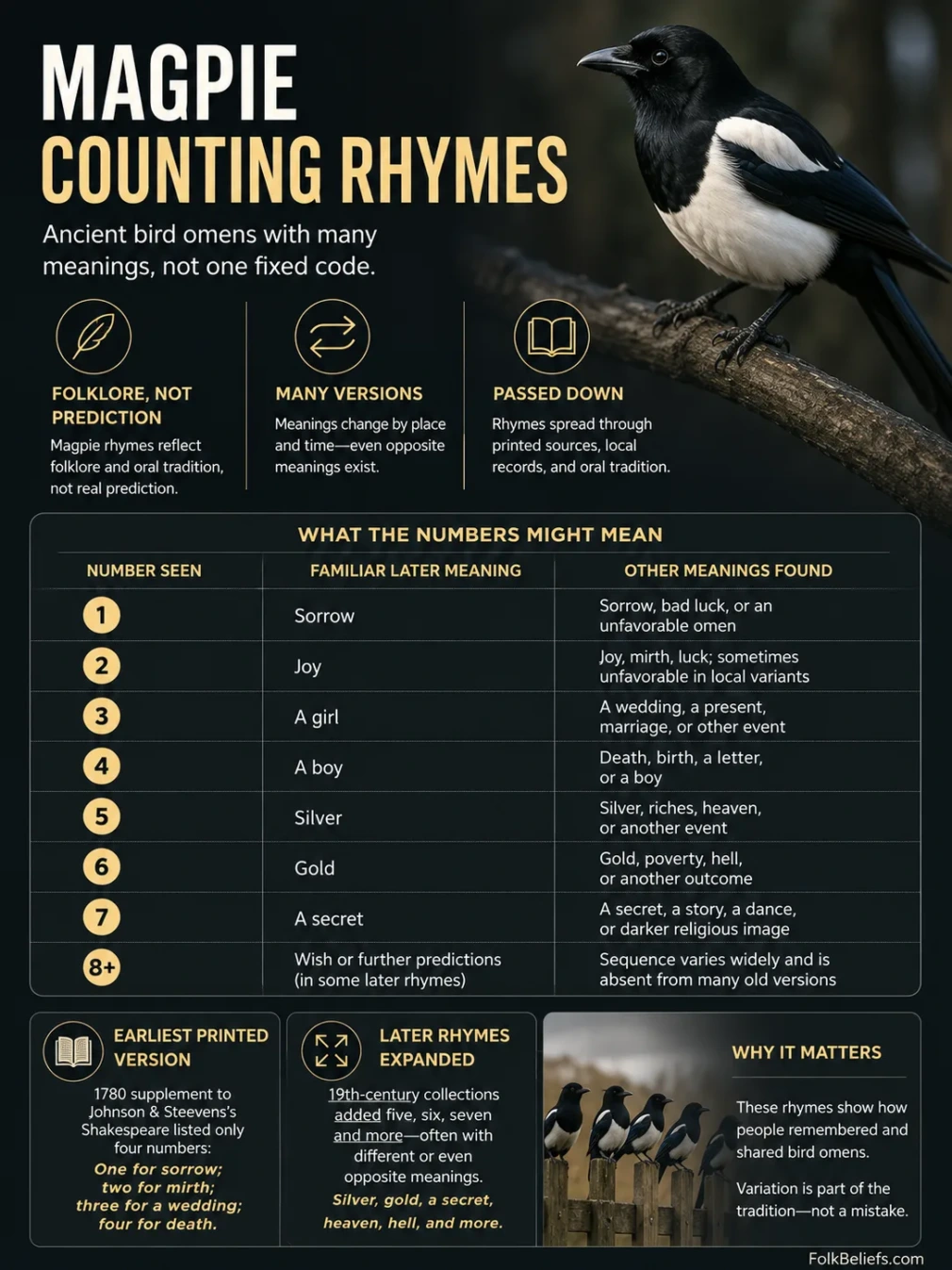
Magpie number superstitions treat the number of birds seen together as an omen. The best-known pattern begins with one magpie for sorrow and two for joy or good luck, but the meanings attached to three, four, and larger groups have never formed one fixed code. British records preserve many versions, and even closely related rhymes can give opposite meanings to the same number.[1]
The rhymes belong to folklore rather than prediction. They are useful evidence of how people remembered and passed on bird omens, especially because changes in the wording can be traced through printed collections, local records, and children’s oral tradition.
How the Magpie Counting Belief Works
The basic action is simple: a person notices several magpies and interprets the count through a remembered rhyme. In many familiar versions, one is unfavorable and two reverses the omen. After that, the sequence becomes much less stable.
| Number Seen | Familiar Later Meaning | Meanings Found in Other Recorded Versions |
|---|---|---|
| 1 | Sorrow | Sorrow, bad luck, or an unfavorable omen |
| 2 | Joy | Joy, mirth, luck; occasionally an unfavorable meaning in a local variant |
| 3 | A girl | A wedding, a present, marriage, or other event |
| 4 | A boy | Death, birth, a letter, or a boy |
| 5 | Silver | Silver, riches, heaven, or another predicted event |
| 6 | Gold | Gold, poverty, hell, or another outcome |
| 7 | A secret | A secret, a story, a dance, or a darker religious image in older versions |
| 8 and above | Wish, kiss, or further predictions in some later rhymes | The sequence varies widely and is absent from many older versions |
This variation is not a corruption of one original master rhyme. It is part of the tradition itself. Michael Aislabie Denham’s nineteenth-century material already gives alternatives such as luck or mirth for two, death or birth for four, silver or riches for five, and gold or poverty for six.[3]
The Earliest Printed Form Was Only Four Numbers Long
The familiar rhyme is sometimes attributed directly to John Brand’s 1777 Observations on Popular Antiquities. The publication history is more precise than that. A later edition of Brand’s work identifies the source as the 1780 supplement to Johnson and Steevens’s Shakespeare, where the augury was explained according to the number of magpies seen together:
One for sorrow; two for mirth; three for a wedding; four for death.[2]
That early record matters because it does not contain the now-familiar sequence of a girl, a boy, silver, gold, and a secret. It also makes three a wedding and four death, showing that the modern meanings of those numbers should not be projected backward onto every older version.
Five, Six, Seven, and Beyond Were Flexible Additions
Denham’s collected North of England material, reprinted by the Folklore Society in 1895 from tracts and pamphlets issued between 1846 and 1859, preserves a much longer sequence. Alongside sorrow, luck, wedding, and death, it extends the counting through silver, gold, a secret, heaven, hell, and a final religiously framed omen. The text itself marks several alternatives, showing that collectors were already encountering more than one wording.[3]
Later popular forms softened or replaced some of these older outcomes. One widely remembered sequence became:
- One for sorrow
- Two for joy
- Three for a girl
- Four for a boy
- Five for silver
- Six for gold
- Seven for a secret never to be told
It is better to describe this as a familiar version rather than the full or original magpie rhyme. Historical records do not support the idea that every number once had one universally accepted meaning.
The Same Number Could Mean Opposite Things
Iona and Peter Opie’s study of children’s lore recorded several contrasting versions in Britain. Bedford material gave one for sorrow, two for mirth, three for a wedding, and four for a birth. At Llanfair Waterdine, the sequence moved from sorrow and joy to a present, a letter, and something better. A version from Forfar in Angus reversed the opening pattern itself, assigning joy to one and grief to two, followed by a wedding and death.[4]
There is therefore no reliable universal answer to questions such as “What do three magpies mean?” Three may indicate a girl in one familiar rhyme, but historical records also assign it a wedding, marriage, present, or other outcome. The place, period, and version of the rhyme matter.
Irish Records Preserve Several Versions Side by Side
The National Folklore Collection provides especially clear evidence that variation could occur at a very local level. A Schools’ Collection page from Moate, County Westmeath, records one informant’s short form as sorrow, joy, wedding, and boy. On the same page, another version gives sorrow, joy, marriage, death, silver, gold, and a secret.[5]
Such records should not be turned into a single “Irish meaning” for each number. They document what particular informants or local circles knew. Their value lies precisely in showing how readily the rhyme changed while retaining a recognizable counting structure.
Why One and Two Are More Stable Than the Later Numbers
Despite all the variation, the pairing of one with sorrow or ill luck and two with joy, mirth, or luck appears repeatedly. It forms the most recognizable part of the British magpie-counting tradition and remains the version summarized in modern British superstition collections.[1]
The later numbers are easier to reshape because the rhyme needs words that fit both rhythm and expectation. Weddings, births, money, letters, secrets, and other anticipated events all work naturally as fortune-telling subjects. Oral transmission allows one remembered pair of words to be replaced by another without destroying the rhyme.
The Rhyme Could Become a Children’s Fortune-Telling Formula
Magpies did not always need to be physically present for the number sequence to survive. The Opies recorded children adapting magpie-style counting to other forms of fortune telling. Bus-ticket numbers, for example, could be reduced to a number and interpreted with a sequence using sorrow, joy, a letter, a boy, silver, gold, and a secret. The rhyme had moved from reading birds to providing a reusable set of numbered predictions.[4]
This helps explain why magpie counting can survive as a childhood habit even where the speaker does not treat the omen literally. A rhyme can function as a superstition, a game, a memory aid, or some mixture of all three.
Saluting One Magpie Belongs to the Same Folklore, but It Is a Different Custom
The practice of greeting or saluting a solitary magpie is closely associated with the unfavorable meaning of one bird. Some people acknowledge the magpie with a salute or polite greeting as a traditional way of countering the omen.[1]
The salute should not be treated as an obligatory second half of every counting rhyme. Protective responses to a lone magpie also vary by place and period. Counting the birds tells what the omen is supposed to mean; greeting, turning, making a gesture, or using another verbal charm belongs to the separate question of what a person traditionally did after seeing one.
Magpie-number meanings record folk interpretation, not the behavior or predictive ability of the birds themselves. Seeing one, three, seven, or any other number of magpies does not provide evidence that the events named in the rhymes will occur.
Sources and Records
- ↑1a ↑1b ↑1c SuperstitionsMap, “English and UK-Wide Superstitions: Beliefs and Omens Across Britain”,
- ↑2 John Brand, Observations on the Popular Antiquities of Great Britain,
- ↑3a ↑3b Michael Aislabie Denham, The Denham Tracts: A Collection of Folklore,
- ↑4a ↑4b Iona and Peter Opie, The Lore and Language of Schoolchildren,
- ↑5 National Folklore Collection, UCD, “Incidental Remarks Relative to Folklore,” Moate, County Westmeath,
Documented Locations
Countries: Ireland
These labels identify where a version has been documented. They do not mean that everyone in the country, region, or community shares the belief.