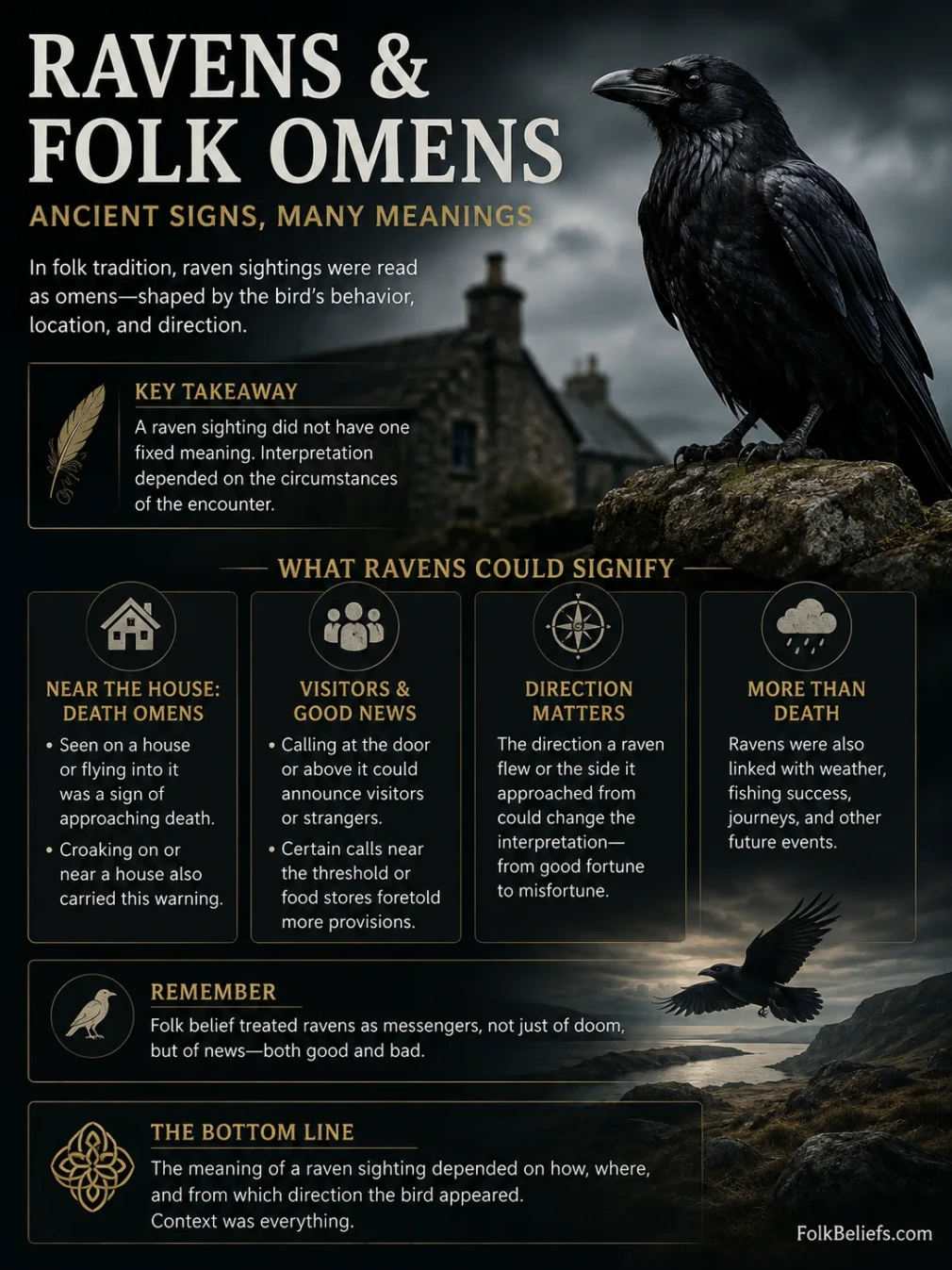
A raven sighting does not have one fixed meaning in folk tradition. Historical records describe ravens as warnings of death, messengers of approaching visitors, signs connected with journeys, and birds whose calls or direction of flight could alter an omen. The details depended on place, period, and the circumstances of the encounter. A raven simply appearing nearby was not automatically interpreted the same way everywhere.
What Could a Raven Sighting Mean in Folk Belief?
Some of the clearest raven omen records are surprisingly specific. A medieval Irish text did not treat every raven encounter as a single warning. The place where the bird called, the direction from which the sound came, and even the part of the household nearest the raven could change the interpretation. Icelandic folklore likewise attached prophetic meaning to the raven’s calls, flight, direction of approach, and behavior around homes and livestock.[1][2]
| Raven Encounter | Recorded Folk Interpretation | Recorded Context |
|---|---|---|
| Raven calling at different parts of a house | The meaning could range from approaching visitors to illness, danger, or an increase in food. | A fifteenth-century Irish manuscript fragment published by John Abercromby in 1884.[1] |
| Raven seen on a house | Recorded as a death omen. | A Schools’ Collection record from Callan, County Kilkenny.[3] |
| Raven flying into a house | Recorded as a sign of death. | A Schools’ Collection record from Ratharoon West, County Cork.[4] |
| Raven calls, flight, or approach direction | Could be read as information about death, weather, fishing, or other future events. | Recorded strands of Icelandic raven folklore.[2] |
These records show why a bare statement such as “seeing a raven means death” is too broad. Death is certainly one documented interpretation, but traditional omen systems could depend on what the raven was doing rather than on its presence alone.
Ravens Near the House and Death Omens
The association between ravens and approaching death appears repeatedly in historical folklore from Britain and Ireland. In the Callan record, the bird had to be seen on the house. In the Ratharoon account, the more unusual event of a raven flying into the house carried the death meaning.
A nineteenth-century collection from northern England and the Borders also lists ravens croaking on or near a house among traditional signs of approaching death. The raven appears there alongside other household death omens rather than as an isolated belief.[5]
The location matters. These sources record particular circumstances: a raven on a house, entering a house, or croaking close to one. They do not establish a rule that every raven encountered on a road, in a field, or flying overhead was considered a death omen.
A Raven’s Call Could Announce Visitors Rather Than Misfortune
The medieval Irish material gives the raven a much wider vocabulary of omens. A raven calling at the door could announce strangers or soldiers. Calling above the door could indicate other visitors. A call near the feet of the husband’s bed was connected with the arrival of a son, brother, or son-in-law. A raven calling at the threshold of the place where food was kept could foretell an increase in provisions.[1]
Other positions in the same record carried darker readings. A raven calling near the household man’s bed before an expedition could indicate that he would not return safely, while another placement was connected with the death of the wife. The source therefore preserves a location-based omen system, not a simple good-raven or bad-raven rule.
Direction and Movement Could Change the Omen
Flight direction is another recurring feature of raven divination. Icelandic folklore sources describe attention being paid to where a raven came from, how it flew, whether its head or tail faced the observer, and how it acted near people, animals, and dwellings. Raven calls were also given predictive value.[2]
This kind of belief treats the bird almost like a moving set of signs. Direction, sound, position, and behavior supply the meaning. A person encountering the same species under different circumstances could therefore receive a different traditional interpretation.
Ravens Were Not Always Bearers of Bad News
Icelandic raven tradition also preserves a more favorable side to the bird. Stories tell of kindness to ravens being repaid, and a traditional Icelandic saying expresses the idea that good treatment of the raven will itself be rewarded. These narratives exist alongside stories in which ravens foretell death or loss. The same folklore tradition can therefore portray the bird as ominous in one setting and helpful in another.
The medieval Irish omen text shows the same range on a smaller scale. Some raven calls announce danger, but others indicate visitors, relatives, or additional food. It would be misleading to reduce these records to the modern claim that ravens were universally feared.
Does the Number of Ravens Have a Fixed Meaning?
There is no single historical sequence in the records used here in which one raven always means one thing, two ravens another, three another, and so on. Number-based bird rhymes need particular care because ravens, crows, and magpies are easily mixed together in retellings.
A folklore record from Dangan in County Clare illustrates the problem clearly. It records bad luck from killing a raven, but the familiar sequence assigning different fortunes to one, two, three, and more birds is explicitly attached to magpies, not ravens.[6]
Claims such as “one raven means bad luck, two mean good luck, three mean…” should therefore be checked against the tradition from which the sequence supposedly comes. A rhyme documented for magpies or crows should not automatically be relabeled as raven folklore.
Raven, Crow, or Magpie?
Correct bird identification matters when tracing an omen. Historical collectors sometimes distinguished these birds carefully, while later retellings may blur them together.
For the Common Raven (Corvus corax), useful field marks include a large body, heavy bill, shaggy throat, deep croaking voice, and a wedge-shaped or diamond-shaped tail in flight. Crows are generally smaller and have a different tail profile and voice.[7]
This distinction can completely change the folklore evidence. A count rhyme associated with magpies, a crow omen, and a raven omen may all involve black or dark corvids, but they are not automatically versions of the same belief.
What Does Seeing a Raven Today Mean?
From a folklore perspective, the most accurate answer is it depends on the tradition and the circumstances. A raven on a roof has been recorded as a death sign in one Irish locality. A raven entering a house carried a similar meaning in another record. Medieval Irish material gave different meanings to calls from different parts of a dwelling, while Icelandic traditions read the bird’s direction, voice, and behavior in several ways.
These are records of belief, not evidence that a raven predicts an actual death, visitor, weather change, or future event. Seeing a raven outdoors can simply be ordinary bird behavior. The folkloric question is different: what did a particular community or historical source say that encounter meant?
That distinction also explains why modern interpretations such as “a raven always means transformation,” “repeated ravens are a spiritual message,” or “two ravens guarantee good fortune” should not be presented as universal folk rules without a traceable tradition behind them. Recorded raven lore is far more local and conditional.
Sources and Records
- ↑1a ↑1b ↑1c John Abercromby, “Irish Bird-Lore”,
- ↑2a ↑2b ↑2c Anna Þorbjörg Ingólfsdóttir, “Getið þið sagt mér einhverjar þjóðsögur um hrafninn?”,
- ↑3 National Folklore Collection, UCD, “Omens of Death”,
- ↑4 National Folklore Collection, UCD, “Superstitions – Death”,
- ↑5 William Henderson, Notes on the Folk-Lore of the Northern Counties of England and the Borders,
- ↑6 National Folklore Collection, UCD, “Bird Folklore”,
- ↑7 Cornell Lab of Ornithology, “Common Raven Identification”,
Documented Locations
Countries: Estonia, Iceland, Lebanon, Morocco
These labels identify where a version has been documented. They do not mean that everyone in the country, region, or community shares the belief.