A white owl does not carry one fixed meaning in folklore. Surviving records connect pale or “white” owls with death warnings, protective sayings, witch legends, household omens, and good luck. These meanings come from different places and periods, so a belief recorded in one community should not be treated as a worldwide rule.
The words white owl do not always identify the snowy owl. In older British usage, “White Owl” was also a name for the barn owl, Tyto alba. The Barn Owl Trust records White Owl, Ghost Owl, Death Owl, Church Owl, and Screech Owl among historical English names for the species.[1] This matters because many old European white-owl beliefs concern the pale barn owl living around farms, churches, and settlements rather than the Arctic snowy owl.
Why White Owls Became Signs of Death in Some Traditions
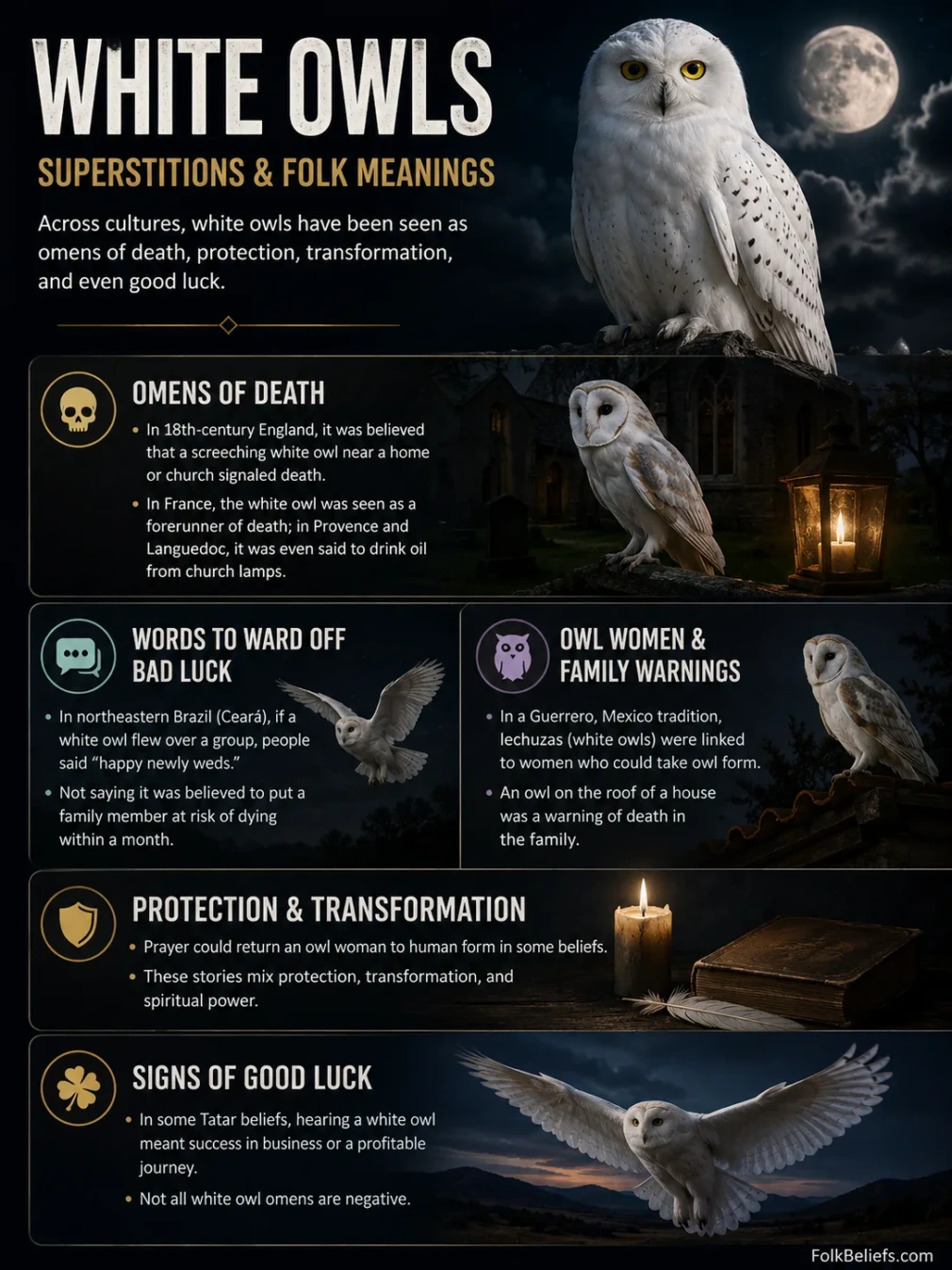
One of the clearest historical English records comes from naturalist Gilbert White. Writing about the white owls around the church at Selborne in the eighteenth century, he described their striking screams and noted a popular belief that a screeching owl attended the windows of dying people. White himself suggested that the bird’s unusual cry helped produce the superstition.[2]
The record shows how an ordinary owl encounter could acquire an ominous meaning through sound, darkness, and location. An owl calling beside a churchyard or house at night was easier to interpret as a warning in a community where similar stories were already familiar.
A nineteenth-century newspaper account preserves a related French association. An 1887 natural-history column reported the white owl as a forerunner of death in France and also mentioned a more specific belief from Provence and Languedoc that the bird drank oil from church lamps.[3]
That newspaper description should be read as a historical report of a belief, not proof that every person or region in France shared it. The Provence and Languedoc detail is more geographically useful than the article’s broad national wording.
A separate USC Digital Folklore Archives record from an informant associated with Ceará in northeastern Brazil describes a white owl passing above a group and a spoken response intended to avert a feared family death.[4] That record belongs to a more specific overhead-flight belief and should not be treated as the general meaning of seeing a white owl.
White Lechuzas in a Guerrero Village Tradition
A 2025 USC folklore record documents another local interpretation through an informant whose grandmother grew up in a small community in Guerrero, Mexico. In that account, lechuzas were explicitly described as white owls connected with stories of women taking owl form. They might appear near a house, in a tree, or on a rooftop. An owl landing on the roof was treated within the grandmother’s tradition as a warning of death in the family.[5]
The same narrative includes the idea that prayer could restore the lechuza to human form. This places the owl within a larger legend complex involving transformation, religious imagery, nighttime warnings, and rules about remaining close to home.
The geographic scope matters. The archive entry describes what the informant associated with her grandmother’s village in Guerrero. It does not establish a single Mexican belief about every white owl. The Spanish word lechuza also has broader uses, so every lechuza story should not automatically be converted into a white-owl tradition.
A White Owl Could Be Lucky Too
Death omens are only one side of the record. Edward B. Tylor’s nineteenth-century Primitive Culture gives an example with the opposite meaning. In a passage discussing what he called “Tatar rules” of animal omens, Tylor wrote that the cry of one small owl caused fear while a white owl was considered lucky.[6]
This is an old ethnographic account, and its terminology reflects nineteenth-century scholarship rather than a precise description of a present-day community. Its value here is narrower: it shows that older recorded folklore did not consistently treat a white owl as an unlucky bird.
What Different White Owl Encounters Mean in the Records
| Encounter | Recorded Folk Meaning | Documented Context |
|---|---|---|
| White owl screaming near homes | Associated with dying people | Eighteenth-century Selborne, England |
| Seeing a white owl | Reported as a death warning | Nineteenth-century account concerning France |
| White lechuza landing on a roof | Warning of a death in the household | Family and village tradition connected with Guerrero, Mexico |
| Encountering a white owl | Lucky rather than unlucky | Nineteenth-century ethnographic account of “Tatar rules” |
Does Seeing a White Owl Mean Someone Will Die?
Folklore records do contain that interpretation, particularly when an owl appears near a home, roof, window, church, or dying person. Yet the documented meanings conflict with one another. Another historical record calls a white owl lucky, while other traditions attach meaning to particular actions or settings rather than to color alone.
For that reason, seeing a white owl cannot be assigned a universal folk prediction. “Death omen” accurately describes certain traditions, but not the white owl’s meaning everywhere.
What If a White Owl Lands on Your House?
The Guerrero lechuza narrative associates a rooftop landing with a family death warning. Older European material similarly connects owls near houses and windows with death. These are related motifs, but they come from separate traditions and should not be merged into one supposed worldwide belief.
Is a White Owl Good Luck or Bad Luck?
Both meanings are documented. Several records treat the bird as disturbing or ominous, while Tylor’s historical account explicitly mentions a lucky white owl. The most accurate answer is therefore neither by default. Luck depends on the particular folklore tradition being discussed.
Why the Owl’s Behavior Matters as Much as Its Color
The surviving examples suggest that white plumage alone did not create every omen. The owl might scream near a window, perch on a roof, appear around a church, or simply be encountered. Each action could become part of the meaning.
This helps explain why two stories about a white owl can point in opposite directions. Folklore often attaches meaning to the whole encounter—place, sound, timing, response, and local story—not just to the animal’s color.
White-owl omens are cultural traditions rather than reliable predictions of death, luck, marriage, or supernatural events. Seeing a pale owl remains a natural wildlife encounter regardless of the meaning attached to it in folklore. Owls should not be disturbed or harmed because of an omen.
Sources and Records
- ↑1 Barn Owl Trust, “Barn Owl Names – Cherub or Demon?”,
- ↑2 Gilbert White, The Natural History and Antiquities of Selborne,
- ↑3 “Superstitions About Birds,” Otago Witness, July 29, 1887,
- ↑4 USC Digital Folklore Archives, “White Owl”,
- ↑5 USC Digital Folklore Archives, “Las Lechuzas”,
- ↑6 Edward B. Tylor, Primitive Culture, Chapter IV,
Documented Locations
These labels identify where a version has been documented. They do not mean that everyone in the country, region, or community shares the belief.