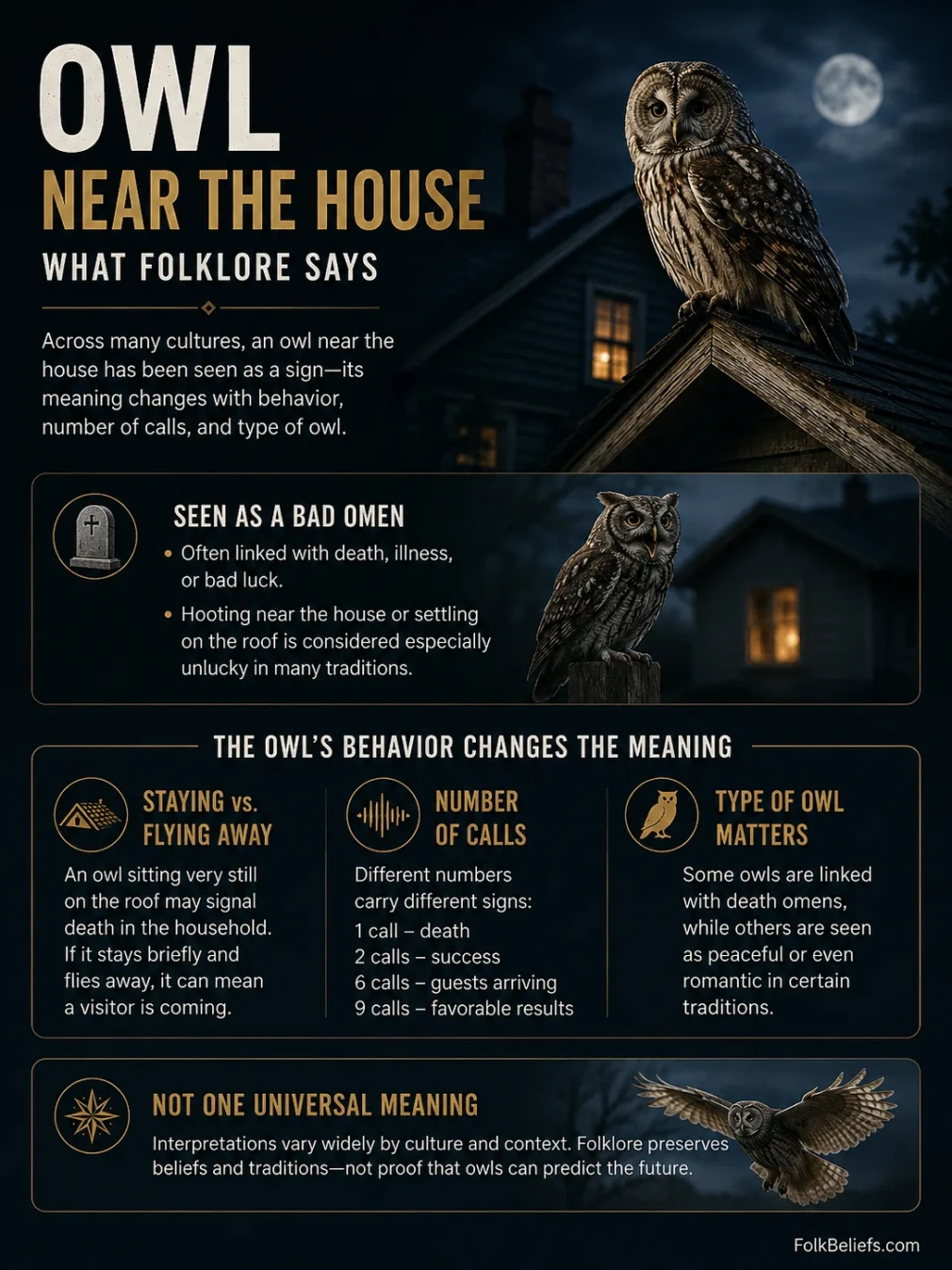
An owl appearing close to a house has been treated as a household omen in many recorded traditions. The darker interpretations connect the bird with bad luck, illness, or death, particularly when it settles on a roof, remains in a yard, or stays close to the people living there. Other records give different meanings, so an owl’s presence near a home does not have one fixed traditional interpretation.
Historical accounts often pay close attention to where the owl appears and how it behaves while it is there. A bird sitting motionless on a roof could be interpreted differently from one that briefly lands and flies away. These meanings belong to folklore and do not show that an owl can predict what will happen to a household.
When an Owl Near the House Is Considered a Bad Omen
One official collection of popular beliefs published by the Republic of Türkiye Ministry of Culture and Tourism records that an owl landing on a house was believed to bring bad luck to that household.[1] The entry records a belief preserved in the collection; it should not be treated as a belief shared by everyone in Türkiye.
Death-related interpretations also appear in records where the owl’s physical position around the home is part of the omen. A James T. Callow Folklore Archive account learned in connection with Rome, Georgia, describes a feared owl that would appear near a gravely ill person’s home and perch on the porch, windowsill, or a nearby tree. The collected story associated its arrival with the person’s approaching death.[2]
The location alone does not create a universal rule. A roof, yard, windowsill, porch, or nearby tree may be important in a particular recorded belief, but another tradition can interpret the same setting differently.
Where the Owl Appears Can Change the Meaning
| Owl’s Position | Recorded Interpretation | Recorded Context |
|---|---|---|
| Lands on a house | Bad luck for the household | Popular-belief collection published by Türkiye’s Ministry of Culture and Tourism[1] |
| Sits motionless on a roof | Death in the household | Greek folklore recorded by John Cuthbert Lawson[3] |
| Stops briefly on the roof and flies away | Arrival and stay of an acquaintance | The same Greek account |
| Perches on a porch, windowsill, or tree near an ill person’s home | Death omen in the collected story | James T. Callow Folklore Archive record associated with Rome, Georgia[2] |
The records are more specific than the general statement that an owl outside the house is unlucky. Position, posture, duration, and the condition of people inside the home can all be part of the original belief.
An Owl Sitting on the Roof
John Cuthbert Lawson’s 1910 account of Greek folklore preserves a detailed example involving an owl on a house roof. An owl sitting there in an unusually still posture was interpreted as foretelling a death in the household. The meaning changed if the bird stayed for only a short time, remained alert, and then flew elsewhere. In that situation, its appearance was associated with the arrival and stay of an acquaintance.[3]
This distinction makes the bird’s posture and duration of stay part of the belief. Merely saying that an owl was on the roof leaves out the details that determined the interpretation in Lawson’s account.
An Owl in the Yard or Close to the Home
A bird does not have to sit directly on the building to become part of household folklore. The Callow archive account associated with Rome, Georgia, describes the owl moving among several places close to an ill person’s home, including a porch, windowsill, and nearby tree. Its presence remained connected with the household even when it changed perches.[2]
This kind of record is useful when considering reports of an owl in a yard or a tree beside a house. The important point is not that every nearby owl carried the same omen, but that some traditions treated continued presence within the immediate space around a home as part of the event being interpreted.
Does an Owl Near the House Always Mean Bad Luck?
No. Bad luck and death appear in several house-owl traditions, but they are not universal meanings. Lawson’s Greek account changes from a death omen to an expected visitor when the owl’s behavior changes from sitting motionless on the roof to making only a brief, alert stop.
The same caution applies when comparing records from different places. An owl landing on a house in one collected tradition and an owl sitting beside a home in another should not be combined into a single worldwide superstition. Each record supports only the setting and interpretation actually described by its source.
Seeing an Owl Near the House and Hearing One Hoot Are Different Events
An owl may be noticed because it is perched on a roof, standing in a yard, sitting in a nearby tree, or resting on another part of the property. Those are location-based encounters. A superstition based mainly on the owl’s call belongs to a related but different group of beliefs.
Traditions involving repeated calls, the number of hoots, the direction of a call, or hooting at a particular time are covered separately in owl hooting superstitions and night omens. Keeping the two situations separate preserves the details found in the historical records.
Why an Owl May Naturally Appear Near a Home
An owl can appear around a building for ordinary biological reasons. The Cornell Lab of Ornithology notes that Great Horned Owls use a variety of roosting and nesting settings, including trees, cavities, ledges, and human-made structures.[4]
A roof edge, mature tree, yard, or structure near a house may therefore provide a useful resting place or access to suitable habitat. The folklore record describes how people interpreted an owl’s presence; the presence itself does not establish that good or bad events will follow.
Sources and Records
- ↑1a ↑1b Republic of Türkiye Ministry of Culture and Tourism, Good Luck- Bad Luck,
- ↑2a ↑2b ↑2c University of Detroit Mercy Libraries, James T. Callow Folklore Archive, “Death Owl”,
- ↑3a ↑3b John Cuthbert Lawson, Modern Greek Folklore and Ancient Greek Religion: A Study in Survivals,
- ↑4 Cornell Lab of Ornithology, Great Horned Owl Life History,
Documented Locations
Countries: Azerbaijan, Bolivia, Brazil, Croatia, Cuba, France, Germany, Ghana, Italy, Jamaica, Mexico, Morocco, Peru, Philippines, Spain, Sweden, Thailand, Tonga, United Kingdom
These labels identify where a version has been documented. They do not mean that everyone in the country, region, or community shares the belief.