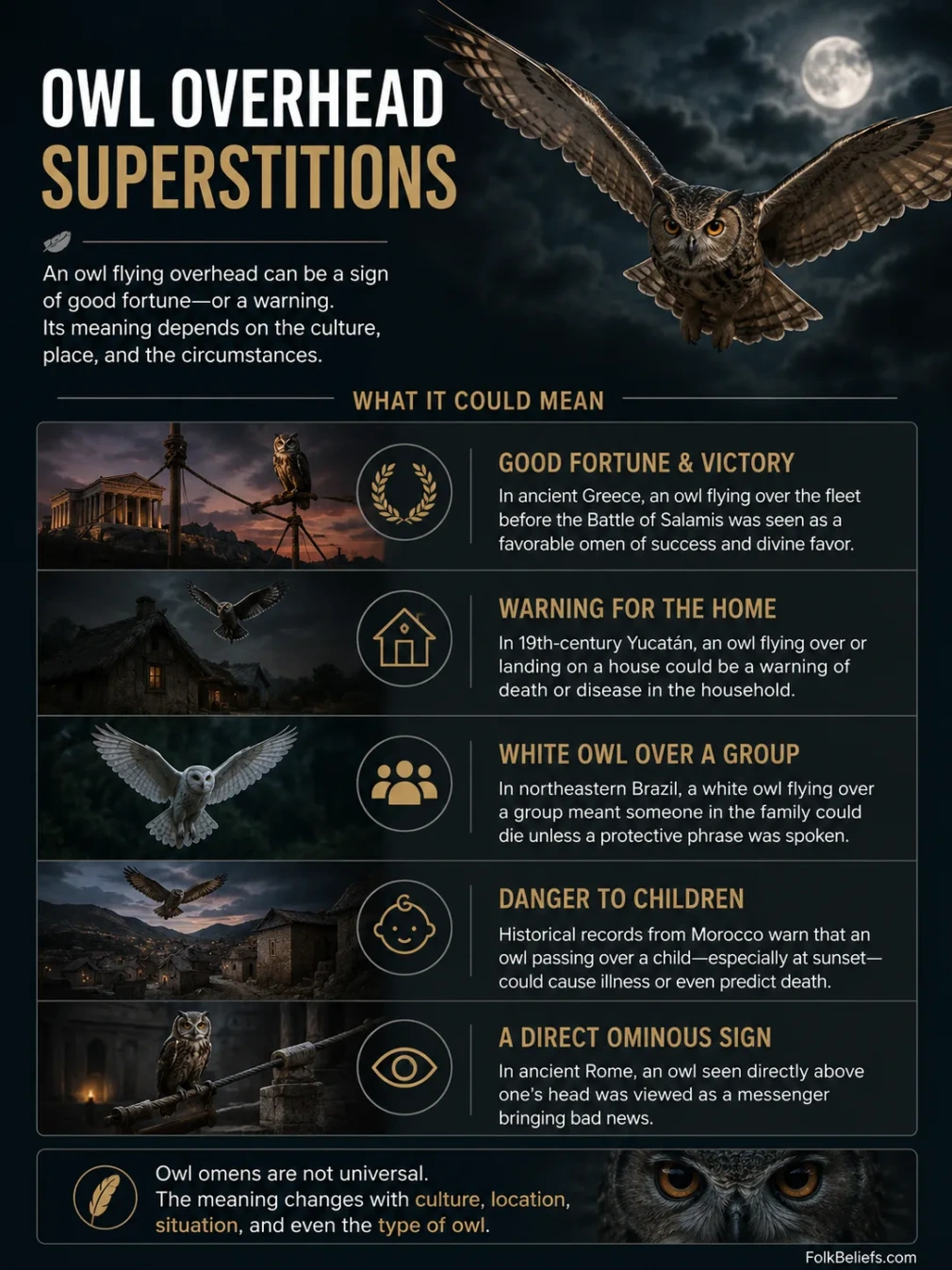
An owl flying overhead does not have one fixed meaning in folklore. Recorded interpretations range from victory and favorable fortune to warnings of death, illness, or trouble. The meaning changes with the place, period, circumstances, direction of flight, and sometimes the kind or color of owl involved.
What Does an Owl Flying Overhead Mean in Superstition?
The broad idea that an owl passing above someone is automatically a bad omen is too simple. Historical and folkloric records preserve several different readings.
| Recorded Setting | Meaning Attached to the Owl |
|---|---|
| Ancient Greek account connected with the Battle of Salamis | A favorable omen that encouraged the Greeks to prepare for battle |
| Nineteenth-century Yucatán records | An owl flying over a house could be treated as a warning of death or disease |
| White owl passing above a group in a northeastern Brazilian informant record | A feared family death unless a prescribed spoken response was made |
| Historical Moroccan ethnographic records | In several local traditions, an owl passing over a young child was feared as a cause or warning of illness or death |
A Favorable Owl Omen in the Greek Tradition
One of the clearest positive examples appears in Plutarch’s Life of Themistocles. In the account surrounding the Greek fleet before the Battle of Salamis, an owl was said to fly on the right side of the ships and settle on the rigging. The appearance was regarded as a favorable omen and helped persuade those present to prepare for battle.[1]
This reading fits the owl’s association with Athena in Athenian tradition. It also shows why an overhead owl cannot be assigned a universal negative meaning. In this particular ancient account, the bird’s movement was connected with favor and expected success, not approaching misfortune.
When an Owl Flew Above a House
A very different interpretation was documented in Yucatán. A scholarly study of Maya warfare and omen traditions cites an 1883 account in which an owl was considered an unsettling bird whose arrival could predict death or disease if it landed on, or even flew over, a house. Later ethnographic records from Maya communities also connect various owl species and calls with illness, death, or other troubling events.[2]
The important detail is the movement over the household. The source does not establish a rule that any owl passing above any person anywhere carries the same prediction. It documents a regional belief involving the bird’s flight in relation to a home.
A White Owl Flying Over People in Northeastern Brazil
The USC Digital Folklore Archives preserves a more specific modern example collected from an informant who had spent most of his life in northeastern Brazil and identified Ceará as his Brazilian residence. According to the account, when a white owl flew above a group of people, those present were supposed to call out a phrase translated as “happy newlyweds.” Failing to do so was associated with a fear that someone in the family would die during the following month.[3]
The spoken phrase acts as a response to the feared omen. The informant remembered taking part in the custom as a child but no longer accepting the prediction as an adult.
This is a white-owl-specific overhead tradition, not a general rule about white owls. Its defining action is the bird passing above people, and the archive entry comes from one informant. The collector, who was also Brazilian, reported not knowing the belief. It therefore should not be presented as a custom shared throughout Brazil or northeastern Brazil.
Historical Beliefs About Owls Passing Over Children
Edward Westermarck’s early twentieth-century ethnographic work in Morocco records several local beliefs involving an owl passing directly above a child. In Fez, he reported a warning against keeping a small child outside near sunset because an owl might fly over the child’s head and supposedly make the child ill. He also recorded among the Ait Warain a belief that an owl flying over a nursing infant foretold the child’s death.[4]
These are historical, locality-specific records rather than statements about Moroccan belief as a whole. They also belong to a wider body of protective customs concerning infants and perceived supernatural danger.
An Owl Directly Above the Head in an Ancient Narrative
An especially literal “owl over the head” omen appears in Josephus’s account of Herod Agrippa I. Josephus describes Agrippa looking upward and seeing an owl sitting on a rope above his head. Agrippa understood the bird as a messenger of bad news because of an earlier prediction associated with the same sign.[5]
This is best treated as a specific ancient omen narrative, not evidence that everyone in the ancient Mediterranean interpreted an owl above the head in the same way. The favorable owl at Salamis and the ominous owl in Josephus show how strongly context could reverse the meaning.
Does the Direction of the Owl Change the Meaning?
Sometimes it does within a particular tradition. Plutarch’s Salamis account specifically places the owl on the right side of the fleet before it settled on the ship. Direction mattered in many systems of ancient omen interpretation, but there is no dependable worldwide rule stating that an owl passing from right to left, left to right, north to south, or directly overhead always predicts a particular event.
Claims that assign fixed meanings to every flight direction need a source tied to a particular place, period, and tradition. Direction should not be separated from the rest of the recorded encounter.
Does an Owl Flying Over You Mean Someone Will Die?
Some documented traditions do connect overhead owls with death, but the idea is not universal. The Yucatán material links an owl flying over a house with death or disease. The Ceará-linked record connects a white owl passing above people with a feared family death. Historical Moroccan records give still more specific readings involving infants.
Other records point in the opposite direction. The owl appearing beside the Greek fleet at Salamis was interpreted favorably. The evidence supports several local traditions rather than one worldwide death-omen rule.
Does the Owl’s Color Matter When It Flies Overhead?
Color matters only when the source itself makes it part of the belief. The Ceará-linked account explicitly identifies the bird as a white owl, so removing that detail would change the recorded tradition. The Yucatán, Moroccan, Greek, and Josephus examples do not create the same white-owl requirement.
A general belief about white owls should therefore not be used to interpret every overhead encounter. In the Brazilian record, both the bird’s color and the act of passing above the group belong to the same specific event.
Why an Owl May Naturally Fly Overhead
An overhead encounter also has an ordinary biological explanation. Owls travel, hunt, defend territories, search for mates, and move between resting and feeding areas. The Cornell Lab of Ornithology describes American Barn Owls hunting by flying low over open habitats, including fields, at dusk and during the night.[6]
Folklore gives such encounters cultural meaning, but an owl’s flight does not provide evidence that a later death, illness, victory, or other event has been predicted. The omen belongs to the tradition in which the encounter is interpreted.
For folklore purposes, details matter: an owl passing above a person, crossing beside a journey, flying over a house, settling on a roof, and calling nearby are separate motifs. Their meanings should not be combined unless the historical or ethnographic record itself connects them.
Sources and Records
- ↑1 Plutarch, The Life of Themistocles,
- ↑2 Karen Bassie-Sweet, Maya Gods of War,
- ↑3 USC Digital Folklore Archives, “White Owl”,
- ↑4 Edward Westermarck, Ritual and Belief in Morocco,
- ↑5 Flavius Josephus, Antiquities of the Jews, Book XIX,
- ↑6 Cornell Lab of Ornithology, “American Barn Owl Life History”,
Documented Locations
These labels identify where a version has been documented. They do not mean that everyone in the country, region, or community shares the belief.