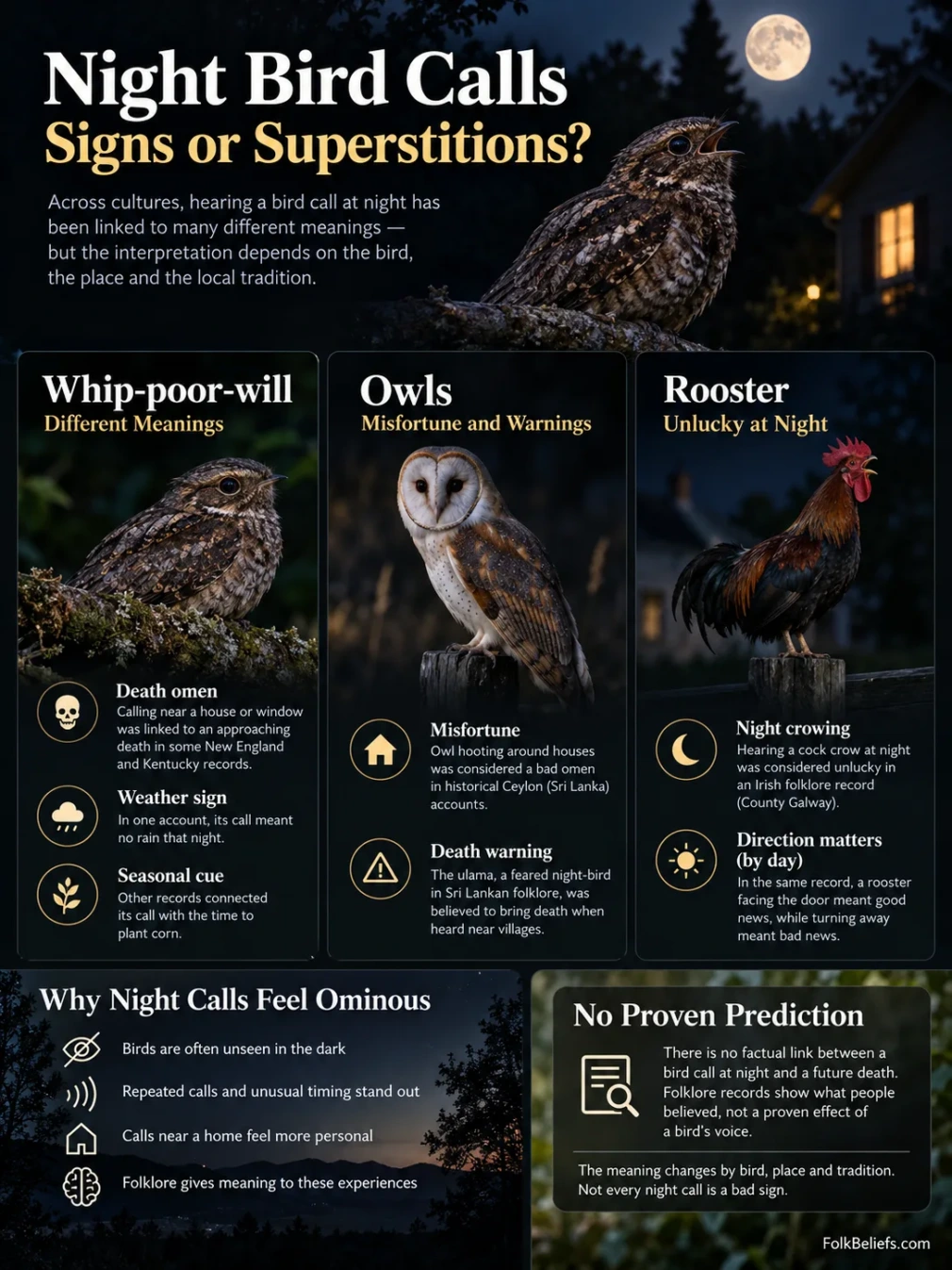
Hearing a bird call at night has been treated as an omen in recorded folklore, but there is no single traditional meaning shared across places or bird species. Depending on the record, a nighttime call could be associated with death, misfortune, weather, seasonal work, or another local sign.
The surrounding details usually matter as much as the sound itself. Folklore records may specify whether the bird called repeatedly, remained close to a house, sounded near a doorway or window, or was heard at an unusual hour. A belief recorded for one species or locality should not be applied automatically to every bird heard after dark.
Why the Bird, Place, and Time Matter
Older folklore records are usually more specific than the modern idea that “a bird calling at night means something bad.” They often name a particular bird and describe where it was heard or what it was doing.
This can change the interpretation completely. A call close to a dwelling may receive one meaning, while the same species calling elsewhere may appear in weather lore or seasonal traditions. Some records also focus on repetition or unusual timing rather than on nighttime alone.
Night calling is a broad folklore category, not one omen. The species, location, behavior, and source tradition determine what a particular record actually supports.
Whip-Poor-Will Calls Show How Meanings Can Change
The whip-poor-will provides a clear example of this variation. In a Maine folklore collection published in 1892, Gertrude Decrow recorded a belief that a whip-poor-will singing repeatedly near a door or beneath a window was a sign of approaching death in the household.[1]
A later Kentucky record in the James T. Callow Folklore Archive preserves a related belief involving a whip-poor-will coming close to the house. Yet material in the same archive gives the bird’s call very different meanings elsewhere. Alabama records connect it with the expectation of no rain that night and with the time to plant corn.[2]
These examples do not create a general code for whip-poor-will calls. They show how one recognizable nighttime sound could acquire different meanings in separate communities and circumstances.
Night Calls Near the Home
The home is a recurring setting in bird-omen records. A call outside a window, beside a doorway, from a roof, or close to a household could be treated differently from a bird heard farther away. This helps explain why broad statements such as “hearing a bird at night means death” go beyond the surviving evidence.
Owls are one well-documented example of species-specific night-call folklore. Records connect particular owl calls with death, misfortune, weather, direction, and counted hoots, depending on the tradition. Those variations belong to the more specific owl hooting traditions rather than to a universal rule for all birds heard at night.
Roosters also appear in folklore when they crow at an unexpected nighttime hour. Because this is a distinct behavior with its own recorded interpretations, it is better treated separately from the general meaning of an unidentified bird calling after dark.
What Meanings Appear in Night-Bird Folklore?
| Type of Recorded Meaning | How It Appears in Folklore |
|---|---|
| Death or approaching loss | Some records attach this meaning to a particular bird calling repeatedly or unusually close to a home. |
| Misfortune | An unfamiliar or unexpected nighttime call may be treated as unlucky in a local tradition without predicting one specific event. |
| Weather | Some bird calls are interpreted as signs concerning rain or other changing conditions. |
| Seasonal timing | Calls of familiar seasonal birds can become cues for planting or other recurring activities. |
These categories overlap, but they should not be turned into a universal list of meanings. A weather belief recorded for one bird does not establish a weather omen for another species, and a death-related household record does not mean that every nighttime call near a home carries the same interpretation.
Why Repeated Calls Can Seem Especially Meaningful
Repeated sounds receive special attention in many kinds of folklore because they are harder to ignore than a single distant call. Some bird records describe persistent calling at a particular place, especially near a house, doorway, or window.
That repetition can also have a straightforward biological explanation. The Eastern Whip-poor-will is nocturnal, and Cornell Lab of Ornithology notes that males may repeat their characteristic song for long periods during the breeding season.[3]
A bird calling again and again during the night may therefore be behaving normally even when the sound is unusually noticeable to people nearby.
Does Hearing a Bird at Night Mean Someone Will Die?
No factual connection between a night bird call and a future death is established by folklore records. Death is one documented interpretation in some traditions, especially when a particular bird behaves in a particular way near a household, but other records give different meanings.
The narrower wording matters. A source describing a named bird calling repeatedly beneath a window cannot support the claim that any bird heard anywhere at night predicts death. The record documents a belief attached to that specific situation.
Night Calling Is Normal for Many Birds
Some birds are naturally most vocal after dark. Others may call at night during migration, breeding, territorial encounters, alarm situations, or periods of increased activity. A person may also notice a familiar sound more strongly at night because surrounding human activity is quieter.
Folklore gives cultural meaning to those encounters, while the calls themselves remain part of ordinary bird behavior. The two should not be confused: a historical omen record shows how a sound was interpreted, not that the interpretation predicts a later event.
Sources and Records
Documented Locations
Countries: Bolivia, Cuba, Fiji, Ghana, Pakistan, Sri Lanka
These labels identify where a version has been documented. They do not mean that everyone in the country, region, or community shares the belief.