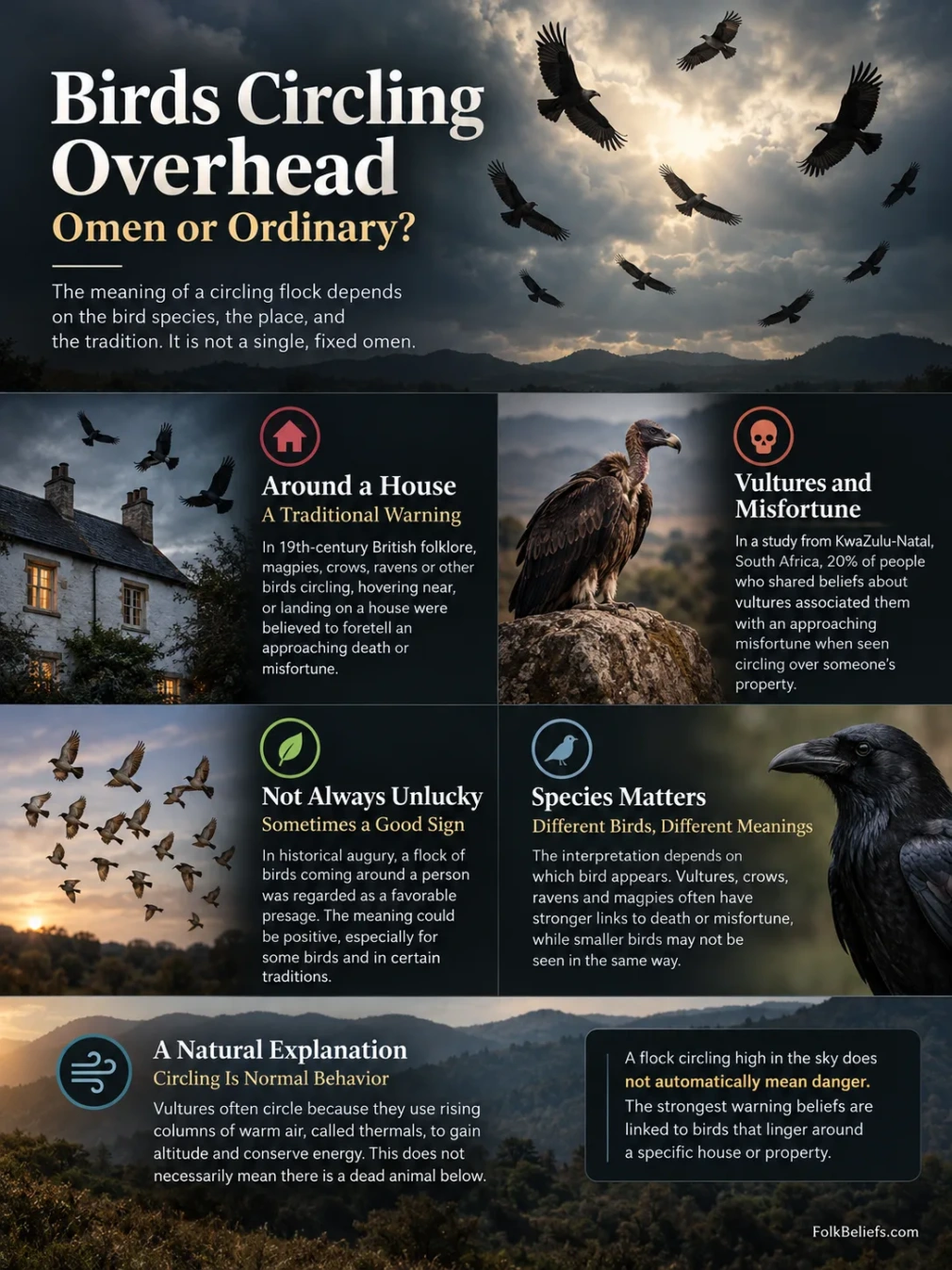
A flock circling overhead does not have one fixed meaning in folklore. Some documented traditions connect birds circling or hovering near a home with death or misfortune, especially when the birds are magpies, crows, ravens, or vultures. Other omen traditions could treat a flock gathering around a person as favorable. The species, place, and older belief tradition therefore matter more than the circular movement by itself.[1][2]
Birds Circling a House as a Death Omen
One of the clearest historical versions comes from nineteenth-century British folklore. William Henderson’s Notes on the Folk-lore of the Northern Counties of England and the Borders, published in 1866, lists magpies flying round a house among signs believed to announce an approaching death. Ravens croaking on or near the house appear in the same group of portents.
Henderson also records a broader belief that birds flying or hovering around a house, landing on the window sill, or tapping at a window could foretell death. One example concerned a white pigeon repeatedly flying around a house and resting at a window. These records concern beliefs collected in particular parts of Britain; they should not be treated as a rule shared by everyone in Britain or Europe.[1]
In this strand of folklore, the important detail is not simply that birds make a circle in the sky. The omen becomes more specific when the flock lingers around a particular house or property.
Vultures Circling Above Property in KwaZulu-Natal
A much newer record documents a closely matching belief in KwaZulu-Natal, South Africa. A study published in the Journal of Ornithology examined perceptions of vultures among communities living near three protected areas. Of 430 completed household interviews, 108 participants reported beliefs concerning vultures.
Among that group, 22 respondents, or 20%, associated vultures circling over someone’s property with an approaching misfortune. The researchers also connected the idea with the isiZulu expression uzulelwa amanqe, translated in the study as vultures hovering over someone. The expression may be used as a warning that a person’s actions are leading toward danger.
The same research also found different meanings. Smaller shares of respondents described vultures as associated with rain or luck. This makes the local evidence especially useful: even within one surveyed setting, vultures did not carry only one interpretation.[2]
A Circling Flock Was Not Always Unlucky
Historical augury gives an almost opposite example. An eighteenth-century Encyclopædia Britannica account summarizing divination in antiquity states that a flock of birds coming about a person was regarded as a favorable presage, while the flight of vultures was considered unlucky.[3]
This distinction matters. A group of birds surrounding or moving around someone could be favorable in one omen system, yet a similar flight involving vultures could carry a darker reading. The historical record therefore does not support the modern idea that every flock making circles overhead automatically means danger.
Why the Species Changes the Superstition
Older bird omens often depended on which bird appeared, where it appeared, and what it did. A flock of small birds passing or circling overhead was not necessarily interpreted in the same way as scavenging birds repeatedly circling a house.
Vultures acquired especially strong associations with death and misfortune because people regularly observed them in landscapes where dead animals were present. Crows, ravens, and magpies also accumulated their own local omen traditions. As a result, later retellings sometimes collapse several separate beliefs into the vague claim that “birds circling overhead mean death.” The surviving records are more specific than that.
The strongest documented warning motif is place-specific: birds circling, hovering, or repeatedly appearing around a particular home or property. A distant flock simply turning high in the sky does not match every historical version of the superstition.
What Circling Vultures Usually Mean in Nature
The natural behavior behind the sight can look more mysterious than it is. The Missouri Department of Conservation notes that vultures seen circling do not necessarily indicate that a dead animal is directly below them. They commonly use rising columns of warm air, called thermals, to gain altitude while conserving energy. Several birds can enter the same rising air and circle upward together.[4]
This behavior helps explain why an observer may see a flock repeatedly turning above the same general area even when nothing unusual is happening on the ground. Folklore gave such visible movements meanings connected with future events, but the flight itself is normal bird behavior.
Folklore records describe beliefs held in particular communities and periods. They do not show that circling birds can predict death, bad luck, weather, or another future event. For this belief, the documented meanings range from death and approaching misfortune to favorable omens, with the bird species and local tradition shaping the interpretation.
Sources and Records
- ↑1a ↑1b William Henderson, Notes on the Folk-lore of the Northern Counties of England and the Borders,
- ↑2a ↑2b Nomthandazo S. Manqele, S. A. Jeanetta Selier, Jim Taylor and Colleen T. Downs, “Vulture perceptions in a socio-ecological system: a case study of three protected areas in KwaZulu-Natal, South Africa”,
- ↑3 Encyclopædia Britannica, “Augury”,
- ↑4 Missouri Department of Conservation, “Vulture Facts”,
Documented Locations
Countries: Spain
Regions: Villalón de Campos (Spain)
These labels identify where a version has been documented. They do not mean that everyone in the country, region, or community shares the belief.