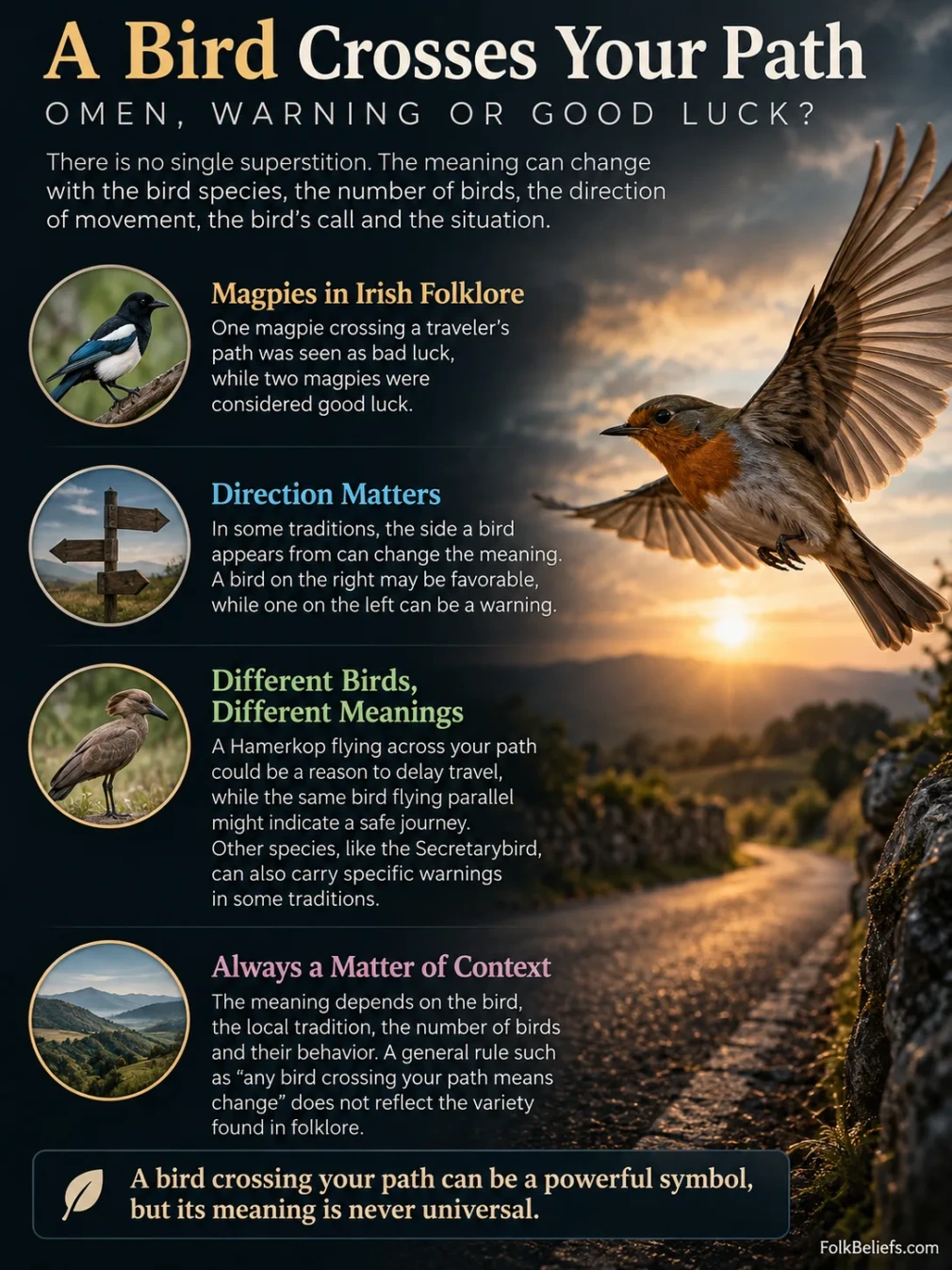
A bird crossing your path does not have one universal superstition. In documented folklore, the meaning can change with the bird species, the number of birds, the direction of movement, the bird’s call, and what the observer was doing at the time. Some traditions recorded a crossing bird as a reason to postpone a journey, while others treated particular birds or directions as favorable.
What Does a Bird Crossing Your Path Mean in Folklore?
The broad idea is that an unexpected bird can become an omen connected with the journey ahead. That does not mean that every bird crossing a road was traditionally interpreted in the same way. Historical records usually contain much narrower rules.
A magpie crossing a traveler’s route, for example, could be read differently from a Hamerkop doing the same thing. One bird might carry a different meaning from two. In traditions where bird divination developed into a larger system, the side from which a bird appeared could matter as much as the species itself.
The most reliable way to read these beliefs is by context: identify the bird, the recorded place or tradition, the number of birds, and the exact behavior. A general rule such as “any bird crossing your path means change” does not match the variety found in folklore records.
Magpies Crossing the Path in Irish Folklore
The National Folklore Collection of Ireland preserves a particularly clear example from Kilmacrenan, County Donegal. The record says that when someone was setting out on a journey, one magpie crossing the path meant bad luck. If two magpies crossed, however, the bad luck was considered to have gone away.[1]
A separate Schools’ Collection record from Beglieve, County Cavan gives a closely related version: a magpie crossing the road in front of someone going somewhere indicated bad luck, while two magpies were associated with good luck.[2]
These records show why the number of birds cannot be separated from the event itself. The crossing is only part of the omen. In these local records, changing from one magpie to two changes the interpretation.
Direction Can Be Part of the Omen
Bird-crossing beliefs can become much more detailed when they belong to an established system of bird omens. William Henry Furness’s 1899 account of traditions he encountered in Borneo describes particular omen-birds appearing during journeys or other undertakings. He noted that not every bird qualified as an omen bird. Some were considered favorable when encountered on the right, while other favorable signs depended on a bird appearing overhead or calling from the left. He also described travelers changing their direction temporarily after a bird appeared on what they considered the wrong side.[3]
This is a historical account of particular communities and encounters, not a rule for all peoples of Borneo. Even Furness warned against assuming that a custom recorded in one community applied across the island.
Iban Bird Omens Are Tied to Named Species
Bird-omen traditions in Borneo are not only a subject of older ethnographic writing. A study published in 2026 examined adat beburung in an Iban ritual chant using interviews with ritual chanters and analysis of the chant itself. The researchers identified seven specifically named bird symbols: ketupung, beragai, bejampung, nendak, pangkas, embuas, and kelabu papau.[4]
The value of this record for interpreting a bird crossing a path is its specificity. The tradition does not reduce every encounter to “bird equals message.” The identity of the bird and the cultural setting belong to the meaning.
A Crossing Bird Could Affect a Journey in Zimbabwean Folklore
Warren Goodwin’s 2018 collection of Zimbabwean bird folklore gives an unusually direct example involving the Hamerkop. In the material he collected, a Hamerkop flying across a person’s path could be treated as a reason to abandon travel plans for that day, whereas one flying parallel to the intended route could indicate a safe journey. The same collection records another path-related belief concerning the Secretarybird: in some Shona traditions, a Secretarybird walking across a traveler’s path was interpreted as an unfavorable omen.[5]
Goodwin states that much of the material was gathered through interviews conducted from 1996 to 1999 and that he included beliefs he could verify through more than one independent informant. Even within the collection, meanings vary between communities and bird species.
Recorded as unfavorable for a journey in particular Irish folklore records.
Recorded as removing the unfavorable implication or bringing good luck in those same regional records.
Recorded in Zimbabwean material as a warning affecting travel.
Recorded as a favorable indication for the journey.
Left or Right Is Not a Universal Rule
Modern explanations sometimes claim that a bird moving from left to right is automatically lucky, or that the opposite direction is automatically unlucky. Historical divination systems do not support such a universal formula.
Cicero’s On Divination discusses Roman interpretations of birds and other auspices and explicitly points to differences between traditions. In his discussion, signs on the left could be favorable in Roman practice, while he contrasts this with peoples who regarded the right as favorable. He also notes that particular birds could have their own directional rules. Cicero uses these inconsistencies while arguing critically about divination itself.[6]
Ancient augury therefore should not be reduced to “left means bad” or “right means good.” The observer’s orientation, the type of bird, the divinatory tradition, and the behavior being observed could all affect the reading.
What Usually Changes the Meaning?
- Species: Historical records usually name particular birds rather than treating every bird alike.
- Number: One bird and two birds can carry opposite interpretations, as seen in the Irish magpie records.
- Direction: Left, right, across, parallel, approaching, or departing may be treated differently in traditions that pay attention to movement.
- Behavior: Flying across a path is not necessarily equivalent to calling beside it, landing nearby, circling overhead, or walking across the road.
- The journey itself: Several documented omens concern someone who is specifically setting out, traveling, farming, or undertaking another planned activity.
- Local tradition: A belief recorded from one informant, village, region, or community should not automatically be attributed to an entire country or culture.
Does the Color of the Bird Determine the Meaning?
Color alone is usually too broad a basis for assigning a traditional meaning. Claims such as “a black bird crossing your path means bad luck” or “a white bird means good fortune” may circulate in modern spiritual writing, but they should not be presented as universal folklore without a record tying that interpretation to a particular tradition.
The documented examples above work differently. Irish records name the magpie. Zimbabwean records identify species such as the Hamerkop and Secretarybird. Iban bird-omen traditions likewise distinguish named birds rather than using a single meaning for every dark, light, or brightly colored bird.
What If a Bird Flies Across the Road in Front of Your Car?
A bird flying across the road while someone is driving can resemble the older idea of an animal crossing a traveler’s route, but the resemblance does not create a documented traditional interpretation by itself. Many older records concern people beginning or continuing a journey and contain additional conditions that determine whether an encounter counts as an omen.
For that reason, a bird passing in front of a car cannot reliably be assigned a folklore meaning without knowing the species and the tradition being consulted. It is also an ordinary event in bird behavior. Folklore records explain how people have interpreted such encounters; they do not establish that a bird’s flight predicts what will happen afterward.
Why Some Crossing Omens Tell the Traveler to Stop
A repeated pattern in several records is the connection between an unexpected encounter and the decision to continue traveling. In that setting, the bird is not merely a general symbol of luck. Its appearance functions as a traditional indication about the proposed journey: proceed, postpone, turn back, or reassess the route.
That pattern helps explain why “crossing the path” can matter more than simply seeing a bird nearby. The bird interrupts the traveler’s line of movement. Yet the surviving records show that the interruption has no fixed meaning on its own. The same basic event can be unfavorable, favorable, or dependent on another detail such as a second bird or a different direction of flight.
Someone looking for the folklore behind a personal encounter therefore needs more than the fact that a bird crossed the path. The species, place, movement, number, and tradition are what turn a general encounter into a documented belief.
Sources and Records
- ↑1 National Folklore Collection, UCD, “Fortune and Misfortune”,
- ↑2 National Folklore Collection, UCD, “Omens”,
- ↑3 William Henry Furness, Folk-Lore in Borneo: A Sketch,
- ↑4 Bejamin Liam and Rosliah Kiting, “The Wisdom of Bird Ritual Symbols in the Poem Pengap Gawai Pangkung Tiang”,
- ↑5 Warren Goodwin, Birds—Messengers in Zimbabwean Folklore,
- ↑6 Cicero, On Divination, Book II,
Documented Locations
Countries: Fiji, Madagascar
These labels identify where a version has been documented. They do not mean that everyone in the country, region, or community shares the belief.