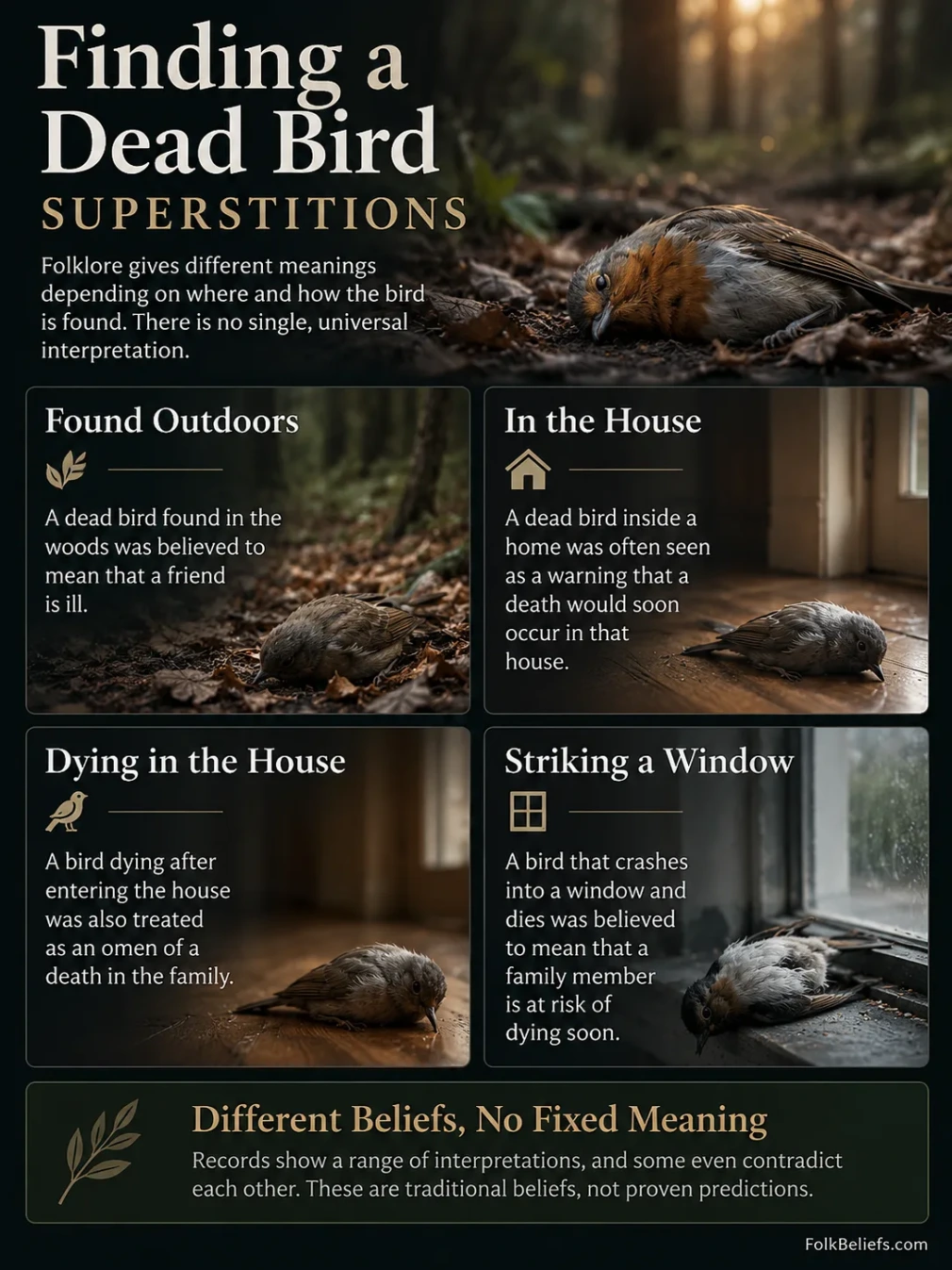
Finding a dead bird has no single fixed meaning in recorded folklore. Surviving collections attach different omens to different circumstances: a bird found dead outdoors, a bird dying inside a house, and a bird striking a window and dying were not always treated as the same event.
Some documented beliefs connect a dead bird with illness, death, or misfortune, especially when the bird is found inside a home or dies after entering the domestic space. Other records show that bird omens could carry very different meanings even within the same regional collection. These are records of folk belief, not evidence that finding a dead bird predicts what will happen.
What Does Finding a Dead Bird Mean in Folklore?
One of the clearest archival records that actually concerns finding a dead bird comes from North Dade, Florida. The James T. Callow Folklore Archive preserves a belief stating that a dead bird found in the woods meant that a friend was ill. The record gives no date for when the belief was learned, and it does not claim that this interpretation represented Florida generally.[1]
A separate Callow Archive item, whose place and date of collection were not recorded, gives a stronger domestic interpretation: a dead bird in the house was said to mean that a death would soon occur in that same house.[2]
| Recorded Situation | Place in the Record | Folklore Meaning |
|---|---|---|
| Dead bird found in the woods | North Dade, Florida | A friend was believed to be ill.[1] |
| Dead bird in the house | Location not recorded | A death in the same house was expected.[2] |
| Bird dying in the house | Detroit, Michigan | The bird’s death was treated as an omen of a death in the family.[1] |
| Bird crashing into a window and dying | Roseville, Michigan | A family member was believed to be at risk of dying soon.[3] |
Why the House and Window Matter in These Beliefs
The surviving records suggest that the circumstances around the bird often mattered more than the simple fact that it was dead. Domestic space appears repeatedly. A bird inside a house, at a window, or dying after entering the house could become part of an omen connected with the people living there.
This pattern also appears in older British bird lore where the bird did not necessarily die. Charlotte Sophia Burne’s Shropshire Folk-Lore, published in 1885, records a death omen associated with a bird flying against a window or entering a room. One account from near Shifnal described a large white bird repeatedly moving outside the window of a sick woman and striking the panes; the observer interpreted it as a “Death Bird.” Another Shropshire account concerned a dark bird behaving unusually near a man’s home before a child in the family died.[4]
These records help explain why later dead-bird superstitions often cluster around windows, rooms, doors, and houses. They belong to a wider family of bird omens in which an unusual encounter close to the home was interpreted in relation to illness, death, news, or another coming event.
A Bird in the House Did Not Always Mean Death
Even closely related bird omens could contradict one another. Daniel Lindsey Thomas and Lucy Blayney Thomas recorded several examples in Kentucky Superstitions in 1920. Entry 3518 says that a bird flying into a house was a sign of death, while a North-eastern Kentucky entry says that a bird injuring itself inside the house foretold a death. Yet elsewhere in the same collection, entry 232 gives an entirely different interpretation: the person who discovered a bird that had flown into the house was expected to marry within the year.[5]
The records do not support a universal rule. A bird indoors could be connected with death in one belief and marriage in another. A dead bird outdoors could be linked with illness rather than death. Location, the bird’s behavior, and the tradition in which the belief was recorded all changed the interpretation.
Finding a Dead Bird on a Doorstep, Porch, or in the Yard
Modern interpretations often assign very precise meanings to a dead bird depending on whether it appears on a doorstep, porch, lawn, driveway, or other part of a property. The archival records above do not support turning each of those locations into a fixed traditional code.
The documented material is narrower. There is a North Dade record for a dead bird found in the woods, records concerning dead or dying birds inside houses, and several traditions involving birds striking windows. That evidence does not justify claiming that every dead bird on a doorstep means a warning, every bird in a yard means change, or every bird near a door predicts a particular event.
A bird found beneath a window may naturally resemble the older window-omen tradition, but resemblance is not the same as evidence that every such discovery carried that folklore meaning.
Does a Dead Bird Mean Someone Will Die?
Some recorded superstitions did say so, but only in particular contexts. The Callow Archive includes beliefs in which a dead bird in a house, a bird dying inside a house, or a bird crashing into a window and dying was associated with an expected death. Those records document what particular informants or communities said; they do not establish a universal belief or a real predictive relationship.
The Florida record is a useful contrast because its meaning was illness of a friend rather than an approaching death. Kentucky material provides another contrast by preserving both death and marriage interpretations for birds entering houses. Folklore collections often preserve this kind of variation rather than one standardized meaning.
Is Finding a Dead Bird Bad Luck?
Calling every dead bird a bad-luck omen is broader than the documented evidence allows. Some records are clearly negative, particularly those connected with death or illness. Others concern bird encounters that carried different predictions, and many traditional bird omens involve living birds rather than dead ones.
For that reason, the most accurate folklore reading depends on the exact recorded tradition. “Dead bird means death” exists as a superstition, but it is one interpretation among several rather than a rule shared across places and cultures.
Sources and Records
- ↑1a ↑1b ↑1c University of Detroit Mercy, James T. Callow Folklore Archive, bird-belief records,
- ↑2a ↑2b University of Detroit Mercy, James T. Callow Folklore Archive, “Dead Bird Superstition” record,
- ↑3 University of Detroit Mercy, James T. Callow Folklore Archive, “Bad Omen” bird record,
- ↑4 Charlotte Sophia Burne, ed., Shropshire Folk-Lore,
- ↑5 Daniel Lindsey Thomas and Lucy Blayney Thomas, Kentucky Superstitions,
These records describe historical and vernacular beliefs. They should be read as folklore rather than as evidence that a dead bird can predict illness, death, marriage, bad luck, or another future event.
Documented Locations
Countries: United States
These labels identify where a version has been documented. They do not mean that everyone in the country, region, or community shares the belief.