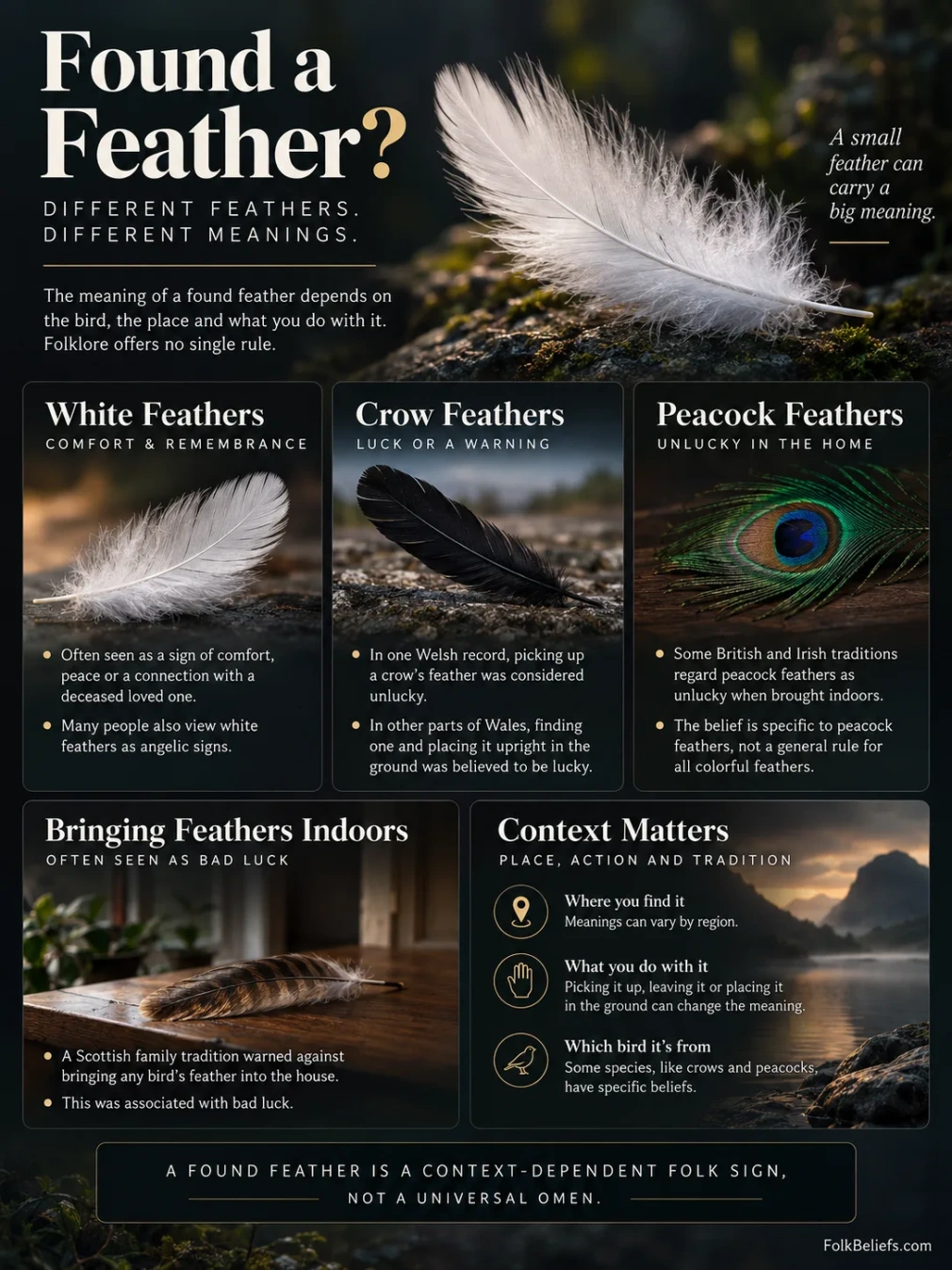
Finding a feather does not have one universal folk meaning. In present-day spiritual belief, an unexpected feather—especially a white one—is often read as comfort, remembrance, or a possible sign connected with someone who has died. Older folklore records are much less uniform. They show that the meaning could depend on the bird, the place, and what a person did with the feather. A nineteenth-century Welsh collection even records opposite interpretations of finding a crow’s feather in different localities.[1]
What Does Finding a Feather Mean in Folklore?
Documented folk beliefs do not support a simple rule that every found feather means good luck, protection, or a message from the spirit world. The surviving records are more specific.
| Feather or Situation | Recorded Folk Meaning | Context |
|---|---|---|
| Crow’s feather | Picking one up could be treated as unlucky | Recorded in Montgomeryshire, Wales |
| Crow’s feather | Finding one could be lucky if it was stuck upright into the ground | Recorded elsewhere in Wales, including Llanfihangel Glyn Myfyr |
| Bird feather brought indoors | Associated with bad luck in one family tradition | Scottish informant recorded by the USC Digital Folklore Archives |
| Peacock feather brought indoors | Regarded as unlucky | Irish Schools’ Collection record |
| White feather after bereavement | May be interpreted as comfort or a sign associated with a deceased loved one | Contemporary personal and spiritual belief |
A Crow’s Feather Could Be Lucky or Unlucky
One of the clearest examples of local variation comes from Elias Owen’s Welsh Folk-Lore, published in 1896. In Montgomeryshire, Owen recorded a belief that a person who picked up a crow’s feather would meet a mad dog before the day ended. The record describes the expected encounter as an omen attached specifically to the act of picking up the feather.
Yet Owen immediately gives another version. In other parts of Wales, finding a crow’s feather was considered lucky if the finder stuck it upright into the ground. He noted that this custom had survived for a long time in Llanfihangel Glyn Myfyr and that crow wing and tail feathers had formerly been seen standing upright in the ground in parts of Wales.[1]
The two Welsh records are useful because they prevent a broad claim such as “a black feather always means protection” or “a crow feather always means bad luck.” Even within a relatively small geographic area, the same object could receive opposing meanings.
Finding a Feather and Bringing It Into the House Are Not the Same Belief
Some traditions focused less on seeing or finding the feather and more on what happened after it was found.
A 2017 entry in the USC Digital Folklore Archives records a Scottish informant who remembered her mother warning her as a child never to bring a bird’s feather into the house. When asked what would happen, she described the consequence simply as bad luck. The archive carefully notes that the informant herself thought the belief might have belonged particularly to her mother or family.[2]
That narrow context matters. It documents a real transmitted family superstition, but it does not establish a rule followed by everyone in Scotland.
Peacock Feathers Had Their Own Household Warning
An Irish record in the National Folklore Collection’s Schools’ Collection gives a more specific version: bringing a peacock’s feather into the house was considered unlucky. The statement appears among a series of locally collected beliefs rather than as a claim about all Irish households.[3]
This is another reason not to reduce feather folklore to color alone. The belief concerns a particular bird and a particular action—taking its feather inside the home.
White Feathers, Loved Ones, and Angels
The interpretation many people encounter today is different from the regional beliefs above. A white feather found during grief is often treated as a comforting connection with someone who has died, while some people interpret white feathers as signs associated with angels.
Psychologist Vanessa Moore described this form of belief after experiencing white feathers following her husband’s death. Writing in Psychology Today in 2021, she reported finding many similar accounts from bereaved people and noted that feathers were among the objects people interpreted as signs. She did not present the feathers as proof of supernatural communication. Instead, she discussed how an object can become emotionally linked with the person who died and provide comfort during bereavement.[4]
Folk meaning and factual claim are different things. A person may understand a white feather as remembrance, reassurance, or an angelic sign. That interpretation belongs to belief and personal experience; the presence of a feather does not demonstrate that a supernatural message has occurred.
Do Different Feather Colors Have Fixed Meanings?
Modern spiritual sources often assign separate meanings to white, black, grey, brown, blue, red, and other feathers. Historical folklore does not provide one shared color code that can be applied across places and traditions.
White Feathers
In contemporary bereavement and spiritual belief, white feathers are commonly connected with peace, remembrance, angels, or a deceased loved one. These are belief-based interpretations rather than a universal rule found throughout older folklore.
Black or Crow Feathers
Recorded Welsh folklore gives conflicting meanings. Picking up a crow’s feather could be ominous in one locality, while finding one and placing it upright in the soil could be lucky elsewhere.
Peacock Feathers
Some British and Irish folk records associate peacock feathers with household bad luck. The belief is tied to the peacock rather than to a general rule about every multicolored or iridescent feather.
Other Colors
Grey, brown, blue, yellow, green, red, and mixed-color feather meanings circulate widely in contemporary spiritual interpretation, but the records used here do not support one inherited historical meaning for each color. Such readings are better treated as modern symbolic systems unless a specific tradition can be documented.
Why the Place and Action Matter
Older feather beliefs often work as small rules rather than broad symbolic dictionaries. A feather could change meaning according to what happened around it:
- Finding it: a crow’s feather could carry a local luck or warning belief.
- Picking it up: the act itself could trigger the omen in one recorded Welsh version.
- Putting it into the ground: the same type of feather could become lucky under another Welsh custom.
- Taking it indoors: some household traditions treated this as unlucky.
- Recognizing the bird: peacock and crow feathers developed beliefs that cannot safely be transferred to every other species.
This pattern is typical of local folk belief: the object alone may not carry the whole meaning. The action, setting, and inherited rule can be as important as the feather itself.
Is Finding a Feather Good Luck or Bad Luck?
It can be either, depending on the tradition. Historical records contain both readings. The Welsh crow-feather examples are unusually clear because one version warns against picking the feather up while another treats finding the same kind of feather as lucky when followed by a particular action.
Modern interpretations often lean toward reassurance, protection, remembrance, or spiritual presence, especially when the feather is white. Those meanings should not be projected backward onto every historical feather belief or presented as something shared by all cultures.
A found feather is therefore best understood as a context-dependent folk sign rather than a universal omen. When a particular meaning can be traced to a region, family, archival record, bird species, or modern spiritual practice, that context is part of the belief itself.
Sources and Records
- ↑1a ↑1b Elias Owen, Welsh Folk-Lore: A Collection of the Folk-Tales and Legends of North Wales,
- ↑2 USC Digital Folklore Archives, “Don’t Bring a Feather into the House”,
- ↑3 National Folklore Collection, UCD, The Schools’ Collection, “Pisreoga”,
- ↑4 Vanessa Moore, Ph.D., “Why Are White Feathers a Source of Comfort When a Loved One Dies?”,