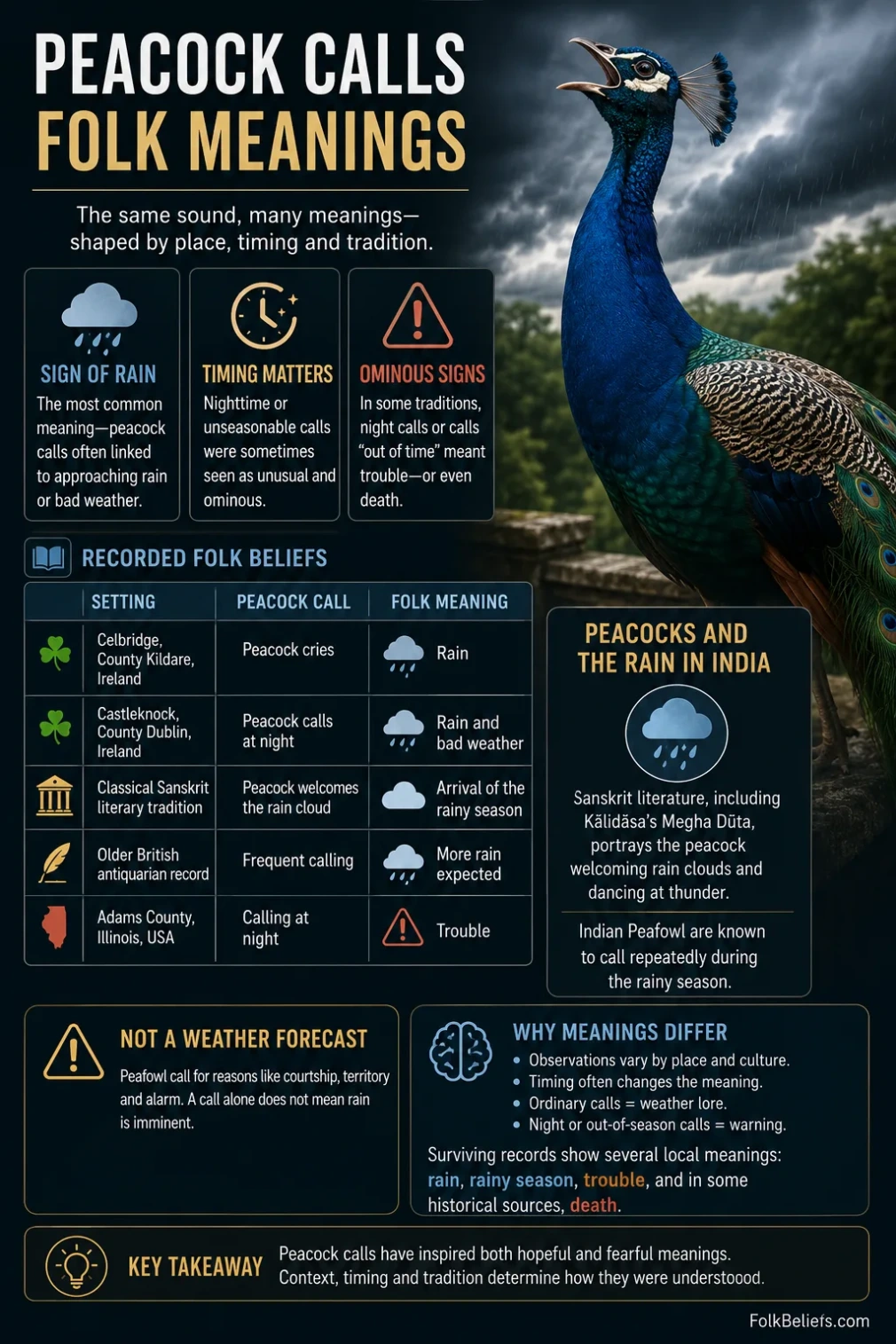
A peacock’s loud call has carried more than one folk meaning. In documented traditions, it most often appears as a sign of approaching rain, but some records give an unusual or nighttime call a darker meaning, such as trouble or death. These interpretations belong to particular places and sources; there is no single worldwide superstition attached to every peacock call.
Peacock Calls as a Sign of Rain
Rain is the clearest recurring meaning in the surviving folklore record. A weather-lore entry from Celbridge, County Kildare, in Ireland’s National Folklore Collection lists the belief simply: when a peacock cries, it is a sign of rain.[1]
The details were not identical everywhere. A Castleknock record in the same collection states that a peacock crowing at night was regarded as a sign of rain and bad weather.[2] These records are evidence for particular Irish weather traditions, not a rule shared by every community in Ireland.
| Recorded Setting | Peacock Call | Folk Meaning |
|---|---|---|
| Celbridge, County Kildare | Peacock cries | Rain |
| Castleknock, County Dublin | Peacock calls at night | Rain and bad weather |
| Classical Sanskrit literary tradition | Peacock welcomes the rain cloud | Arrival of the rainy season |
| Older British antiquarian record | Frequent calling | More rain expected |
| Adams County, Illinois | Calling at night | Trouble |
The Peacock and the Rainy Season in Indian Tradition
The link between peafowl and rain also has a long literary history in South Asia. An English edition of Kālidāsa’s Megha Dūta, or Cloud Messenger, describes the peacock welcoming the cloud. Its accompanying commentary connects this response with the birds’ breeding season and their relief at the return of rain. Elsewhere in the poem, thunder from the cloud prompts a peacock to dance.[3]
This literary association has a natural seasonal background. Cornell Lab of Ornithology describes the Indian Peafowl’s loud may-yow calls as being heard repeatedly during the rainy season.[4] A person hearing more peacock calls as seasonal rains approach could therefore connect a real change in bird activity with the weather.
A peacock call is not a weather forecast. The folklore reflects repeated human observations and inherited interpretations. Peafowl call for several biological reasons, including courtship, territorial communication and alarm, so hearing one does not by itself mean that rain is imminent.
Older Beliefs About Frequent or Unseasonable Calling
An older British antiquarian source preserves both favorable weather-reading and ominous interpretations. John Brand’s Observations on the Popular Antiquities of Great Britain quotes a seventeenth-century work describing the peacock’s harsh calling as a predictor of rain, with more frequent cries interpreted as indicating more rain.
The same compilation also attributes a different belief to Paracelsus: a peacock crying more than usual or “out of his time” was said to foretell a death in the household of its owner.[5] This is a historical superstition preserved by later writers, not evidence that a peacock can predict death.
The distinction between an ordinary seasonal call and a call perceived as unusual matters. In this strand of belief, the familiar sound associated with wet weather could be read as normal, while calling at an unexpected time acquired an ominous interpretation.
Night Calling as a Warning of Trouble
A different version was collected in Adams County, Illinois. The folklore collection Folk-Lore from Adams County, Illinois records the belief that hearing a peacock crying at night meant that trouble was coming. The entry includes an informant narrative connecting repeated nighttime calling with a misfortune that followed.[6]
That Illinois record should not be combined with the older death omen as though they were identical. One speaks broadly of trouble; the other specifically describes death and makes the unusual timing of the cry important. They are separate recorded variants.
Why the Meanings Differ
Peacock-call folklore shows how the same sound can acquire different meanings in different settings. Where peafowl activity was noticed alongside wet weather, the call could become a rain sign. Where nighttime or unseasonable animal noises were treated as departures from the expected order, the same call could become a warning.
Timing is often the dividing line. Some records treat ordinary calling as weather lore while attaching danger to calling that happens at night or at an unexpected season. Other traditions make no ominous distinction at all.
For that reason, claims that “a calling peacock means death” or “a peacock always predicts rain” are too broad. The surviving records support several local meanings: rain, the rainy season, trouble, and in some historical sources, death when the call was considered unusually timed.
Sources and Records
- ↑1 National Folklore Collection, “Weather-Lore – Birds,” Kildraught (2),
- ↑2 National Folklore Collection, “Weather-Lore,” Castleknock,
- ↑3 Kālidāsa, The Megha Dūta, or, Cloud Messenger,
- ↑4 Cornell Lab of Ornithology, “Indian Peafowl Identification”,
- ↑5 John Brand, Observations on the Popular Antiquities of Great Britain,
- ↑6 Harry Middleton Hyatt, Folk-Lore from Adams County, Illinois,
Documented Locations
These labels identify where a version has been documented. They do not mean that everyone in the country, region, or community shares the belief.