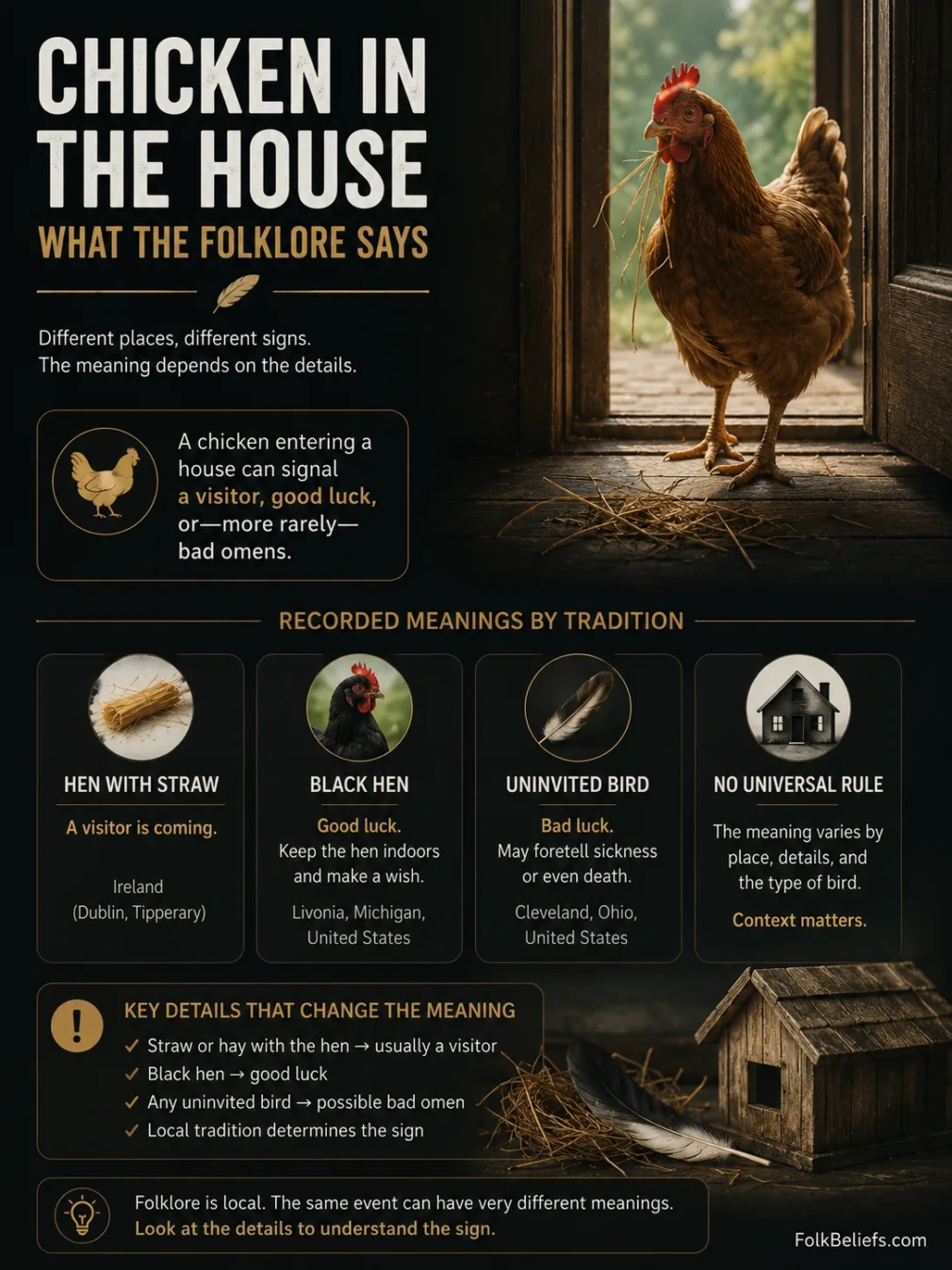
A chicken walking into a house does not have one fixed meaning in folklore. Surviving records give very different interpretations depending on the place and on details such as whether the bird carries straw or whether it is a black hen. Irish records commonly connect a hen entering with straw or hay to an approaching visitor, while a recorded Michigan belief treats a black hen indoors as good luck. A separate Ohio record places an uninvited bird entering a house among bad omens.
What Does It Mean When a Chicken Enters the House?
The documented meanings range from an expected visitor to good luck and, in a broader bird superstition, misfortune. The records do not support treating any one of these interpretations as a universal belief.
| Recorded Detail | Meaning in the Record | Place |
|---|---|---|
| A hen enters the house and drops a straw | A visitor is coming | Killossery, County Dublin, Ireland [1] |
| A hen enters the kitchen with hay or straw hanging from it | A friend is coming to the house | Aherlow, County Tipperary, Ireland [2] |
| A black hen comes into the house | Good luck; wishes were associated with keeping the hen indoors for a time | Livonia, Michigan, United States [3] |
| An uninvited bird enters the house | Bad luck, including fears of sickness or death | Cleveland, Ohio, United States [4] |
The Hen-and-Straw Visitor Omen
One of the clearest chicken-entering-house traditions appears repeatedly in Irish folklore. A record from Killossery in County Dublin says that when a hen comes into the house and drops a straw on the floor, a visitor is expected to arrive. The chicken itself is therefore only part of the sign; the straw is an important part of the recorded belief.[1]
A related entry collected in Aherlow, County Tipperary, describes a hen coming into the kitchen with a piece of hay hanging from it. There the event foretells the arrival of a friend. The wording differs slightly, but the pattern is close: the hen crosses into the domestic space while carrying or trailing plant material, and a visitor follows.[2]
For the Irish hen-and-straw variant, the recorded meaning is usually about someone arriving. It should not automatically be turned into a death omen or a general warning of bad luck.
Other Irish records preserve closely related versions in which the straw may be in the hen’s beak, caught on a leg, hanging from its feathers, or trailing behind it. This variation is typical of orally transmitted beliefs: the recognizable pattern remains while smaller details change between local tellings.
A Black Hen Entering the House as Good Luck
A very different interpretation appears in the James T. Callow Folklore Archive at the University of Detroit Mercy. A belief recorded as having been learned in Livonia, Michigan, says that a black hen coming into a house was considered good luck. According to the record, people might keep the hen indoors for a while and make wishes in connection with its presence.[3]
This record makes the bird’s color important. It does not say that every chicken entering every house has the same meaning. It preserves one belief associated with a black hen and one locality where that belief was reported.
The contrast with the Irish examples is useful. In the Irish material, the accompanying straw points toward a visitor. In the Livonia record, the defining feature is the black hen itself, and the interpretation is favorable.
Does a Chicken Entering the House Mean Death?
Not as a general rule. The chicken-specific records above provide other meanings, especially visitors and good luck.
There is, however, a broader superstition in which a bird entering a house is feared as a bad omen. The Callow archive preserves one such record from Cleveland, Ohio, learned in 1965. It describes an uninvited bird entering the house as an omen connected with sickness, death, despair, or other bad luck.[4]
That Cleveland record refers to any sort of bird, rather than documenting a belief specifically about chickens. It therefore provides evidence for a broader bird-in-the-house omen, but it should not replace the more specific chicken traditions when interpreting a hen that simply walks indoors.
This distinction helps explain why modern descriptions of the superstition can appear contradictory. Different traditions may be referring to different birds, colors, behaviors, or accompanying signs even when the basic event—an animal crossing the doorway—looks similar.
Where the Irish Records Were Preserved
The Irish examples belong to the National Folklore Collection’s Schools’ Collection. The collecting project gathered folklore and local tradition through primary schools in the Irish Free State between 1937 and 1939. More than 50,000 schoolchildren from about 5,000 schools took part, recording material from their home districts, including traditions learned from parents, grandparents, neighbors, and other local people.[5]
These records are valuable because they preserve beliefs with identifiable local settings. They also show why broad statements such as “a chicken in the house always means bad luck” are unreliable. A belief documented in County Dublin, County Tipperary, Michigan, or Ohio may preserve a different interpretation without any of those versions needing to be treated as the universal one.
These meanings are folklore records rather than predictions. A chicken may enter a house for ordinary reasons such as an open door, nearby food, shelter, or simple exploration. The documented superstitions show how people interpreted the event in particular traditions; they do not establish that the bird can predict a visitor, good luck, illness, or death.
Sources and Records
- ↑1a ↑1b National Folklore Collection, UCD, “Beliefs about Happenings in the House”,
- ↑2a ↑2b National Folklore Collection, UCD, “Signs and Superstitions”,
- ↑3a ↑3b University of Detroit Mercy, James T. Callow Folklore Archive, “Prediction or Belief”,
- ↑4a ↑4b University of Detroit Mercy, James T. Callow Folklore Archive, “Superstition”,
- ↑5 National Folklore Collection, UCD, “The NFC Collections”,
Documented Locations
Countries: Philippines
These labels identify where a version has been documented. They do not mean that everyone in the country, region, or community shares the belief.